
Chevy Traverse Key Fob Battery: CR2032 or CR2450?
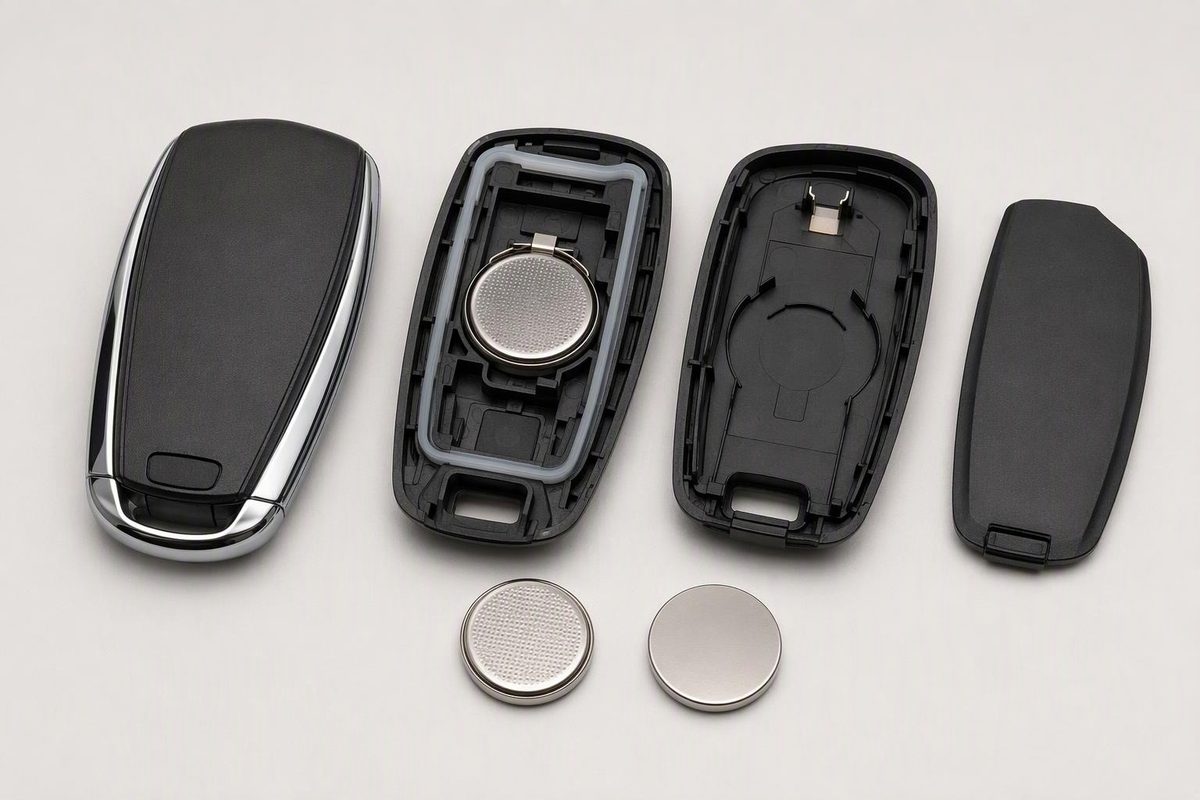
Find the right Chevy Traverse key-fob battery, including the 2024 Limited exception, then match the opening method and polarity to your remote.
A Chevy Traverse key fob does not always take a CR2032. Older documented remotes use CR2032, while the redesigned 2024 Traverse and the 2025–2026 models specify CR2450. The 2024 Traverse Limited still uses CR2032, so the year alone is not enough to choose a battery. Opening points and battery orientation also differ.
Which battery does your Traverse fob need?
The table covers factory remote designs in the North American owner’s manuals linked below. If your remote is aftermarket or has a replacement housing, check its instructions and the installed cell before buying.
| Model/manual | Battery | Positive (+) side | Opening point |
|---|---|---|---|
| Older separate-key remote: 2009 and 2017 | CR2032 | Facing down | Notch along the case seam |
| Removable-key smart fob: 2018 and 2023 | CR2032 | Facing the back cover | Area near the removable-key slot |
| 2024 Traverse Limited | CR2032 | Facing the back cover | Area near the removable-key slot |
| Redesigned 2024 Traverse | CR2450 lithium | Facing up | Bottom center of the fob—not the key slot |
| 2025 and 2026 Traverse | CR2450 lithium | Facing up | Bottom center of the fob—not the key slot |
For an unlisted year, use Chevrolet’s owner-manual finder and look under “Remote Key Operation” or “Remote Keyless Entry System Operation.” Match the illustrated housing, not just the buttons.
Replace the battery using the matching procedure
Work on a clean surface. Photograph the old battery’s code and orientation before removing it. Avoid touching the circuit board; Chevrolet warns that static electricity can damage it. Keep new and used coin cells away from children, and seek immediate medical attention if one is swallowed. Dispose of used batteries according to local requirements. Chevrolet safety warnings
Older remote with a separate ignition key
For the housing documented in the 2009 and 2017 manuals:
- Insert a thin, flat tool into the notch along the case seam. The 2017 instructions say not to insert it too far: stop as soon as resistance is felt.
- Twist gently to separate the halves.
- Remove the old battery without using a metal object.
- Install a new CR2032, positive side down.
- Snap the case back together.
These are the 2017 Traverse instructions, pages 34–35. Stop if your housing has no matching notch rather than prying at an arbitrary seam.
CR2032 smart fob with a removable mechanical key
For the design documented in 2018, 2023 and the 2024 Limited:
- Press the side release button and pull out the mechanical key.
- Insert a flat tool into the opening area near the key slot and separate the case halves.
- Push the battery and slide it toward the bottom of the fob to remove it.
- Install a new CR2032 with its positive side facing the back cover. Push it down until retained.
- Reassemble using the instructions for your housing, then reinsert the key.
The 2018 manual, page 38, says to snap the battery cover back onto the transmitter. The 2023 manual, pages 13–14, and 2024 Limited manual, pages 13–14, also require checking that the silicone mat has no gaps or wrinkles, then placing the fob button-side down on a hard surface and pressing the other half straight down. Do not force it closed if a seal or component is trapped.
CR2450 fob on the redesigned Traverse
The important difference is the opening point: use the mechanical key blade at the bottom center of the fob, not in the key slot.
- Press the release button and remove the mechanical key.
- Use its blade at the bottom-center opening to separate the halves.
For battery access, consult the diagrams in the 2025 manual, pages 11–12. The written sequence is ambiguous: it lists old-battery removal before pulling the seal tab “to access the battery” and removing the battery cover. If the cell is not accessible after opening the housing, stop and ask a dealer or qualified technician rather than guessing which internal layer to pry up.
The manual specifies removing the old cell without a metal object and fitting a CR2450 lithium battery, positive side up. Before closing, the seal and cover must be properly seated and the silicone mat must have no gaps or wrinkles. Reassemble button-side down on a hard surface, press the other half straight down, and reinsert the key. Do not close the housing with a damaged or displaced seal; Chevrolet warns that improper reassembly can let liquid reach the circuitry.
Test before attempting programming
With the fob closed, test lock and unlock near the vehicle, then test keyless entry if equipped. If it still fails:
- Recheck the full battery code, polarity and seating.
- Try another fresh battery of the specified type.
- Compare with a known-working spare in the same location. One failing remote points toward that remote; both failing calls for checking interference or the vehicle rather than buying another fob immediately.
Chevrolet advises checking distance, signal obstruction and the battery, then consulting a dealer or qualified technician if operation remains incorrect. 2026 manual, page 7
Do not start a relearn merely because you changed the battery. The documented replacement procedures end with reassembly, not programming. Programming a replacement transmitter is a separate task; the 2017 manual, page 34, directs owners to the dealer for it. Avoid generic ignition-cycle or lock/unlock “reset” routines.
If the battery is dead and you need to drive
Mechanical entry and starting authorization are separate functions. Use the mechanical key for the driver-door lock; on smart-fob models, follow your manual’s instructions for removing the lock-cylinder cap.
For backup starting, the 2018 manual places the fob in the transmitter pocket inside the center-console storage area. The 2025 manual places it in the cupholder. With the vehicle in Park, press the brake and ENGINE START/STOP. These are model-specific examples, not interchangeable locations. 2018 backup-start and entry instructions, pages 37 and 40–41 · 2025 instructions, pages 11 and 14–15
If the dashboard and other vehicle electrics are also dead, check the vehicle’s 12V battery rather than treating it solely as a fob problem. Our Traverse battery-location guide covers that separate battery and the jump points.