
How to Replace Your Ram Key Fob Without Ordering the Wrong One
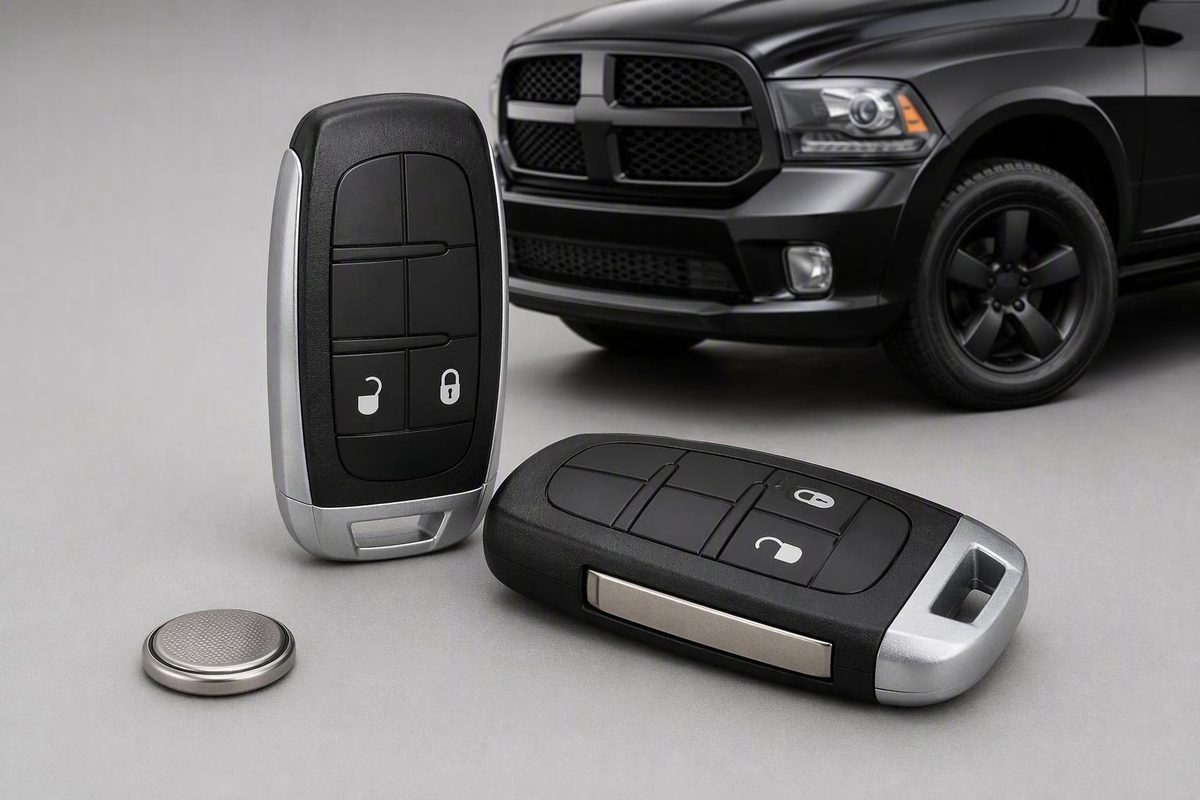
One owner's $149.98 mobile-locksmith package included a new fob, programming and a cut valet key. Exact fit and working-key status shape your options.
A Dodge Ram key fob replacement is not simply a remote that looks like the original. It must match the truck’s key system, ignition type, electronic identifiers, frequency, factory features, and programming requirements. A correctly shaped fob with the right number of buttons may still be unusable if its FCC ID, part number, or proximity configuration is wrong.
The safest order is to diagnose the existing fob, identify the exact system fitted to the truck, and choose a programming route before buying anything. Then compare the complete cost of the hardware, enrollment, immobilizer authorization, blade cutting, mobile service, shipping, taxes, and possible failed-programming charges.
Editorial note: This is a compatibility-first purchasing guide, not an official Ram fitment chart or service procedure. VIN-specific part identification and programming eligibility must still be confirmed with a suitable parts source or service provider. Key Fob Zone provides informational guidance and does not sell, cut, program, or replace Ram key fobs. Information and cited prices were reviewed on August 17, 2026.
First decide what actually needs replacing
Place your situation into one of four categories:
- The fob is intermittent or completely dead. Diagnose the battery, physical damage, interference, and recognition problem before replacing the electronics.
- The shell or buttons are damaged, but the fob still operates. A replacement housing or button pad may be sufficient if the original circuit board and transponder remain serviceable.
- You want to add a spare while at least one programmed key still works. This may open a limited DIY route, depending on the truck and programming product.
- Every programmed key has been lost. Treat this as an all-keys-lost service job, not an ordinary spare-key purchase.
These situations require different repairs. A battery replacement restores power to the existing electronics. A shell replacement preserves and transfers the original electronics. A complete replacement introduces another electronic credential that generally must be recognized and authorized by the truck.
Troubleshoot before replacing the electronics
If the fob works intermittently, inspect it before ordering:
- Try the buttons from different distances.
- Look for cracks, separated case seams, or worn button pads.
- Consider whether the fob was dropped or exposed to water.
- Check whether the problem began after a battery change.
- Confirm that the battery is installed in the correct orientation.
- Move phones and other wireless devices away from the fob and truck.
- Try another programmed fob, if available, to distinguish a fob problem from a vehicle-side problem.
- Check the owner documentation for a recognition or synchronization procedure applicable to the exact truck.
A dealership troubleshooting guide identifies weak batteries, physical or water damage, wireless interference, and recognition issues as possible causes. For supported push-button vehicles with a weak fob battery, it advises pressing the nose of the fob against the start button while operating the ignition switch. That is a model-dependent temporary starting method, not a universal procedure for every Ram truck. The guide specifies a CR2032 battery only for its 2023 Ram 1500 Classic example, so verify the number printed on your battery or stated in the truck’s documentation rather than assuming every Ram fob uses that cell (Ram fob troubleshooting guidance).
For additional background—not Ram-specific fitment advice—see this guide to key-fob battery lifespan and warning signs.
If only the plastic case is broken, a shell may be the least disruptive repair. Transfer work still requires care: preserve the original circuit board, transponder components, battery contacts, and emergency blade.
The hidden blade has a limited role
Many Ram fobs include a removable mechanical emergency key.
A complete replacement can therefore involve two separate tasks:
- Electronic programming or enrollment: Allows the truck to recognize the credential.
- Mechanical blade cutting: Makes the emergency key fit the door lock.
Identify the key system fitted to your truck
“Dodge Ram key fob” is a broad shopping phrase covering several key systems. Product descriptions do not always use the same terminology, so concentrate on physical operation and electronic identifiers rather than the seller’s preferred label.
Common key and remote terms
Transponder key: A mechanical ignition key containing an electronic transponder. Remote buttons may be separate or absent.
Integrated remote key: A mechanical key and remote-button assembly combined in one housing. Depending on the design, the transponder and remote electronics are also contained in the key head.
FOBIK: A fob-shaped integrated key used with a keyed ignition module. Sellers sometimes apply the term loosely.
Proximity smart remote: A keyless credential used with push-button start and, when equipped, passive entry. The truck detects an authorized remote without requiring it to be inserted into an ignition slot.
Emergency blade: A removable or concealed mechanical key intended primarily for door access. It is not a substitute for transponder or proximity authorization.
Reject a keyed FOBIK listing for a push-button truck even if the seller’s model-year range appears to include your vehicle.
Why the year alone is not enough
Older Dodge Ram listings demonstrate how many configurations can exist within a short period. Retail catalogs for 2008–2010 trucks show integrated remotes, FOBIKs, flip keys, three- and four-button layouts, and FCC identifiers including KOBDT04A, IYZ-C01C, OHT692427AA, OHT692713AA, and OHTC92715AA. Multiple configurations appear within the same model year, so “fits 2009 Dodge Ram” is not a complete compatibility statement (older Dodge Ram key-fob catalog).
Merchant listings for 2013–2021 trucks broadly illustrate the use of both non-proximity FOBIKs and proximity smart remotes during that period. Treat those ranges as orientation only, not as a definitive factory fitment chart (commercial overview of Ram fob types).
Also distinguish among:
- Ram 1500
- Ram 1500 Classic
- Ram 2500, 3500, 4500, and 5500 HD applications
These names can overlap in calendar year without using the same key system. Retail catalogs list separate Ram 1500 and Ram 2500-plus configurations with different buttons and functions. A programming claim for one platform should not be extended to another without exact confirmation.
Match the truck’s equipped functions
Depending on its equipment, a remote may support some combination of:
- Lock and unlock
- Panic alarm
- Remote start
- Proximity entry
- Power-tailgate operation
- Tailgate release
- Air-suspension controls
- Memory-related functions
The replacement must support the functions installed on the truck. An extra printed button does not add equipment the vehicle lacks. Recent retail listings, for example, show separate Ram 1500 and Ram 2500-plus configurations with remote start, power-tailgate, and air-suspension combinations (Ram remote catalog).
Use this compatibility checklist before ordering
Complete this worksheet before comparing prices:
- VIN: ______
- Exact model year: ______
- Series: Dodge Ram / Ram 1500 / Ram 1500 Classic / 2500 / 3500 / 4500 / 5500
- Trim: ______
- Body or generation designation, if known: ______
- Ignition: keyed / FOBIK slot / push-button
- Proximity entry: yes / no / unknown
- FCC ID: ____
- Original part number: ___
- Frequency: _______
- Button count: ____
- Required functions: lock / unlock / panic / remote start / tailgate / air suspension / other
- Emergency-blade type: __
- Working programmed key remains: yes / no
- Chosen programmer or service provider: ______
- Customer-supplied fobs accepted: yes / no
- Return allowed after programming attempt: yes / no
If you still have the original fob, photograph:
- The front and complete button layout.
- The back and logos.
- The label or identifiers inside or on the case.
- The emergency blade.
- Any original packaging or part label you retained.
Keep the photographs with the VIN and vehicle details. They give a parts department, locksmith, or seller something more precise to evaluate than “a fob for a 2017 Ram.”
Match identifiers, not just appearance
The same model year may appear in listings with multiple FCC IDs, part numbers, frequencies, button counts, and feature combinations. Shape and button count may be useful filters, but they do not establish electronic compatibility by themselves.
One keyed-ignition marketplace listing, for example, identifies FCC ID GQ4-53T and part numbers 56046953AG, 56046953AD, 56046953AC, 56046953AF, and 56046953AE. The seller claims a broad fitment range but expressly excludes push-button-start vehicles and requires professional programming (MechanMagic GQ4-53T listing).
Use this hierarchy when confirming a replacement:
- VIN-based part identification
- Exact ignition and proximity system
- FCC ID
- Original or documented superseding part number
- Frequency
- Button and feature configuration
- Physical design
A seller’s broad year range belongs near the bottom of the decision, not at the top.
What if the original fob is missing?
If every original fob is gone or its label is unreadable, do not infer the part from marketplace photographs. Request VIN-based confirmation from an official parts source, a dealer parts department, or a qualified automotive locksmith familiar with the truck generation.
Ask the source to identify the compatible part number and any accepted superseding numbers in writing. Give those numbers to the provider who will perform the programming.
Written confirmation matters because catalog titles and product images can conflict. One Ram catalog includes image captions and linked titles displaying different part numbers, demonstrating why a photograph should not override written identifier confirmation (replacement Ram key catalog).
Before checkout, save or print:
- The complete fitment description
- FCC ID and part number
- Frequency
- Ignition exclusions
- Programming requirements
- Written seller confirmation
- Return and warranty terms
Compare new OEM, refurbished OEM, aftermarket, and used fobs
No replacement category is automatically right for every buyer. The practical choice depends on correct identification, the provider’s hardware policy, what the seller has tested, and what happens if enrollment fails.
New OEM
A new OEM fob is sold as original-equipment hardware in new condition. It offers the clearest original-equipment provenance when correctly identified, but the seller should still confirm whether the unit is unused and ready for enrollment.
“New OEM” is not a guarantee of compatibility. An OEM fob with the wrong part number, frequency, generation, or feature configuration can still be unusable. Confirm whether the package includes an emergency blade and whether that blade arrives cut.
Refurbished OEM
A professionally refurbished OEM fob is original hardware resold after a seller’s claimed inspection, reset, cleaning, repair, or testing process. Because “refurbished” can describe different levels of work, ask:
- Which electronic functions were tested?
- Was the housing or button pad replaced?
- Was the fob reset for enrollment?
- Is it specifically ready to be enrolled to another truck?
- Are the battery and emergency blade included?
- What warranty applies after an enrollment attempt?
Do not equate “refurbished” with “reset” unless the seller explicitly confirms both.
Aftermarket
An aftermarket fob is manufactured outside the original-equipment supply category. It may cost less, but button feel, feature support, electronic compatibility, and provider acceptance can vary.
Evaluate an aftermarket option by checking:
- Exact identifier compatibility
- Supported factory functions
- Written programming requirements
- Warranty coverage
- Return eligibility after attempted enrollment
- Acceptance by your chosen locksmith or dealer
Retail catalogs show that new OEM, refurbished OEM, and aftermarket products are all sold for Ram applications. Those categories do not independently establish equal reliability or programming success.
Used or pulled fobs
A used fob has previously been associated with another vehicle. There is no supported universal rule that every used fob can—or cannot—be reused.
Buy one only if the seller and your selected programmer both confirm that:
- The exact fob generation can be reset.
- The supplied unit has been reset or can be reset locally.
- The provider will attempt enrollment.
- The return policy covers a failed reset or enrollment attempt.
Category comparison
| Replacement type | Provenance | Typical listing category | Programming requirement | Reset concern | Warranty or return questions | Risk if provider refuses customer-supplied hardware |
|---|---|---|---|---|---|---|
| New OEM | Original-equipment part represented as new | OEM new | Normally still requires vehicle-specific enrollment | Ask whether it is unused and enrollment-ready | Is enrollment failure covered? Can it be returned after opening or programming? | You may need another provider or have to repurchase hardware through the provider |
| Refurbished OEM | Original hardware processed and resold | OEM refurbished | Requires enrollment to the truck | Confirm what “reset” means and whether it is ready for enrollment | What was tested? Are the case, battery, and blade covered? | The provider may reject the seller’s reset claim |
| Aftermarket | Non-OEM replacement | Aftermarket new | DIY or professional route depends on the product and truck | Electronic compatibility remains critical | Are programming attempts covered? Are missing functions grounds for return? | The hardware cost and an attempt fee may both be lost |
| Used or pulled | Previously owned hardware | Used, salvage, or pulled | Professional reset and enrollment may be needed | Highest uncertainty unless reset capability is confirmed | Is it returnable if it cannot be reset? | The provider may refuse it entirely |
Customer ratings, sales volume, and merchant assurances do not prove that a fob will program to your VIN. Written compatibility confirmation and provider acceptance are more useful than popularity indicators.
Calculate the total replacement cost, not just the fob price
The advertised fob price is only one part of the transaction. Build the budget around receiving a successfully operating key.
Itemized cost worksheet
| Cost component | Your quote |
|---|---|
| Replacement fob or key hardware | $__ |
| Programming or vehicle enrollment | $__ |
| Immobilizer or transponder authorization | $__ |
| Emergency-blade blank | $__ |
| Emergency-blade cutting | $__ |
| DIY programming tool, if applicable | $__ |
| Mobile locksmith callout | $__ |
| All-keys-lost surcharge, if any | $__ |
| Shipping | $__ |
| Taxes | $__ |
| Fee after unsuccessful enrollment attempt | $__ |
| Missing-key deletion, if requested | $__ |
| Estimated working-key total | $__ |
Some providers combine remote pairing and immobilizer authorization into one service line. Others quote the fob, blade, cutting, and programming separately. Ask what the final price actually includes.
Illustrative hardware-price snapshots
The following merchant prices were checked on August 17, 2026. They are snapshots, not expected local quotes:
- Older aftermarket examples were displayed at approximately $9.10 and $11.52.
- Older OEM-new FOBIK examples were displayed at $82.35 and $136.12 (older Dodge Ram listing prices).
- One aftermarket two-pack was displayed at $22.03, compared with a listed price of $23.95 (GQ4-53T two-pack listing).
- Selected recent-model retail listings showed starting prices from approximately $52.95 to $138.95.
Price, stock, discounts, configuration, and seller terms can change. Low hardware prices may exclude the emergency blade, cutting, programming, shipping, taxes, and the cost of replacing an incompatible unit.
A merchant collection for selected 2013–2017 applications displayed certain replacement FOBIKs at $44.95, a non-proximity programmer at $119.95, and a $169.90 bundle containing a programmer, three-button FOBIK, and photo-based blade-cutting service. The described programmer requires at least one working key, so the bundle should not be treated as an all-keys-lost solution (2013–2017 fob and programmer listings).
One forum participant reported paying $149.98 for a mobile-locksmith package that included a new fob, programming, and a cut valet key. That is one owner’s anecdote, not a national rate, price guarantee, or quote for another truck (RamForum replacement-fob discussion).
Quote request template
Send this to a dealer or automotive locksmith before ordering:
I need a replacement key fob for VIN _, a [year/model/series] with [keyed/push-button] ignition and [proximity/non-proximity] entry. The original fob shows FCC ID _ and part number ____.
Please provide an itemized quote for:
- The exact fob you would supply
- Programming or enrollment
- Immobilizer or transponder authorization
- Emergency-blade cutting
- Mobile service, if applicable
- Taxes and other charges
- Any all-keys-lost charge
- Any fee if a customer-supplied fob fails to enroll
- Deletion of the missing credential, if applicable
If I supply the fob, will you accept [OEM new/refurbished OEM/aftermarket] part number ____? Will the quoted service authorize engine starting as well as the remote buttons?
Compare the working-key total, not the first hardware price displayed in a search result.
Choose the programming route before buying the fob
The first programming question is:
Does at least one programmed, working key remain?
If one working key remains
Adding a spare may offer more options than recovering from all keys lost. Some narrowly specified DIY programming products use an existing working key as a prerequisite. That does not mean the truck supports a generic owner-programming sequence or that any programmer will work.
For selected 2013–2017 non-proximity applications, one merchant offers a programmer but explicitly requires at least one working key. Confirm that the product supports the exact truck, FOBIK, FCC ID, ignition type, and intended immobilizer function before buying it.
If no working key remains
Do not assume a spare-key DIY product can recover an all-keys-lost truck. The process may require compatible professional equipment and vehicle-specific authorization.
In one third-party case involving a 2011 Ram 1500 with no working fob, the answering mechanic recommended a compatible shop-level or bidirectional scan tool with access to key programming, or a mobile automotive locksmith. That advice applies only to the reported case and is not an official procedure for every Ram year or key system (2011 Ram 1500 all-keys-lost discussion).
Remote pairing is not necessarily start authorization
Verify two separate concepts:
- Remote-button pairing: The fob operates functions such as lock, unlock, or panic.
- Immobilizer or transponder enrollment: The truck recognizes the credential as authorized to start the engine.
When a seller, programmer, or guide uses the word “programming,” ask which task it covers.
This is why generic button-and-ignition sequences should not be presented as universal Dodge Ram key-fob procedures. If instructions do not identify compatible years, ignition systems, working-key prerequisites, and immobilizer coverage, they do not establish that the process will create a fully functional starting key.
“Pre-programmed” does not mean ready for your truck
The phrase may refer to:
- Electronics loaded with generic firmware
- A remote prepared for a particular application
- A unit tested before shipping
- Data copied or cloned in a specific service context
- Marketing language without a precise technical definition
A marketplace fob may be described as “pre-programmed” while its listing still says that vehicle pairing or professional service may be required. The label alone does not prove enrollment to your truck or authorization to start it.
Before purchasing, answer three questions:
- Does my exact truck support owner programming with this product?
- Does the method require an existing working key?
- Will the procedure authorize engine starting as well as the remote buttons?
If the seller cannot answer all three for your configuration, budget for professional programming rather than assuming DIY success.
Dealer, automotive locksmith, or DIY kit: pick the right provider
The appropriate provider depends on the truck, key system, and working-key status. There is no universal rule that one channel is always cheaper or more capable.
| Scenario | Limited DIY kit | Qualified automotive locksmith | Dealer |
|---|---|---|---|
| Adding a spare with a working key | Possible only when the exact kit supports the truck and all prerequisites are met | May supply, program, and cut a spare | May identify the part by VIN, order it, program it, and arrange blade cutting |
| Replacing a failed electronic fob | Possible only if vehicle and product eligibility are documented | May assess the fob, supply alternatives, and program supported systems | May diagnose, identify, order, and program supported factory parts |
| All keys lost | Do not rely on a kit requiring a working key | Mobile or shop service may be available, depending on equipment and generation | Another route for VIN-based identification, ordering, and programming |
| Push-button proximity system | Use only a product explicitly supporting the exact proximity system | Capability varies by provider and generation | Can confirm factory application and service availability |
| Lost or stolen key | DIY enrollment may not address deletion of the missing credential | Ask whether the missing key can be removed while valid keys are retained | Ask whether the missing credential can be removed while remaining keys are preserved |
When a DIY kit makes sense
Consider a DIY product only when all of the following are true:
- The exact year, series, ignition type, and key system are supported.
- The FCC ID and part number match.
- The required number of working keys is available.
- The kit enrolls the credential needed for engine starting.
- Its instructions apply to the precise platform.
- The return terms remain acceptable if the process fails.
Do not apply a claim for 2019–2024 Ram 1500 DT six-lug models to a Ram 1500 Classic or an HD truck. The owner discussion making that DIY claim explicitly excluded HD applications (platform-limited DIY discussion).
When to call an automotive locksmith
A qualified automotive locksmith may be able to:
- Identify or source a compatible fob
- Program customer-supplied or provider-supplied hardware
- Enroll the transponder or proximity credential
- Cut the emergency blade
- Provide mobile service
- Handle some all-keys-lost situations
Capability varies with vehicle generation, equipment, software access, and business policy. Ask whether the locksmith supports your exact truck—not merely “Ram keys.”
When to use a dealer
A dealer parts or service department is another route for:
- VIN-based part identification
- Ordering a factory replacement
- Programming supported fobs
- Cutting or arranging blade service
- Diagnosing a vehicle-side recognition problem
This does not mean only dealers can program every Ram fob. Dealer service is one available route; locksmith and limited DIY options depend on the exact system.
Questions to settle before ordering
Ask the chosen provider:
- Will you program a customer-supplied fob?
- Do you accept aftermarket or refurbished OEM hardware?
- Have you confirmed the FCC ID and part number?
- Is there a charge if enrollment fails?
- Does the service include immobilizer authorization?
- Can you cut the emergency blade?
- Is mobile service available, and what does the callout include?
- In an all-keys-lost case, what proof of ownership or identification do you require?
- Must every remaining key be present?
- If a key was lost or stolen, can you remove that missing credential while preserving the valid keys?
Do not claim that a missing fob has been disabled unless the provider confirms that it was removed from vehicle memory.
Verify the replacement before the return window closes
Test the replacement immediately after programming and blade cutting. Do not stop after confirming that one button works.
Post-programming checklist
Test every function the truck is equipped to support:
- [ ] Engine starts normally
- [ ] Engine continues running without a security warning
- [ ] Lock button works
- [ ] Unlock button works
- [ ] Panic function works
- [ ] Remote start works
- [ ] Proximity entry works
- [ ] Push-button start recognizes the fob normally
- [ ] Tailgate release or power-tailgate control works
- [ ] Air-suspension controls work
- [ ] Memory-related functions behave as expected
- [ ] Operating range is comparable to the original fob
- [ ] Emergency blade unlocks the door
- [ ] Every remaining original key still starts and operates the truck
A push-button truck should recognize the replacement during ordinary use.
Compare the replacement with both the original fob and the truck’s installed equipment. A missing function may indicate:
- The wrong button configuration
- Incompatible electronics
- Incomplete remote pairing
- Incomplete immobilizer enrollment
- A weak or incorrectly installed battery
- A truck-side feature or antenna problem
Test all remaining original keys after enrollment.
Test the emergency blade in the door as well. If it does not turn smoothly, return to the cutter rather than forcing it. Electronic programming does not compensate for a poorly cut mechanical key.
Retain the packaging, receipts, listing screenshots, compatibility confirmation, and written programming results until every function has been checked. Review return restrictions before cutting or programming because eligibility may change after the product is altered or an enrollment attempt occurs.
If recognition remains intermittent after successful enrollment, revisit the battery, contacts, case condition, water exposure, and nearby wireless interference before ordering another fob.
Dodge Ram key fob replacement FAQs
Can I program a Dodge Ram replacement key fob myself?
Sometimes, but only with a product that explicitly supports the exact truck and key system. Some DIY programmers require an existing programmed key, making them suitable for adding a spare rather than resolving an all-keys-lost situation.
Confirm the Ram series, ignition type, proximity status, FCC ID, part number, and immobilizer coverage. Do not assume a generic button sequence applies to every Dodge Ram, Ram 1500, Ram 1500 Classic, or Ram HD truck.
How do I know which key fob fits my Ram truck?
Verify the VIN, exact model year and series, keyed or push-button ignition, proximity status, FCC ID, part number, frequency, button count, and required factory functions. Appearance or model year alone is not enough.
If the original label is missing or unreadable, obtain VIN-based part confirmation from an official parts source, dealer parts department, or qualified automotive locksmith instead of guessing from product photographs.
Will a replacement advertised as pre-programmed work immediately?
Not necessarily. “Pre-programmed” may mean the electronics were prepared or tested, not that the fob was enrolled to your truck.
Ask whether the product still requires remote pairing, immobilizer enrollment, or transponder authorization. Unless the seller clearly documents vehicle-specific enrollment, budget for an additional programming step.
How much does a Dodge Ram key fob replacement cost?
There is no reliable fixed price across all years, systems, providers, and locations. Hardware listings range from inexpensive older aftermarket remotes to more expensive OEM and recent-model smart fobs, but the hardware price may exclude programming, blade cutting, mobile service, shipping, taxes, and failed-enrollment fees.
Request itemized dealer and locksmith quotes. Compare the cost of receiving a compatible, cut, programmed, engine-authorized key—not merely the advertised fob price.
What should I do if I have lost every working Ram key?
Do not purchase a spare-key DIY kit unless it explicitly supports an all-keys-lost procedure for the exact truck. Contact a dealer or qualified automotive locksmith and provide the VIN, model, series, ignition type, and any available original-key identifiers.
Ask about proof-of-ownership requirements, compatible programming equipment, fob supply, blade cutting, mobile service, total charges, and whether the missing credential can be removed from vehicle memory.
Final replacement checklist
Use this order of operations:
- Diagnose whether the existing fob needs a battery, shell, or complete electronic replacement.
- Record the VIN, exact truck configuration, ignition type, FCC ID, part number, frequency, buttons, and required functions.
- Determine whether at least one programmed key still works.
- Confirm the programming provider, customer-supplied-fob policy, blade service, failed-enrollment fee, and complete quote.
- Buy only after checking compatibility, programming eligibility, and return protection.
- Test engine authorization, every equipped remote function, every remaining key, and the emergency blade.
The cheapest advertised fob is not the cheapest Dodge Ram key fob replacement if it cannot be enrolled, cannot start the truck, or omits features the vehicle is equipped to use.