
Which Autel Key Jobs Now Need NASTF Validation
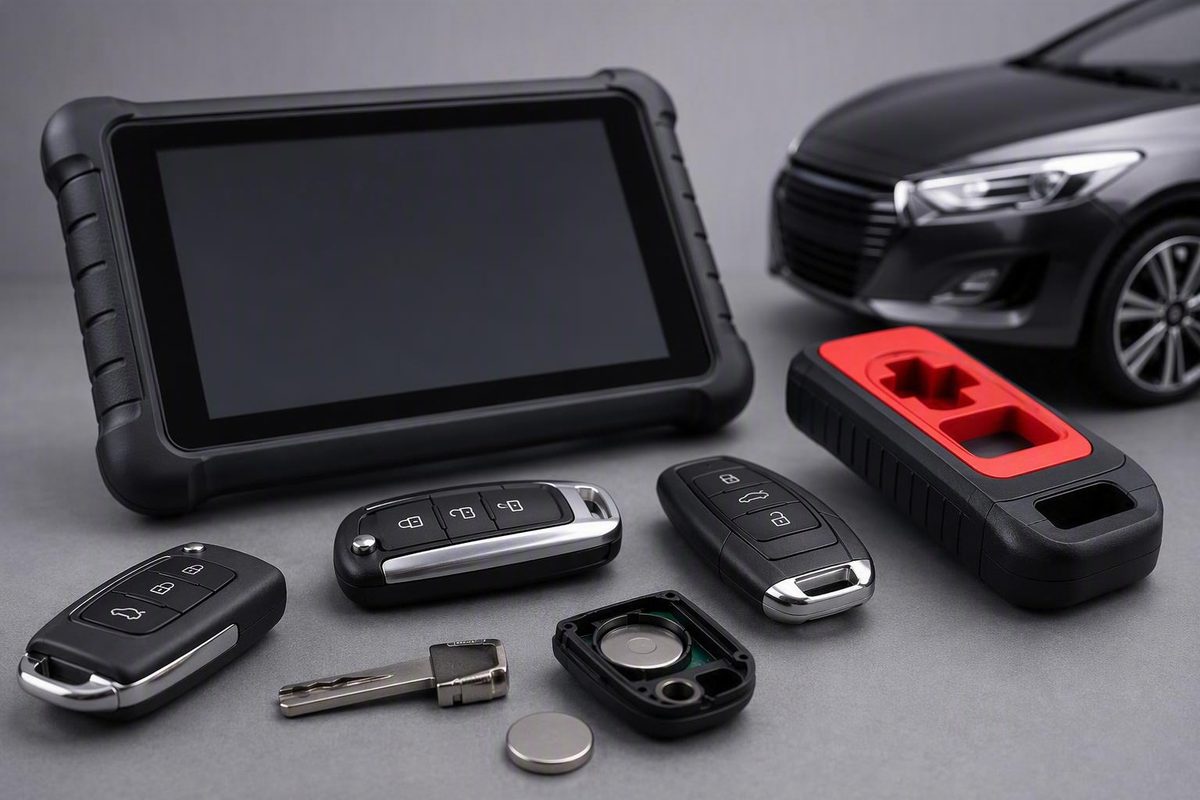
See which Autel key and immobilizer jobs may need NASTF VSP validation, what remains usable without it, and when to use a locksmith or dealer.
No, NASTF validation is not a universal requirement for every Autel key programmer or function. Autel announced a phased Secure Data Release Model (SDRM) rollout beginning with supported KM100 security transactions in Q3 2026, followed later by the IM508 and IM608 series. Routine diagnostics and product lines outside that announced rollout remain unaffected under the current guidance.
The exact position depends on the tool, installed software and transaction. Autel’s July 1 announcement describes the phased rollout, but the supplied Autel material did not confirm that KM100 enforcement was live as of August 26. Locksmith Ledger separately reported September 1, 2026, as the KM100 effective date. That is a trade-reported date rather than an exact date established by the supplied Autel announcement.
A DIY owner without a NASTF Vehicle Security Professional credential may still use unaffected Autel functions. If a supported Add a Key, All Keys Lost or immobilizer transaction requests SDRM authentication, the practical route is a credentialed automotive locksmith or the dealer. The available evidence does not provide make-by-make, model-year coverage or typical customer prices, so neither can be stated reliably here.
Enter the vehicle, Autel tool, job and VSP status; the result identifies the supported route and flags what still needs verification.
This checker uses the rollout facts currently available. Make, model and year are recorded for the result, but the published evidence does not provide a vehicle-by-vehicle coverage matrix.
A supported Add a Key transaction may request SDRM validation once enforcement is active. The supplied Autel material did not confirm live KM100 enforcement as of August 26; September 1 was reported by a trade publication.
Route: Check the current Autel prompt. If VSP authentication is required, use a credentialed automotive locksmith or dealer.
Typical cost: — not supplied by the cited evidence
Security transactionKM100 first phase| Tool | Timing | Current Evidence | Without VSP |
|---|---|---|---|
| KM100 | Q3 2026; Sept. 1 trade-reported | Announced; live status not confirmed as of Aug. 26 | Protected job may be blocked |
| IM508 series | Later phase | No firm activation date supplied | Verify current prompt |
| IM608 series | Later phase | No firm activation date supplied | Verify current prompt |
| Other Autel lines | Outside announced rollout | Described as unaffected by current guidance | NASTF not required by this rollout |
| Transaction | SDRM Position | No-VSP Route | Typical Cost |
|---|---|---|---|
| Add a Key | Potentially protected when supported | Credentialed locksmith or dealer if prompted | — |
| All Keys Lost | Specifically identified as potentially covered | Credentialed locksmith or dealer if prompted | — |
| Immobilizer function/reset | Specifically identified as potentially covered | Credentialed locksmith or dealer if prompted | — |
| Other security procedure | May be covered by tool and application | Verify before starting | — |
| Routine diagnostics | Described as unaffected | Continue, subject to normal tool requirements | — |
| TPMS, ADAS, EV or unrelated service | Described as unaffected | Continue, subject to normal tool requirements | — |
Sources: Autel July 1 announcement and SDRM Resource Center; Locksmith Ledger’s August 20 report; NASTF credential guidance. Vehicle-specific coverage and customer prices were not supplied.
The KM100 Comes First, but Enforcement Is Transaction-Specific
Autel placed the KM100 first in its Q3 2026 SDRM rollout. Locksmith Ledger reported a September 1 effective date, while the Autel resource material available for review did not give an exact activation date or confirm live enforcement on August 26.
Those statements describe three different statuses:
- Officially planned: Autel announced KM100 integration for Q3 2026.
- Trade-reported effective date: Locksmith Ledger published September 1.
- Confirmed live: The supplied Autel material did not establish live enforcement as of August 26.
Even after activation, the requirement is expected to cover supported security transactions rather than every menu or use of the KM100. An authentication prompt on one vehicle also does not prove identical behavior for another make, model year, software release, region or procedure.
KM100 users handling security work after the reported launch date should therefore be ready for VSP authentication. They should not assume that every key operation will request it, or that the absence of a prompt on one car establishes a general exemption.
IM508 and IM608 Activation Dates Remain Unconfirmed
The rollout is model-specific. A date reported for the KM100 should not be applied automatically to an IM508 or IM608.
| Tool Family | Announced Timing | Evidence Status |
|---|---|---|
| KM100 | Q3 2026; September 1 trade-reported | Rollout announced; live status not confirmed in supplied Autel material as of August 26 |
| IM508 series | Later phase | No firm activation date supplied |
| IM608 series | Later phase | No firm activation date supplied |
| Other Autel lines | Not in announced rollout | Described as unaffected by current guidance |
Autel’s SDRM Resource Center names the KM100, MaxiIM IM508 series and MaxiIM IM608 series as the affected families. It places the KM100 in Q3 2026 and the two MaxiIM series in future phases.
The resource center describes diagnostic scan tools, TPMS tools, ADAS calibration equipment, EV diagnostic tools, service tablets and other Autel product lines as unaffected by this rollout. That statement is subject to later Autel changes; it is not a permanent guarantee.
The word “series” also does not establish that every hardware variant will enter enforcement simultaneously. The supplied evidence does not define variant-by-variant dates, minimum software releases, complete vehicle coverage, regional scope or every affected application.
Protected Security Jobs May Request a VSP Login
The planned control applies to qualifying transactions, not simply to ownership of an affected programmer. Autel specifically identifies supported All Keys Lost and immobilizer functions. Available specialist guidance also includes Add a Key among the potentially affected categories.
| Potentially Protected | Described as Unaffected |
|---|---|
| Supported Add a Key | Routine vehicle diagnostics |
| Supported All Keys Lost | General scan-tool functions |
| Supported immobilizer functions or resets | TPMS and ADAS functions |
| Other designated security procedures | EV diagnostics and unrelated service-tablet functions |
These categories do not prove that every procedure bearing the same name will require authentication. Coverage may depend on the Autel model, installed software, vehicle, application and exact operation.
The practical dividing line is whether Autel treats the requested operation as a protected vehicle-security transaction inside an implemented SDRM workflow. Routine code scanning is described as unaffected. A supported All Keys Lost procedure is a likely authentication candidate once enforcement is active for that tool and application.
No supplied source gives a comprehensive list by manufacturer, model and model year. A shop should not promise that a particular vehicle will proceed without credentials—or that it will certainly request them—without checking current coverage and the tool’s live workflow.
A Covered Transaction Uses VSP Credentials and MFA
SDRM authenticates and records authorized vehicle-security transactions. NASTF operates the credential framework, while participating tool workflows use it to validate supported security work.
For the supported transactions described in the available guidance, the technician enters an active NASTF Vehicle Security Professional ID and a passcode generated by NASTF’s multifactor-authentication app. The transaction is then validated and logged in the NASTF SDRM database.
NASTF states that it operates SDRM and provides credentials to technicians and locksmiths requiring access to security-related automotive information and systems. It serves automotive professionals in the United States and Canada, although that does not prove identical Autel implementation in both countries.
Buying or activating an Autel programmer does not provide a VSP credential. NASTF separately controls eligibility, applications, approval, account status and credential policies.
The following access requirements are also separate:
- Ownership of the Autel hardware
- An applicable Autel software subscription
- An active NASTF VSP credential
- Any required OEM service or security access
- Access to another platform, such as AutoAuth
One does not automatically replace another. A valid Autel subscription is not a VSP credential, while a VSP credential does not resolve an expired subscription or an unsupported vehicle application.
The evidence supports the general VSP-and-MFA process but not a universal screen-by-screen sequence. Prompts, error codes, connectivity requirements, offline behavior and interrupted-transaction recovery may vary by tool, software, vehicle and procedure.
An Autel Tool Can Still Work Without a NASTF Account
Current guidance describes blocking qualifying security transactions rather than disabling the entire programmer. A technician without a VSP credential should still be able to use functions outside the protected workflow, subject to ordinary subscription, compatibility and connectivity requirements.
The expected outcomes are:
- A routine diagnostic task remains outside SDRM validation.
- A supported All Keys Lost or immobilizer task may stop for authentication once validation is active.
- A function on an Autel product outside the announced rollout remains unaffected by this particular policy.
- A protected transaction may be unavailable without valid credentials even though the device itself continues to operate.
This matters with IM-series tablets used for both diagnostics and immobilizer work. A credential request for a protected operation does not necessarily affect code scanning or unrelated service functions on the same hardware.
A NASTF account is not required merely to purchase an Autel programmer, nor is one included with the hardware. Triad’s specialist guidance distinguishes general tool operation from protected-transaction authorization.
The available evidence does not establish how every offline function behaves, what an expired subscription changes or what happens after repeated authentication failures. Continued general operation should not be read as a guarantee that every non-SDRM obstacle has been removed.
DIY Owners Without VSP Need a Locksmith or Dealer for Blocked Jobs
A DIY owner can continue with an operation that the tool permits without SDRM authentication. If the tool requests an active VSP ID and MFA passcode, buying the programmer does not create a legitimate way around that requirement.
For a blocked transaction, the normal alternatives are a NASTF-credentialed automotive locksmith or the vehicle dealer. Which one can complete the job depends on vehicle support, required OEM access and the specific immobilizer system.
The sources supplied for this article do not give reliable typical prices for the DIY, locksmith or dealer routes. They also do not provide a make-and-model-year matrix showing which procedures remain OBD-programmable. Any fixed price or universal brand rule would therefore be unsupported.
A small shop faces the same authorization divide. A shop may own compatible Autel hardware yet be unable to complete a protected transaction if no eligible technician has an active VSP credential and access to the MFA app. Credentials should not be assumed to be transferable among employees.
Shops Should Verify Access Before Starting the Procedure
Credential readiness belongs in job intake, especially for KM100 security work scheduled after the trade-reported effective date. An authorization failure is more consequential after a vehicle has been disassembled or placed in a state where it cannot start.
Before accepting the job, record the exact Autel model and variant, installed software version, vehicle identification and requested procedure. Distinguish Add a Key, All Keys Lost, immobilizer work and routine diagnostics rather than describing all of them as key programming.
Check whether the tool’s phase is merely announced, has a reported date or is officially documented as live. If the transaction may be protected, verify the technician’s VSP account status and access to the MFA app before beginning. Account possession alone is insufficient if the credential is inactive or the authorized technician cannot generate a passcode.
Locksmith Ledger reported that registration required proof of insurance, a business license and a locksmith license where applicable. It also published then-current primary, subordinate-account and renewal charges, but those figures are not included here because they can change and must be checked directly with NASTF.
Professional discussion has additionally identified business-registration records, identification, locally required locksmith licensing and consent to a background check as reported application considerations. Current eligibility and documentation requirements should come from NASTF rather than an old discussion or retailer summary.
No supplied evidence supports a technical bypass, universal offline alternative or guaranteed recovery sequence. If validation fails, stop and check the credential, account status, MFA access, connectivity and current official support guidance.
Theft Investigations Help Explain the Tighter Controls
Autel presents SDRM integration as a response to vehicle theft, unauthorized access and illicit use of security-capable tools. Its stated approach preserves access for legitimate locksmiths and repair technicians while adding identity validation and transaction records to protected operations.
WTOP reported that six people were charged in a federal indictment concerning an alleged vehicle-theft operation. Officials alleged that Autel devices were used to steal vehicles electronically, and U.S. Attorney Jeanine Pirro advocated tighter regulation or registration of the devices. WTOP reports the allegations and officials’ comments.
The defendants were accused; the report does not establish guilt. It also does not show that SDRM had already been deployed or prove the effectiveness or scope of a particular validation rule. A public call for regulation is not itself an implemented policy.
SDRM may increase accountability and make unauthorized transactions more difficult. The supplied evidence does not support a claim that it will eliminate vehicle theft. The system also introduces practical dependencies involving credential administration, MFA availability, connectivity and transaction logging.
Verify the Live Status for Every Security Job
Start with the exact programmer. Determine whether it is a KM100, an IM508-series unit, an IM608-series unit or another Autel product. Then classify the task as routine diagnostics or a protected security operation.
Check Autel’s current SDRM Resource Center and NASTF guidance on the day of the job. Confirm the installed software, vehicle coverage, application and any stated online requirement. A current model-specific notice or authentication prompt is more useful than screenshots or social posts repeating an earlier rollout announcement.
IM508 and IM608 users should be especially cautious about borrowed deadlines. Both series are identified for later phases, but no firm activation dates were supplied. The trade-reported KM100 date is not an IM508 or IM608 deadline.
Unresolved implementation questions include geographic differences between the United States and Canada, supported manufacturers and model years, software-release requirements, subordinate-account handling, offline availability and recovery after an interrupted transaction.
The defensible answer remains specific: NASTF does not universally gate every Autel programmer. It may gate a supported security transaction once SDRM enforcement is active for that tool and application. Without valid VSP credentials, the likely result is a blocked protected transaction—not a completely disabled device.