
How to Replace the Right Cherokee Fob Without Paying for the Wrong One
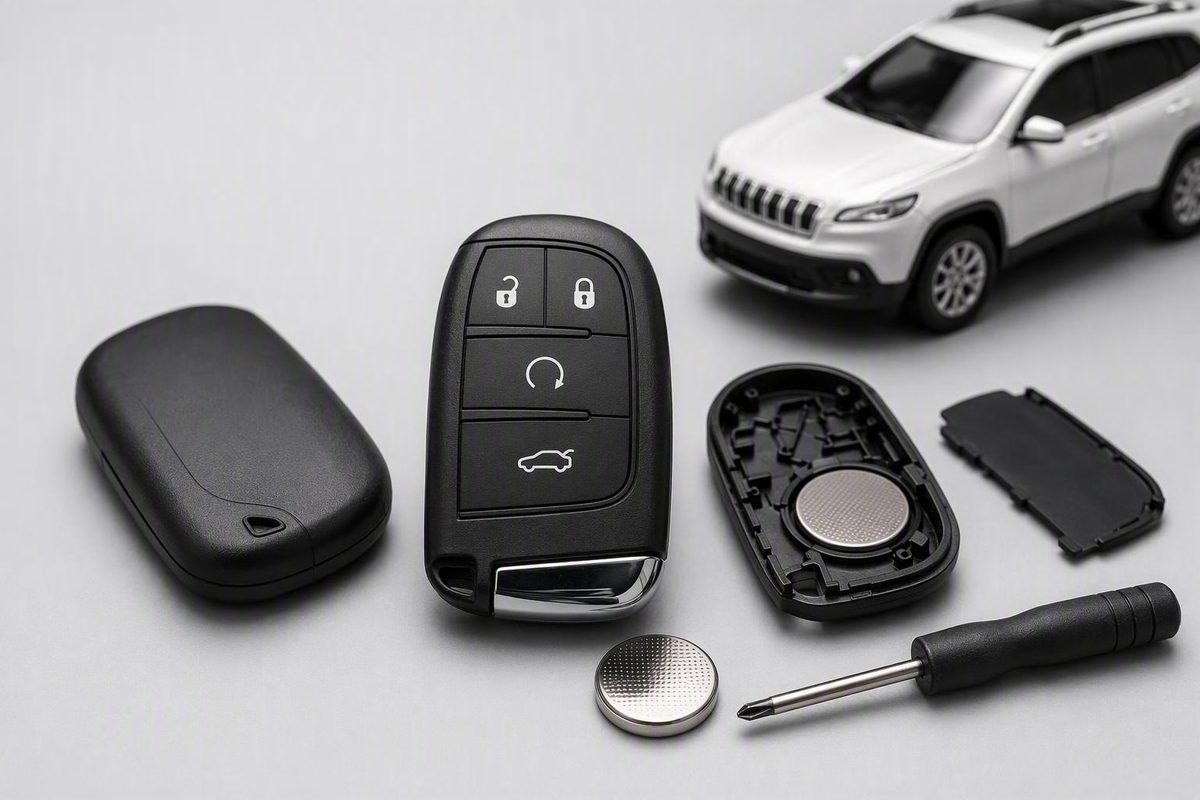
Match the FCC ID, full part number, ignition type and button layout before buying. If the old fob was lost, ask whether its credential can be removed.
A Jeep Cherokee key fob replacement is a vehicle-security purchase, not an appearance match.
The safest sequence is to diagnose what failed, record the identifiers from the vehicle and original fob, preserve every required feature, and confirm cutting and programming arrangements before paying. Compare the cost of a functional, tested replacement—not merely the advertised price of the remote.
Scope note: This guide provides a cost-comparison framework, not a national installed-price range. The available evidence includes seller-specific hardware prices but not enough dated, geographically representative dealer and automotive-locksmith quotes to establish a reliable current total. Service practices can also vary by model year, ignition system, security configuration, market, and provider. The dollar examples below are US-dollar listing snapshots and must be rechecked before purchase.
First decide whether the entire fob needs replacement
Start with the symptom instead of assuming the complete fob has failed:
- Reduced range or intermittent buttons: Verify the battery designation, orientation, and condition first.
- Cracked or worn housing with working electronics: Consider a compatible replacement shell.
- Damaged emergency blade: Ask whether the correct blank can be supplied and cut without replacing the electronics.
- Missing fob or severe electronic damage: Plan for a complete replacement and vehicle-specific programming.
- Fresh battery or new housing did not restore the required functions: Continue with compatibility checks for a complete replacement.
Diagnose remote and starting functions separately
Remote-control functions and starting authorization are related but distinct. Test both:
- Do lock, unlock, panic, hatch, and remote-start buttons work as equipped?
- Does the key or fob still allow the engine to start?
- Does passive entry work, if equipped?
- Does the emergency blade mechanically unlock the door?
A fob may still authorize starting when worn buttons, damaged contacts, or failed remote electronics prevent lock and unlock commands.
That distinction matters when deciding whether to transfer the original electronics into a new shell. If the vehicle still starts but the case or buttons are damaged, a complete replacement may be unnecessary.
Check the exact battery designation
Open the fob only according to that case’s design. Record the coin-cell number and its positive-side orientation before removing it.
A Cherokee replacement retailer identifies CR2032, CR1616, and CR2016 cells as battery types commonly found in these remotes, but it does not assign one battery to every Cherokee fob. The same catalog separately offers batteries, cases, blades, and complete remotes, reinforcing the need to diagnose the component before replacing the whole unit. Verify the marking in your own fob rather than buying by vehicle name or year alone. Review the retailer’s Cherokee battery and repair categories.
Do not pry blindly toward the circuit board. Case seams, release points, hidden-key arrangements, and battery retainers differ.
When a shell or blade is enough
A replacement shell can avoid electronic pairing only when the original electronics remain functional and can be transferred safely.
Before transferring parts:
- Photograph the original component positions.
- Compare the new shell’s interior with the original.
- Confirm that every button aligns with the circuit board.
- Track every spring, pin, blade retainer, and separate chip.
- Stop if components are glued, corroded, broken, or difficult to remove without force.
Treat the emergency blade as a separate component. A replacement blank must match the original keyway and be cut by a suitable provider. Cutting the blade does not program the electronic credential, and pairing the electronics does not cut the blade.
Replace the complete unit when the fob is missing, its electronics are irreparably damaged, or a confirmed battery, contact, housing, or blade repair does not restore the functions you need.
Build a compatibility profile before shopping
Model year and visual appearance are useful screening tools, but neither proves compatibility. Look-alike fobs may contain different radio electronics, security credentials, frequencies, capabilities, or blade types.
Complete this worksheet before requesting prices:
| Compatibility item | What to record |
|---|---|
| Vehicle | Exact model year |
| Model name | Jeep Cherokee, not Grand Cherokee |
| Market | Country or original sales market |
| Ignition | Keyed ignition, ignition-slot fob, or push-button start |
| Vehicle identity | Full VIN |
| Fob identity | FCC ID and full part number, including suffix |
| Radio specification | Frequency, where available |
| Mechanical key | Keyway or blade type |
| Controls | Button count and exact symbols |
| Features | Lock, unlock, panic, remote start, hatch or liftgate, passive entry |
| Current key situation | Zero, one, or multiple working keys |
Find the existing identifiers
Begin with the original fob if it remains available. Purchase records and earlier dealer or locksmith invoices may also list a part number.
Photograph the markings rather than relying on handwritten notes. Characters such as 0, O, 1, and I are easily confused.
One retailer’s Cherokee catalog filters products by model year, part number, FCC ID, frequency, condition, key type, and button count. GQ4-53T, GQ4-54T, and GQ43VT9T appear among its FCC IDs, but these are catalog examples—not a definitive year-by-year compatibility table. See the retailer’s filters and warning about look-alike fobs.
Broad seller year ranges can overlap. A listed year range, FCC ID, or similar-looking case should therefore remain a screening tool rather than a guarantee. Compatibility may also depend on the part-number suffix, ignition design, equipment, market, frequency, or security configuration.
If no original fob remains
Give the prospective seller or service provider:
- Full VIN
- Exact year, make, and model
- Country or original sales market
- Ignition type
- Trim and relevant vehicle configuration
- Original functions, if known
- Number of working keys remaining
The VIN may help a qualified provider identify the configuration or relevant key information, but “VIN matched” should not end the inquiry. Ask for written confirmation that the proposed hardware has the correct electronics, frequency, keyway, ignition support, and button configuration.
Use this confirmation request:
Please confirm in writing that this exact part number and FCC ID support my Jeep Cherokee’s VIN, market, ignition type, security configuration, blade type, and original functions. Please also confirm who can program it and whether it remains returnable after an unsuccessful programming attempt.
Keep Grand Cherokee information separate
Cherokee and Grand Cherokee are different model lines. Do not transfer a Grand Cherokee part number, battery assumption, working-key requirement, programming sequence, or owner anecdote to a Cherokee without separate confirmation for the exact vehicle.
This is especially important when using videos and forums, where “Jeep,” “Cherokee,” and “Grand Cherokee” may be used loosely. Confirm the model, year, market, and ignition design before acting.
Match the key type and every original button
Cherokee replacements may be described using several overlapping terms:
- Conventional keyless-entry remote: Operates remote functions and may be separate from the ignition key.
- Transponder key: Contains an electronic chip that must be recognized by the immobilizer, even though the key looks primarily mechanical.
- Remote-head or FOBIK-style key: Combines remote buttons, starting credentials, and a key or ignition-slot form.
- Proximity smart key: Supports push-button starting or passive entry when the correctly paired fob is present.
Seller terminology is not always consistent. Use the physical design, identifiers, and vehicle configuration rather than relying on a category name alone.
Keyed ignition versus push-button start
A keyed-ignition Cherokee and a push-button-start Cherokee within a similar year range may require different hardware and programming support. Equipment intended for one configuration should not be assumed to support the other.
Tell the seller or programmer exactly how the vehicle starts:
- A conventional metal key turns in the ignition.
- A FOBIK-style unit inserts into an ignition slot.
- A proximity fob remains in the cabin while a button starts the vehicle.
If a listing does not distinguish these configurations, request clarification before ordering.
Inventory every original function
Record every function on the original:
- Lock
- Unlock
- Panic
- Remote start
- Hatch release
- Power-liftgate release
- Passive or proximity entry
- Emergency insert blade
Retail listings demonstrate why this matters: Cherokee products appear in three-, four-, and five-button configurations, including versions with remote start and power-liftgate controls. Visible recent-model listing prices and features vary by product option, and programming or blade cutting is not stated as included. Compare the seller’s listed Cherokee feature combinations.
A replacement with too few or different buttons may omit an existing function.
Separate the blade from the electronic credential
The components perform different jobs:
- The blade may mechanically unlock a door.
- A transponder or proximity credential authorizes starting.
- Remote electronics operate lock, panic, hatch, or liftgate commands.
- Passive-entry electronics may support touch-to-unlock operation.
A correctly cut blade can unlock the vehicle while leaving it unable to start. A paired fob may start the engine while an uncut emergency blade remains useless during a dead-battery or lockout situation.
Before contacting providers, photograph:
- The front button layout
- The rear case
- Every label and identifier
- The case interior, if safely accessible
- Both sides of the emergency blade
- The vehicle’s ignition or start-button arrangement
Choose a programming path based on how many working keys remain
Organize the job around whether zero, one, or multiple keys can still start the vehicle. The available evidence does not establish one official Cherokee-wide programming procedure, working-key count, PIN rule, or credential-retention policy.
No working keys
Request vehicle-specific guidance from an authorized Jeep dealer or a properly equipped automotive locksmith. The vehicle will commonly need to be available so the provider can identify or cut the key, communicate with the security system, pair the credential, and test it.
A mobile provider may be able to work at the vehicle; a shop or dealer appointment may require transportation if the Cherokee cannot be driven. Replacement without the original can involve the VIN, manufacturer information, or lock decoding, depending on the vehicle and provider. Photo identification, registration, and proof of ownership may be requested, and possession of the VIN alone should not be treated as authorization. KeyMe’s general all-keys-lost guide outlines these identification and replacement steps.
Ask:
- Can you supply the correct fob?
- Can you identify and cut the emergency blade?
- Must the vehicle come to your shop?
- Is mobile service available at its location?
- Does the quote include all-keys-lost programming?
- What identity and ownership documents are required?
- Can you evaluate whether the missing credential remains enrolled?
One working key
A supported commercial DIY package may be an option, but only when the seller explicitly documents the exact Cherokee year, ignition configuration, original button layout, replacement hardware, and working-key requirement.
Tom’s Key Company separates Cherokee listings by year range and push-button-start configuration and advertises one-existing-key programming for supported vehicles. Its separate 2014–2018 collection says the relevant programmer requires at least one working key. These are seller-specific eligibility rules, not a universal Cherokee procedure. Check the seller’s Cherokee programming categories.
Before buying a DIY package, ask:
- Does it support the exact year and VIN configuration?
- Is it intended for keyed ignition, an ignition-slot fob, or push-button start?
- Does it support the original button layout?
- Is one working key sufficient for this exact application?
- Is a computer, phone, app, subscription, PIN, or internet connection required?
- Is the programmer single-use, vehicle-locked, or reusable?
- Are the fob and emergency blade included?
- Is the blade cut or supplied as a blank?
- What support and return options apply if pairing fails?
Multiple working keys
Do not assume that two working keys enable onboard programming. The evidence does not establish an official Cherokee-wide procedure or universal working-key count.
Generic Jeep instructions may concern other models, older systems, or a particular OBD programmer rather than true onboard programming. Grand Cherokee forum anecdotes should not be treated as Cherokee instructions.
If using professional service, ask whether every available key should be brought. Some workflows or providers may require existing keys, but the evidence does not establish that as a rule for every Cherokee.
Cutting and pairing are separate services
- Supplying compatible electronic hardware
- Supplying the correct blade blank
- Cutting the blade
- Pairing the transponder or proximity credential
- Configuring or verifying remote functions
- Reviewing existing or missing credentials
A DIY package may include one, several, or none of these. “Programmer included” does not mean “blade cut,” while “key cut” does not mean “electronics paired.”
Whether using DIY or professional service, ask:
- Will adding this fob retain the currently working keys?
- Must all current keys be present?
- Is a security PIN or code required for this vehicle?
- Can the provider report or manage enrolled credentials?
- Can a missing credential be removed if the system and equipment support it?
- Will every remote, starting, proximity, and blade function be tested?
Compare dealer, automotive-locksmith, online, and DIY routes
No route is best for every owner. The decision depends on whether the vehicle can be driven, how many working keys remain, whether hardware has already been purchased, and who accepts the compatibility risk.
| Route | Eligibility | Hardware source | Programming equipment | Vehicle presence | Blade cutting | Convenience | Compatibility risk | Questions to ask |
|---|---|---|---|---|---|---|---|---|
| Authorized dealer | Vehicle-specific availability and service capacity | Dealer-supplied or approved customer part | Dealer equipment | Confirm for the exact service | Confirm with dealer | One provider may handle the transaction; appointment or transport may be needed | Depends on the quoted part and service | Is the part confirmed by VIN and configuration? What does the quote include? |
| Automotive locksmith | Provider must support the exact Cherokee system | Locksmith-supplied or approved customer part | Automotive security and diagnostic tools | Usually needed; mobile service may be possible | Often available, subject to blank and equipment | May combine supply, cutting, and pairing | Depends on provider capability and hardware source | Do you support this year and ignition type? Is travel included? |
| Online fob plus professional programming | Local programmer must approve the part | Owner purchases online | Dealer or locksmith equipment | Required for pairing | Usually arranged separately | Broad hardware choice but more coordination | Higher when ordered before programmer approval | Will you accept this FCC ID, part number, and condition? |
| Supported DIY package | Exact vehicle, fob, ignition, and key-count conditions must qualify | Package seller | Included or specified tool | Vehicle remains with owner | May be separate | Convenient when fully documented | Support boundaries and return exclusions matter | Does my exact configuration qualify? What happens after a failed attempt? |
| All-keys-lost professional service | Provider must support the security system | Provider normally confirms or supplies hardware | Professional diagnostic equipment | Commonly required; mobile service may avoid towing | Must be included or added | More complex because no credential remains | High if the owner orders parts independently | What proof is required? Are travel, towing, cutting, and pairing included? |
Dealer route
An authorized dealer is one possible source of vehicle-specific hardware and programming. Do not assume that it is always required, least expensive, or the only safe route.
Request an itemized written quote. Ask whether it includes:
- Fob or key hardware
- Emergency blade
- Blade cutting
- Electronic programming
- Diagnostic or shop charges
- Taxes
- Testing
- Review of existing or missing credentials
Automotive-locksmith route
An appropriately equipped automotive locksmith may be able to supply, cut, and program a replacement, potentially at the vehicle’s location. Capability varies, so the business description alone does not prove support for a particular Cherokee.
Before scheduling, verify:
- Business name, physical or mobile-service details, and contact information
- Experience with the exact Cherokee year and ignition system
- Whether customer-supplied hardware is accepted
- Proof-of-ownership procedures
- Itemized pricing, including travel and after-hours fees
- Warranty and failed-programming policy
- Whether the provider can cut the blade and test every function
If you already bought a fob, send its FCC ID, part number, condition, photographs, and original listing before the appointment.
Online hardware plus local programming
This route separates the hardware purchase from the service. It provides access to OEM, aftermarket, refurbished, and pre-owned options, but places more compatibility work on the buyer.
Use this order:
- Identify a local programmer.
- Send the proposed listing and identifiers.
- Obtain written approval.
- Confirm whether used or refurbished hardware is accepted.
- Review return restrictions.
- Order only after programming and cutting arrangements are clear.
Do not buy first and assume someone will program it later. A low-priced fob has little value if local providers reject it or the vehicle cannot enroll it.
Supported DIY route
Use DIY only when the product documentation explicitly supports:
- Exact Jeep Cherokee year
- Market, where relevant
- Keyed, ignition-slot, or push-button configuration
- Original button layout
- Specific replacement hardware
- Number of working keys available
- Required codes, accessories, apps, or connections
A generic Jeep video or an anecdote about another model is not a substitute for product-specific support.
All-keys-lost route
Ask the provider to explain how the replacement will be identified, cut, paired, and tested without the original. Confirm whether the vehicle must be transported or whether mobile service is available.
Also ask which documents must be presented. General automotive guidance identifies the VIN, vehicle year, make and model, photo identification, and proof of ownership or registration as information commonly requested, but provider requirements can differ.
Quote-request script
I need a replacement for a [year] Jeep Cherokee with VIN [VIN] in [country/market]. It has [keyed ignition/ignition-slot fob/push-button start], and I have [zero/one/number] working keys. The original fob has [number] buttons for [list functions]. Its FCC ID is [ID], part number is [number], and frequency is [frequency, if known].
Please confirm compatibility with this exact vehicle and state whether your quote includes the fob, emergency blade, blade cutting, electronic programming, testing, mobile travel, towing, shipping, shop charges, and taxes. Please also state whether all existing keys must be present, whether they are expected to remain active, what happens if programming fails, and whether a missing credential can be reviewed or removed.
The site describes its editorial background on its About Key Fob Zone page, while its terms state that content is general information provided as-is and without warranties. Read the site’s content terms.
Evaluate OEM, aftermarket, refurbished, and pre-owned fobs
Retail catalogs commonly use these categories:
- OEM new: New hardware identified as an original-equipment product.
- OEM refurbished: Original-equipment hardware renewed or repaired to a seller-defined standard.
- Aftermarket new: Newly manufactured replacement hardware from a non-OEM source.
- Pre-owned: Previously owned hardware with a potentially variable physical and programming history.
- Other branded replacements: Third-party products sold under a key manufacturer’s or retailer’s brand.
OEM versus aftermarket is not an automatic quality ranking. Compare exact compatibility, seller support, warranty, return rights, included components, branding, and completed cost.
Some sellers state that their OEM products are the same type supplied by dealers or that aftermarket products offer similar functions without the Jeep logo. Those are seller representations, not independently verified conclusions.
Refurbished and pre-owned do not mean new
Ask the seller to define the condition:
- Was the circuit board tested?
- Were the housing, buttons, contacts, or blade replaced?
- What does the cosmetic grade mean?
- Is a battery installed?
- Is the emergency blade included?
- Has the unit previously been paired?
- Was any required reset or unlocking work performed?
- What post-refurbishment testing was completed?
“Pre-owned” identifies a history, not readiness for enrollment.
Previously programmed hardware needs special scrutiny
There is no supported universal rule that every used Cherokee fob can be reused—or that none can. Eligibility may depend on the fob, prior pairing state, vehicle security system, available reset process, programmer equipment, and provider policy.
Obtain written answers to four questions:
- Has this exact unit previously been paired?
- Has it been reset or unlocked where necessary?
- Will the intended dealer, locksmith, or DIY tool accept it?
- Can it be returned after a failed enrollment attempt?
A listing that says a fob “fits” does not answer those questions.
Purchase checklist
Confirm:
- Condition: new, refurbished, or pre-owned
- OEM, aftermarket, or other brand
- FCC ID and full part number
- Frequency
- Button count and symbols
- Ignition-system support
- Included emergency blade
- Cut or uncut blade status
- Battery inclusion
- Programming eligibility
- Intended provider’s acceptance
- Warranty scope
- Return deadline
- Exclusions after opening, cutting, or attempted programming
- Shipping costs and timing
- Stock status
Inventory changes quickly. In one supplied retailer snapshot, visible aftermarket Cherokee products included multiple button configurations but were all marked unavailable. That snapshot should not be treated as evidence of present stock. Check the retailer’s live inventory before ordering.
Calculate the completed replacement cost—not just the fob price
The advertised fob is only one line in the budget:
| Cost item | Your quote |
|---|---|
| Replacement fob or key hardware | $_____ |
| DIY programmer, if applicable | $_____ |
| Emergency-blade blank | $_____ |
| Blade cutting | $_____ |
| Electronic programming | $_____ |
| Mobile-service or travel fee | $_____ |
| Towing | $_____ |
| Shipping | $_____ |
| Shop or diagnostic charges | $_____ |
| Taxes | $_____ |
| Return shipping or restocking risk | $_____ |
| Replacement of an incompatible part | $_____ |
| Completed estimated total | $_____ |
Ask whether each quote covers hardware only or a replacement that will be cut, paired, and tested.
Seller-price examples from supplied listing snapshots
These examples are advertised US-dollar prices from undated supplied listing snapshots, not verified current offers or national market ranges. Recheck price, stock, condition, eligibility, and inclusions before buying.
Tom’s Key Company listed selected 2014–2018 three- and five-button smart-key fobs at $89.90, separate programmers at $119.95, and bundles containing a programmer and key-cutting-by-photo service at $169.90. The seller states that the relevant DIY programmer requires at least one working key; exact vehicle and fob support still must be confirmed. Review the seller’s listed products and prices.
A separate Cherokee retailer snapshot displayed selected hardware starting at $34.95 and an OEM five-button fob at $99.77. Those amounts were product prices and did not establish that programming, cutting, labor, shipping, travel, or taxes were included.
Another recent-model retail snapshot showed starting hardware prices from $37.95 to $68.95, depending on the listed feature combination. As with other “starting from” prices, the final amount may depend on the selected condition or option.
These examples do not support a completed dealer or automotive-locksmith price range. Historical forum reports and an undated commercial estimate also lack the recency, geographic scope, and consistent inclusions needed for a reliable present-day benchmark.
Compare quotes with identical scope
A low hardware price is not automatically the least expensive route. An online purchase may still require:
- Local programming
- An emergency blade
- Blade cutting
- Shipping
- Mobile travel
- A second appointment
- Replacement of rejected hardware
- Towing if no working key remains
Require every provider to state what happens if the part cannot be programmed. Compare like with like: spare-key addition versus all-keys-lost service, mobile versus in-shop work, and owner-supplied versus provider-supplied hardware.
Three ways the cost can come together
Online fob plus local programming: Buy a fob only after a local dealer or locksmith approves the exact part, then pay separately for cutting and pairing.
Bundled fob, programmer, and blade service: Use one seller for the hardware, supported programming tool, and pre-cut or photo-cut blade. Verify that every component supports the exact Cherokee.
Professional all-keys-lost mobile replacement: A qualified provider travels to the vehicle, verifies ownership, identifies or supplies the hardware, cuts the blade, pairs the credential, and tests it. Travel or after-hours charges may apply, but the arrangement can avoid towing and fragmented responsibility.
The meaningful comparison is the cost of a functional, tested replacement—not the cheapest plastic remote.
Verify the replacement and secure the vehicle
Do not accept the job after testing only the lock button. Remote operation, starting authorization, proximity recognition, and mechanical blade operation must be checked separately.
Post-programming checklist
Test every applicable function:
- [ ] Engine starts normally
- [ ] Lock works
- [ ] Unlock works
- [ ] Panic works
- [ ] Alarm arms and responds correctly
- [ ] Remote start works
- [ ] Hatch release works
- [ ] Power liftgate opens or closes as intended
- [ ] Passive entry works at each equipped door
- [ ] Push-button start recognizes the fob
- [ ] Backup starting method works, if provided
- [ ] Emergency blade mechanically unlocks the door
- [ ] Every previously working key still performs as intended
- [ ] No unexpected key or security warning remains
A successful lock command does not prove that the starting credential is correctly paired.
If pairing fails
Review the assumptions in order:
- The vehicle is a Cherokee, not a Grand Cherokee.
- The FCC ID is acceptable for the application.
- The full part number and suffix are acceptable.
- The frequency matches the vehicle and market.
- The ignition configuration is supported.
- The button layout and original features match.
- The keyway and blade are correct.
- Used or refurbished hardware is eligible.
- The DIY tool explicitly supports the configuration.
- The required number of working keys is available.
- Every programming step completed successfully.
- Blade cutting and electronic pairing were both addressed.
Only then should vehicle-side causes be investigated.
Address lost or stolen credentials
If a fob was lost or stolen, ask whether the missing credential can be removed from that vehicle’s memory. General automotive guidance indicates that some supported systems allow previously programmed lost keys to be erased, but capability and procedure vary and are not confirmed uniformly across Cherokee configurations. Review the general guidance on lost-key removal and final testing.
Ask the provider to document:
- Whether the missing credential was removed
- Whether existing fobs were retained
- Whether all intended fobs are enrolled
- Whether the system can report the number of stored credentials
- Whether additional security work is recommended
A new fob restores access, but it does not by itself prove that a missing credential has stopped being recognized.
Save the replacement records
Keep the invoice and record:
- Fob brand and condition
- Part number
- FCC ID
- Frequency, if provided
- Button configuration
- Blade code or cutting details, where appropriate
- Programming provider
- Programmer or package information
- Warranty and return terms
- Service date
These details can make the next spare or replacement easier to identify and price.
Frequently asked questions
Can I program a Jeep Cherokee replacement key fob myself?
Possibly, but only for a specifically supported vehicle and product combination. Some commercial DIY packages advertise support for selected Cherokee years and configurations and require at least one working key.
Confirm the exact model year, market, ignition type, original buttons, replacement part, and working-key requirement in writing. If no working key remains—or if the seller cannot document exact support—use an authorized dealer or properly equipped automotive locksmith. Do not treat a generic Jeep sequence or Grand Cherokee procedure as a Cherokee-wide tutorial.
How much does a Jeep Cherokee key fob replacement cost with programming?
The supplied evidence does not support a reliable current national total for dealer or automotive-locksmith replacement. Completed cost depends on the fob type and condition, blade, programming method, number of working keys, provider, location, travel, towing, shipping, shop charges, and taxes.
Use the worksheet above and obtain itemized local quotes with identical scope. Seller hardware and DIY-package prices are useful comparison points, but they do not establish the local cost of a cut, paired, and tested replacement.
Can I replace a Jeep Cherokee key fob if I have lost every key?
A qualified provider can often investigate an all-keys-lost replacement using vehicle information, available manufacturer information, or lock decoding. The exact method depends on the vehicle and provider.
Expect to provide the vehicle details and proof that you are authorized to obtain the key. Ask whether the quote includes hardware, blade cutting, electronic pairing, mobile travel or towing, testing, and review of the missing credential.
Can I replace only the battery, case, or emergency key blade?
Yes, when the remaining components still work and compatible repair parts are available. Reduced range or intermittent buttons justify checking the exact battery first. A cracked housing may be replaced if the original board and any separate transponder can be transferred safely. A damaged blade may be replaced with the correct blank and suitable cutting.
A case or blade repair will not correct irreparable electronic damage. A cut blade also does not replace the electronic pairing required for starting.
Can a used Jeep Cherokee key fob be programmed to my vehicle?
Sometimes, but there is no universal answer. Eligibility depends on the exact fob, prior pairing status, vehicle security system, available reset or unlocking process, and the equipment and policies of the intended programmer.
Before buying, require written confirmation that the unit has been prepared as necessary, that your programmer will accept it, and that it can be returned if enrollment fails. “Compatible,” “OEM,” and “refurbished” do not automatically mean ready to pair.
Bottom line: Diagnose the existing fob, record the vehicle and fob identifiers, match every original feature, and choose a programming route based on the ignition type and number of working keys. Compare completed costs that include hardware, cutting, pairing, and testing. The most expensive mistake is ordering by appearance or year alone. If compatibility remains unresolved, obtain written confirmation from an authorized Jeep dealer, a properly equipped automotive locksmith, or the prospective seller before purchasing.