
Is the Fob Dead—or Is Your Telluride Out of Power?
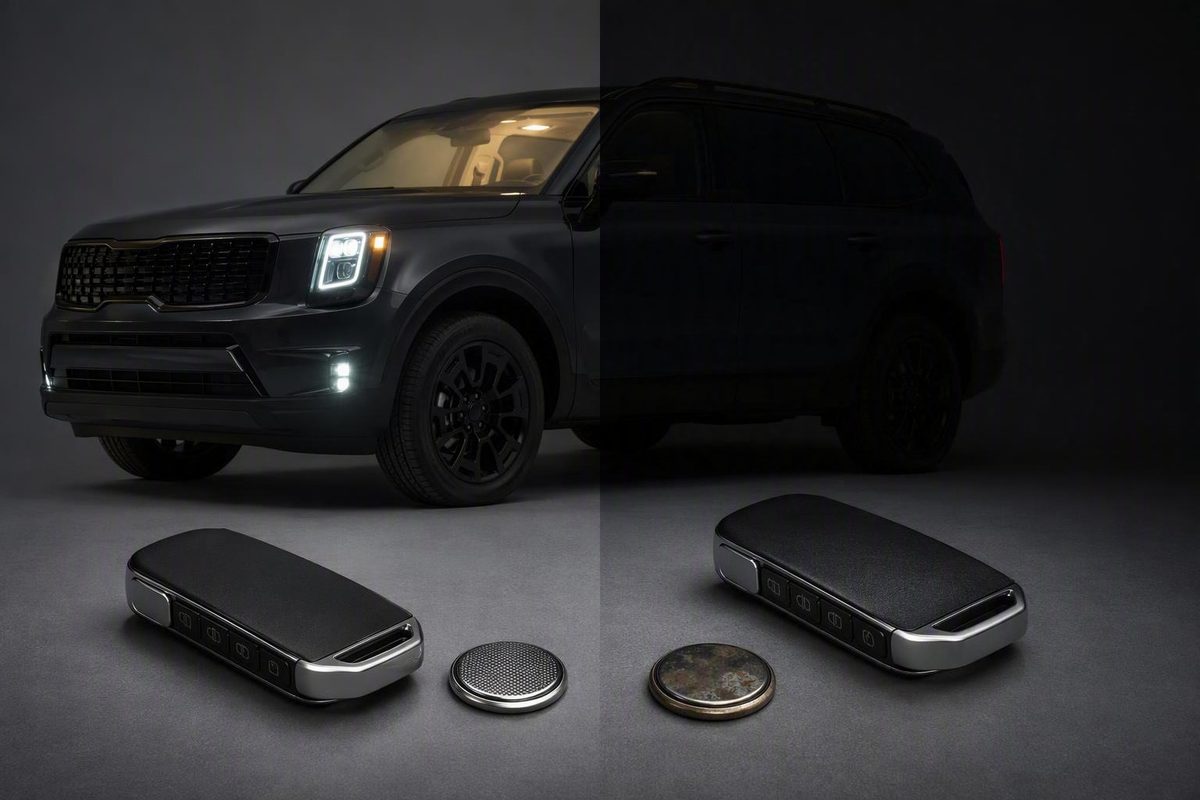
Use the spare and check cabin lights: one failed remote points to its coin cell; two failed fobs plus a dark SUV point to the 12-volt battery.
If your Kia Telluride key fob won’t unlock the doors, first distinguish a fob-side problem from a vehicle-power problem. One failed fob—especially when the spare works—points toward the original fob and its coin-cell battery. If both fobs fail and the Telluride has no cabin lights, dashboard activity, mirror movement, beeps, or lock sounds, investigate the vehicle’s 12-volt battery and connections instead.
Use This 60-Second Symptom Check
| What you observe | More likely path | Next check |
|---|---|---|
| One fob fails, but the spare works | Failed fob or weak coin-cell battery | Inspect the failed fob and verify its battery |
| The fob works only beside the vehicle | Weak fob battery is plausible | Test the spare, then replace the verified coin-cell type |
| Both fobs fail, but cabin lights and the dashboard work | Fob, interference, programming, or receiver issue | Test both fobs away from interference; check vehicle-side entry functions |
| Both fobs fail and the vehicle is completely dark | Discharged 12-volt battery or poor connection | Use the mechanical key, then check vehicle battery power and connections |
| A jump restores locks, lights, and starting | Vehicle power was low | Diagnose why the 12-volt battery discharged |
The fob battery is the small coin cell inside the physical remote. The 12-volt battery supplies the Telluride’s locks, lights, dashboard, control modules, and starting systems. Replacing the coin cell does not charge or repair the vehicle battery, while jump-starting the SUV does not repair a damaged fob.
Two failed fobs alone do not prove that the 12-volt battery is discharged. The stronger clue is total electrical darkness throughout the SUV.
Before replacing anything, note:
- The Telluride’s model year and trim
- Whether one or both physical fobs fail
- Whether cabin lights, dashboard displays, mirrors, beeps, door handles, or locks respond
- Whether either fob works at very close range
- Whether restoring 12-volt power restores both fobs
That short symptom log can help prevent an unnecessary fob purchase—or another vehicle-battery replacement that does not address recurring discharge.
Get Into the Vehicle Before Diagnosing It
Press and hold the release button on the smart fob, then pull out the mechanical key. Locate the driver-door key cylinder, expose it if covered, insert the mechanical key, and turn it to unlock the door.
The key-cylinder arrangement can vary by model, trim, and region. Some Kia handles have a removable keyhole cover, while other designs require manipulating the handle to expose the cylinder. Follow the vehicle-specific owner’s manual if your handle does not match the general instructions. Kia’s emergency smart-key guidance shows the general entry process.
Once inside, check for electrical activity. Cabin lights or a responsive dashboard indicate that the Telluride has at least some 12-volt power. A black cabin, silent locks, inactive mirrors, and no response from the start button point more strongly toward the vehicle’s battery or its connections.
If the fob’s coin cell is weak but the Telluride itself still has power, general Kia dealership guidance says a push-button vehicle may start when you press the brake and hold the fob against the start button while operating the start control. This is general guidance rather than a Telluride-specific manufacturer procedure, so check your owner’s manual for the exact method. The dealership instructions describe this weak-fob-battery fallback.
Manual entry also provides access only. It does not charge the battery or identify whether the underlying fault is an aging battery, a poor connection, a charging problem, or a key-off electrical draw. If the Telluride is completely dead and you cannot safely restore power, use roadside or professional assistance rather than attempting improvised electrical work.
Follow the Key-Fob Path When the Vehicle Still Has Power
Start with the spare fob. If it operates the locks normally, the original fob is the more likely problem—not a vehicle-wide loss of electrical power. Reduced range or operation only while standing beside the Telluride also makes a weak coin-cell battery plausible, although it does not prove that the battery is the only possible cause.
Kia identifies the instrument-panel message “The battery level on your smart key is low” as a low-smart-key-battery warning. Treat that message as supporting evidence and replace the battery promptly, but do not assume the battery is healthy merely because no warning appeared. Kia documents the warning in its smart-key guidance.
Before buying a replacement coin cell, remove the existing battery and read the number stamped on it, or consult documentation for your exact model year and fob. Non-model-specific Kia dealership guides do not provide a sufficiently consistent basis for prescribing CR2032 for every Telluride fob. Match the existing cell unless vehicle-specific documentation directs otherwise.
For a compatible smart-fob design, the general replacement sequence is:
- Remove the mechanical key.
- Find the designated opening slot near the lower part of the fob.
- Use the intended key edge or tool carefully to separate the case.
- Note the old battery’s exact type and orientation before removing it.
- Install a matching battery in the same orientation.
- Close the case completely and reinstall the mechanical key.
Do not force a fob whose case does not match that design. Opening methods vary, and forcing the wrong seam can damage the housing or internal components. If the correct opening point or battery type is unclear, consult the Telluride owner’s manual or ask a Kia parts department to identify the cell for the exact fob.
After installation, check that:
- The battery is seated flat
- Polarity matches the original installation
- The battery and contact surfaces are clean
- The case is completely closed
- Each button moves normally
Test the fob beside the Telluride and again from a reasonable distance. If a fresh, correctly installed battery changes nothing, do not automatically condemn the fob. Compare both fobs and test them in another location before paying for replacement or programming.
Follow the 12-Volt Battery Path When the Telluride Is Electrically Dark
The Telluride’s electronic locks and response to the key fob depend on vehicle power. If the 12-volt battery is sufficiently discharged—or its electrical connection is interrupted—both perfectly good fobs can appear dead.
One owner report illustrates the symptom pattern without establishing a universal cause: neither fob worked, the mirrors and beeps were inactive, and the cabin remained black after manual entry. Connecting jumper cables restored power, activated the alarm, restored fob response, and allowed the vehicle to start. The Telluride owner’s account records that sequence.
Recovery after a jump strongly supports a vehicle-power problem, but it does not identify why the battery was low. Diagnostic possibilities include a deteriorated 12-volt battery, loose or corroded connections, charging-system trouble, or an abnormal electrical draw while the vehicle is parked.
With the vehicle off, look for battery connections that are visibly loose or heavily corroded. Do not use unverified fuse-removal procedures or improvised electrical repairs to hunt for a drain.
For repeated failures, ask a qualified service provider to document:
- Battery condition under an appropriate test
- Terminal and cable security and integrity
- Charging-system performance
- Key-off parasitic draw after the vehicle has entered its normal sleep state
- The circuit associated with any abnormal draw
- Relevant software status
- The completed repair and post-repair test results
If the battery has already been replaced and the Telluride still needs frequent jumps, another battery swap alone is not a diagnosis. Ask the service department to identify the failed component or active circuit and record the measurements supporting its conclusion.
If the Telluride stalls or loses safety-related electrical functions while being driven, stop in a safe place as soon as conditions permit and seek roadside or professional assistance.
Check Digital Key Only If Your Telluride Supports It
Smartphone Digital Key is separate from the physical key fob and its coin-cell battery. Troubleshooting one should not be treated as troubleshooting the other.
Kia says a registered Digital Key phone left within Bluetooth range for an extended period may increase low-voltage battery consumption on compatible configurations. Kia also says passive Digital Key entry may be temporarily disabled when the 12-volt battery falls below its normal operating range. Failed passive phone entry can therefore be a consequence of low voltage; it does not, by itself, prove that the phone caused the discharge.
On supported vehicles, Touch Mode may provide a fallback. Hold the compatible phone near the driver-door handle to lock or unlock, then place it on the charging pad and operate the brake and start button as directed. Kia lists Digital Key 2 Touch for select 2023–2025 Telluride trims, while full Digital Key 2 is listed for select 2027 Telluride and Telluride HEV trims or newer. Kia’s Digital Key page provides the compatibility and operating details.
Before relying on Digital Key, verify the exact trim, compatible phone, operating system, wallet app, account setup, software, subscription or service status, and regional availability. A physical fob, Digital Key 2 Touch, and full passive-entry Digital Key 2 are distinct systems.
What the 2026 Telluride Battery-Drain Lawsuit Does—and Does Not—Establish
A lawsuit filed June 25, 2026 alleges a parasitic battery-drain defect in 2020–2026 Kia Tellurides. In plain language, the plaintiffs claim electronic control modules may remain active after shutdown instead of entering a low-power sleep state, weakening the 12-volt battery. One report says the alleged drain can leave too little power to operate cabin lights, start the engine, or unlock the vehicle through the key fob. That report also references a 60-month/60,000-mile warranty, but the reference does not establish coverage for any particular battery, diagnosis, or repair. ClassAction.org summarizes the filing, alleged mechanism, and warranty reference.
The litigation is Brenman v. Kia America Inc., Case No. 8:26-cv-01428, in the U.S. District Court for the Central District of California. A separate report describes plaintiff allegations involving engine stalling and disabled safety features. Top Class Actions identifies the case and those additional allegations.
These are plaintiff allegations, not established technical findings. The claimed defect, Kia’s knowledge, any nondisclosure, the affected population, and the alleged resulting failures remain disputed claims in litigation. The reports do not prove that an electronic module caused a particular Telluride lockout.
The available evidence also does not establish a model-wide defect, official repair, technical service bulletin, service campaign, or current recall status. Check current Kia and National Highway Traffic Safety Administration records using the VIN because applicability may be vehicle-specific. Ask Kia or a dealer about warranty eligibility based on the individual Telluride’s diagnosis, age, mileage, and applicable terms rather than assuming coverage from the lawsuit report.
The practical order is straightforward: try the spare fob, check whether the Telluride shows any electrical response, enter with the mechanical key, and verify the exact coin-cell battery if the vehicle still has power. If the SUV is dark or repeatedly needs a jump, request documented testing of the battery, connections, charging system, and key-off draw. The 2026 lawsuit makes parasitic drain worth discussing with the service department, but symptoms and measured test results—not the allegation alone—should determine the diagnosis.