
Faraday Pouches Work, but Thieves Changed Tactics
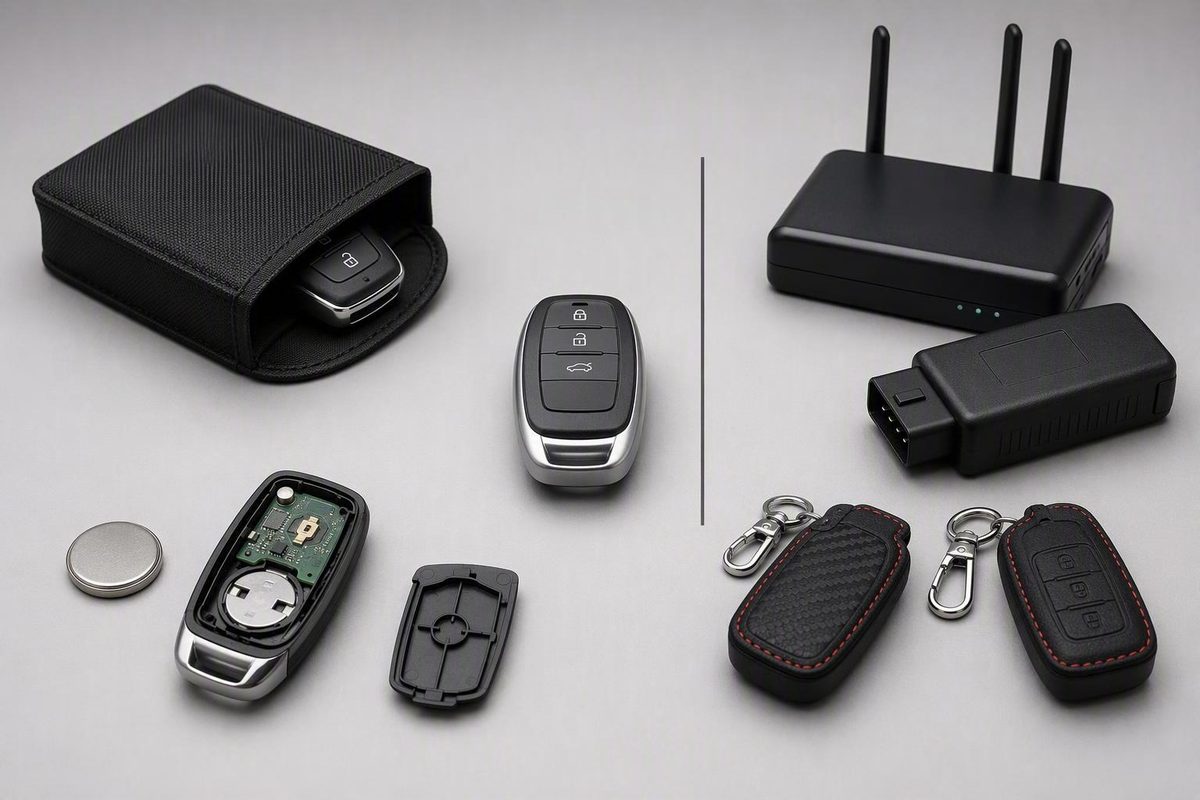
Faraday pouches still block relay theft, but not CAN-bus or OBD attacks. Identify your car’s exposure and choose the security layer that fits.
A functioning Faraday pouch still blocks keyless relay theft in 2026, but it provides zero protection against CAN-bus or OBD-port attacks. That limitation now matters more: Équité Association reported that thieves have largely shifted from relay attacks to vehicle-side CAN-bus intrusions, while separate August 2026 reporting identified growing use of OBD-II port scanners (Insurance Business, Aug. 14, 2026; WFSB, Aug. 6, 2026).
The practical verdict is not to discard the pouch. Keep using and testing it if your car has passive keyless entry, then add the vehicle-side protection that matches your car: an OBD-port lock or other model-appropriate diagnostic protection, plus a visible steering-wheel lock where physical access is the larger concern.
The Received Wisdom Is Right About Relay Theft
The standard advice—put the key in a Faraday pouch or box—is sound when the threat is a relay attack.
A relay attack retransmits communication between the vehicle and the legitimate fob, often while the key remains inside the owner’s home. Equipment near the car and equipment within range of the fob bridge a distance the keyless system would not normally accept. The vehicle then behaves as though the authorized key is nearby.
A properly closed Faraday enclosure interrupts that radio path. Its conductive material attenuates communication entering and leaving the enclosed fob. If the vehicle and key cannot complete their exchange, an attacker cannot relay that exchange. RACV’s explanation of relay attacks likewise stresses that the key must be fully enclosed and the container properly sealed.
Relay theft has not disappeared. A Baltimore-area police warning about fob-signal theft on Aug. 27, 2026, shows why owners of passive-entry vehicles should not abandon shielding merely because other methods are growing.
The mistake is treating relay protection as protection against keyless car theft generally. It is not. The pouch acts on the fob’s radio communication; it cannot block commands injected through the vehicle’s own diagnostic port or wiring.
Relay And Vehicle-Side Attacks Use Different Doors
The distinction is easiest to see by following what each method touches.
| Attack Route | Primary Target | Pouch Helps? | Matching Layer |
|---|---|---|---|
| Keyless relay | Legitimate fob’s radio exchange | Yes | Tested Faraday storage |
| OBD reprogramming | Diagnostic interface | No | Model-appropriate OBD protection |
| CAN-bus injection | Wiring or electronic modules | No | Model-specific protection and physical delay |
| Physical removal | Vehicle itself | No | Steering lock, barrier, tracking |
An OBD-based attack begins at the vehicle. Reporting by WFSB on Aug. 6, 2026 described thieves using OBD-II port scanners, which connect to the diagnostic interface rather than intercepting the household fob’s signal. Shielding the fob does not restrict access to that port.
CAN-bus injection also operates on the vehicle side. Depending on the vehicle and method, an attacker may target accessible wiring or an electronic module and inject commands into the internal network. The stored key need not be interrogated at all. Reporting on pouch wear makes the same distinction between relay protection and CAN-bus or “headlight” attacks that bypass the fob. The Oxford Mail discusses both pouch leakage and bypass attacks.
These routes should not be collapsed into a single category called “signal theft.” Relay equipment communicates with the genuine fob. OBD and CAN attacks target the car. A countermeasure positioned around the key can interrupt the first route but is physically absent from the second.
Choose your keyless system, OBD exposure and usual parking place; the tool identifies which attack surface needs the next security layer.
This decision tool assumes you store every accessible fob in a tested, fully closed Faraday pouch. It compares that relay protection with the vehicle-side exposure created by diagnostic access and parking.
Default example: A passive-keyless car with its stock OBD port accessible and parked on the street has low relay exposure with a working pouch but high vehicle-side exposure. The pouch should stay; an OBD lock and visible steering-wheel lock are the next layers.
Passive entry creates a relay target, but a tested, closed pouch interrupts the required fob communication.
The accessible diagnostic port and open street parking leave a route that never needs the shielded fob.
Result: Vehicle-side protection wins the next-purchase decision. Keep the pouch, then add a model-appropriate OBD-port control and a visible steering-wheel lock.
Highlighted rows are the closest match for the selected vehicle. “Fit” describes the route’s relevance to the inputs, not a measured theft probability.
| Method | What It Touches | Faraday Pouch | Fit For These Inputs |
|---|---|---|---|
| Keyless relay | Live radio exchange with the legitimate fob | Directly relevant if tested and closed | Controlled |
| OBD reprogramming | Diagnostic port under the dash | No protection | Strong match |
| CAN-bus injection | Vehicle wiring or electronic modules | No protection | Possible vehicle-side route |
| Signal jamming | Owner’s intended locking transmission | Not necessarily | Verify the car locked |
| Unauthorized key programming | Vehicle credential enrollment | Not universal protection | Model dependent |
| Physical key theft | The genuine key after it is taken | No protection once removed | Separate household risk |
| Forced entry | Windows, doors and cabin | No protection | Physical layer needed |
| Towing or removal | The vehicle itself | No protection | Tracking/recovery layer |
No supplied source gives model-specific theft probabilities, so the tool uses qualitative route matching rather than percentages.
Sources: Équité Association shift reporting via Insurance Business, Aug. 14, 2026; OBD-II scanner reporting by WFSB, Aug. 6, 2026; relay and shielding explanations from RACV and CAR Magazine. Ratings are qualitative; no theft-rate figures were supplied.
The tool gives a qualitative exposure rating, not a theft probability. No supplied evidence quantifies the chance that a particular vehicle will be stolen under each parking condition. Make-and-model vulnerabilities, local theft patterns and existing factory security still matter.
A Working Pouch Still Needs To Be Tested
The word “Faraday” on a package does not establish that a pouch blocks communication between your particular key and car. Performance depends on the conductive material, seams, closure, pouch condition, fob, vehicle, frequencies and keyless system involved.
In its 2026 product coverage, CAR Magazine placed fobs in closed pouches and attempted to unlock and start a car. All the pouches it tested passed. The published account does not identify the vehicle models, give signal measurements, state the number of trials or describe an independent laboratory protocol. It supports a practical conclusion about those products in that setup, not a universal ranking. See CAR Magazine’s test summary.
No supplied evidence provides standardized, repeated testing across numerous vehicles, worn products, frequencies and realistic relay equipment. It also does not quantify how much pouch use reduces total vehicle theft. The direct car-and-key check is therefore more useful to an owner than an unsupported claim that a product “blocks everything.”
Test The Actual Key And Vehicle
First confirm that the uncovered fob works normally. Check passive entry if fitted, then verify the remote lock and unlock buttons. This baseline prevents a weak fob battery or unrelated vehicle fault from producing a false pass.
Place the entire fob in the compartment identified as shielded. Some pouches have an unshielded convenience pocket. Remove bulky or sharp contents, position the fob below the closure and fasten the flap, roll, zip or hook-and-loop section exactly as directed.
Beside the car, try passive entry without opening the pouch. Then press the remote buttons through the closed material. The vehicle should not unlock, flash or otherwise respond as though the key were available.
If the owner’s manual permits a straightforward and safe check, test whether normal keyless starting recognizes the sealed fob. Do not use a backup-start procedure, leave the vehicle running unattended or create a lockout risk.
Open the pouch and confirm that the vehicle detects the fob again. Reseal it and repeat the checks. Alternating exposed and enclosed tests helps distinguish shielding from an intermittent response. Carwow gives similar testing guidance and identifies wear, corrosion, damage and incorrect closure as possible causes of leakage.
A pass means only that the tested vehicle did not detect that fob inside that correctly closed pouch in its present condition. It does not certify every frequency, vehicle, relay setup or future condition.
Treat Any Repeatable Response As A Failure
The pouch has failed its practical test if passive entry recognizes the sealed key, a remote button operates the vehicle or a normal starting check authorizes the car. Welcome lights, extending handles or mirrors can also reveal that the vehicle has detected the key.
Before replacing the pouch, confirm that the fob is in the shielded pocket and fully below the closure. Remove excess contents, align the flap and repeat both the exposed baseline and sealed test.
If the vehicle repeatedly detects the correctly enclosed key, stop relying on that pouch. Brand familiarity, price, reviews and attenuation claims do not override a failed test with the car it is supposed to protect.
A phone call, Wi-Fi check or Bluetooth test is not a substitute. Those checks cover the frequencies and protocols used by the phone connection, not necessarily those used by the automotive fob.
Pouches Can Leak After Wear Or Damage
Faraday pouches have no proven universal expiry date. A pouch that worked when new can later leak because its conductive enclosure or closure has deteriorated. An older pouch has not necessarily failed merely because of its age; current performance matters more than the purchase date.
Supported failure factors include punctures, torn or separating seams, repeated sharp folds, abrasion from keys, overstuffing, moisture, corrosion, manufacturing defects and incomplete closure. The conductive layer may sit beneath intact-looking outer fabric, so appearance alone cannot confirm that shielding remains continuous.
Test a pouch immediately after purchase, after moving it to another fob or vehicle and after moisture, crushing, punctures or visible seam damage. It also needs periodic testing during normal use. The supplied evidence does not establish one validated interval for every product.
A pouch carried and flexed daily warrants closer attention than a box left in a dry cabinet. A rigid box avoids repeated folding but still depends on an intact conductive enclosure and a fully seated lid. Neither format is inherently reliable without a vehicle-side test.
The Second Countermeasure Should Match The Exposed Route
A tested pouch remains the direct layer for a car with passive keyless entry. Store every accessible fob, including spares, inside working shielded storage. An exposed spare can still provide the live credential that a relay attack needs.
For a stock, accessible OBD port, investigate a model-appropriate port lock, relocation or other diagnostic-interface protection. The correct product and installation depend on the vehicle and its servicing requirements. An OBD measure complements a pouch because the two devices guard different access points.
A visible steering-wheel lock adds physical delay after an attacker reaches or electronically opens the vehicle. It does not stop relay communication, CAN injection or diagnostic access by itself, but it can remain relevant when the electronic route changes.
For models associated with attacks through accessible wiring or modules, obtain model-specific guidance from the manufacturer, dealer, insurer or a qualified vehicle-security installer. An OBD-port lock does not automatically secure every possible CAN-bus access point.
Parking controls address physical opportunity rather than fob radio. A locked garage, gate or driveway barrier can place another obstacle between the car and someone trying to reach its diagnostic port, wiring or cabin. Street parking leaves fewer owner-controlled barriers, making visible physical delay more relevant.
Tracking belongs to a separate recovery layer. It may help locate a stolen vehicle but does not prevent a relay exchange, an injected command or physical removal on its own.
Other Theft Methods Also Bypass The Pouch
Relaying is not the same as cloning, jamming or stealing the physical key.
Cloning or unauthorized programming generally involves creating or enrolling another credential the vehicle accepts. A Faraday pouch does not universally prevent that process. Jamming interferes with an intended radio exchange, such as stopping a locking command from reaching the car; the appropriate habit is to verify that the vehicle actually locked.
Shielding also does nothing after someone obtains the genuine key and removes it from storage. It cannot reinforce windows, doors or locks, and it cannot prevent towing or physical removal of the vehicle.
This is why a pouch should be described precisely: it isolates an enclosed fob from radio communication when it is intact, properly closed and effective with that vehicle. That remains useful protection in 2026, but it covers one attack surface. Cars exposed to OBD, CAN-bus or physical attacks need a second layer positioned at the vehicle.
Common Faraday Pouch Decisions
Testing Frequency Depends On Use And Condition
Test immediately after purchase, after changing vehicles or fobs, after damage or moisture exposure and periodically during ordinary use. Retest at once if the car unexpectedly responds while the key is sealed. There is no proven universal interval.
A Car That Unlocks Has Failed The Test
Confirm that the key is in the shielded compartment, completely below the closure and not distorting an overfilled pouch. Reseal it and compare exposed and enclosed operation. Replace the pouch if the vehicle repeatedly detects the correctly stored key.
A Box Is Not Automatically Better Than A Pouch
A box may be convenient for several household keys and avoids daily folding. A pouch is portable but may experience more rubbing, punctures and seam stress. The better choice is the enclosure that fits every fob, closes consistently and passes repeated checks with the actual vehicle.
CAN-Bus And OBD Protection Requires A Vehicle-Side Layer
A Faraday pouch cannot prevent an attack that never communicates with the stored fob. Keep the pouch for relay exposure, then use vehicle-appropriate diagnostic protection, physical delay or model-specific CAN-bus measures for the route that remains open.