
Should You Put an OBD-Port Lock on Your Ford?
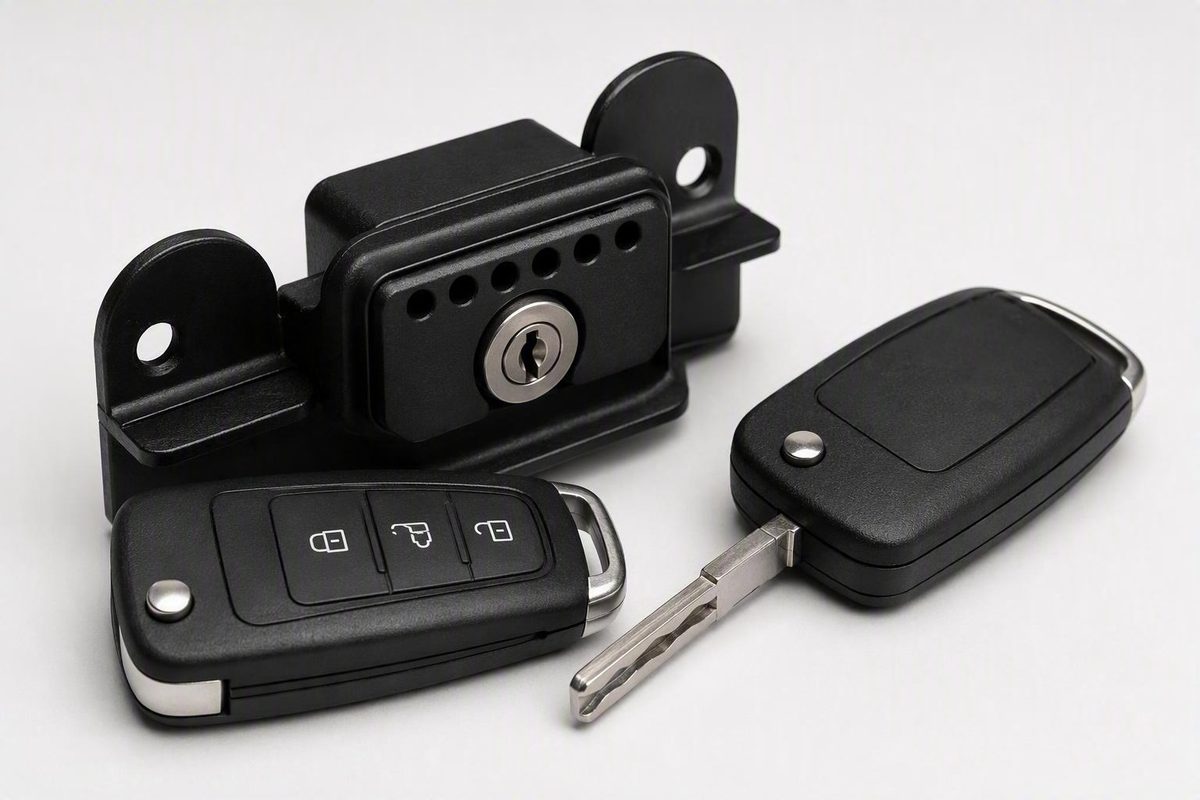
They may obstruct OBD-assisted key programming, but not relay theft, stolen keys, forced entry or towing; exact Ford fit and service access matter.
An OBD-port lock may add friction to one theft route by physically obstructing—or, in some designs, electronically restricting—access through your Ford’s diagnostic connector. It could delay or block an attempt that depends on that port, but the evidence reviewed here does not establish that an OBD lock prevents Ford theft. It also does not address relay theft, access through a non-OBD vehicle-network point, use of a valid stolen key, forced entry, or towing.
Consider one only after confirming exact fit and a safe installation and service-access plan for your model year, trim, key system, and VIN.
Short answer: an OBD lock adds friction, not complete protection
A physical OBD lock encloses or covers the diagnostic connector so equipment cannot simply be plugged into it. The port is commonly beneath the driver-side dashboard, so an attacker generally must first enter the cabin to reach it. The lock does not prevent that initial entry; it adds another obstacle afterward. RACV’s OBD-lock security explainer describes both the cabin-access requirement and the role of a physical port cover.
That distinction matters. If an attempted theft depends on connecting key-programming equipment to the OBD port, a suitable lock may consume time or block that route. However, the sources reviewed for this article provide no Ford-specific success rate or controlled tamper test showing that an OBD lock reliably prevents theft. The sensible description is access control, not a theft guarantee.
The cited evidence also does not show that every Ford—or every F-150 or push-button-start model—permits unauthorized key programming through the port. Vehicle architecture and factory protection can differ by model year, trim, and key system. A report involving one model or an older vehicle should not automatically be applied to a current Ford.
Treat claims such as “universal fit,” “theft-proof,” or “works on all F-150s” as marketing unless the seller provides exact fitment documentation and meaningful independent testing. A standardized connector does not by itself prove that a lock fits safely around the surrounding trim, wiring, pedals, or knee-area components.
Threat-versus-defense table: identify the attack before choosing protection
“Key-fob theft” can describe several unrelated methods. Start with the attack path, then choose a security layer that intersects it.
| Attack path | What happens at a high level | Is an OBD lock relevant? | More relevant security layer |
|---|---|---|---|
| OBD-assisted key programming | After cabin entry, equipment is connected to the diagnostic port in an attempt to authorize another key | Potentially. A compatible lock may obstruct connector access | OBD protection, cabin alarm, visible deterrent |
| Relay theft | The legitimate key’s radio communication is relayed or amplified | No. The radio path does not depend on the OBD connector | Secure key storage; tested signal-blocking storage |
| Non-OBD network access | An attempt uses a vehicle-network access point other than the diagnostic connector | Not established. An OBD lock protects the port, not every possible access point | Vehicle-specific immobilizer or alarm assessment |
| Stolen valid key | A working key is used | No | Secure spare-key storage; ask whether the missing key can be deauthorized |
| Forced entry | A door, window, or lock is attacked | No for the initial entry | Alarm, secure parking, lighting, steering-wheel lock |
| Towing | The vehicle is physically removed | No | Parking barriers and location tracking |
| Post-theft tracking | A tracker reports location after movement | No effect on key programming | Concealed tracking and a recovery plan |
OBD-assisted programming and relay theft are distinct: one involves physical access to the diagnostic connector, while the other exploits the keyless-entry or start radio path. Physical and electronic OBD protection therefore cannot be assumed to stop relay theft or attacks that do not use the connector, as explained in this overview of OBD-port locking devices.
An OBD lock and signal-blocking key storage are not substitutes. A steering-wheel lock adds a visible physical barrier, while a tracker may support recovery rather than prevent key pairing. Layered protection makes sense because each measure addresses a different route.
Why the diagnostic port can be involved in key pairing
OBD-II uses a standardized 16-pin diagnostic connector that technicians can use to access vehicle information and read or clear fault codes. It is a legitimate service interface, not a component installed primarily for key programming. That legitimate role is also why permanently disabling it is not a sensible generic fix.
On some vehicles, the connector can participate in authorized replacement-key pairing. Instructions for specific Simple Key products describe an OBD-connected consumer device that pairs certain replacement keys on compatible Ford, Lincoln, and Mercury vehicles. Crucially, the vendor requires users to check the vehicle’s make, model, and year against its Ford-family compatibility and pairing documentation.
This establishes a narrow point: the diagnostic connector can have an authorized role in pairing certain replacement keys. It does not establish that an intruder can pair a key to every Ford, that all Ford key systems work alike, or that one lock will defeat every programming tool. Those questions require evidence for the exact vehicle and attack method.
Physical versus electronic OBD locks
A physical lock encloses or covers the connector. It must be removed with its key, code, or release mechanism before a diagnostic tool can be attached.
An electronic OBD protection device is intended to restrict communication between the port and vehicle systems while the vehicle is secured.
| Consideration | Physical lock | Electronic protection |
|---|---|---|
| Basic function | Blocks direct physical connection | Restricts communication while secured |
| Installation | May require trim access or a model-specific enclosure | May require vehicle-specific electronic installation |
| Service access | Lock must be removed | Authorized diagnostic access must be provided |
| Questions to ask | What happens if the key or mechanism is lost or damaged? | How is access restored if authorization fails? |
| Compatibility | Connector position and surrounding structure matter | Network architecture and device operation matter |
Automotive guidance distinguishes physical enclosures from electronic devices that block communication while a vehicle is secured, but it does not provide independent comparative testing that justifies ranking one category above the other.
Avoid treating connector cutting, rewiring, disabling, relocation, or a decoy port as routine DIY work. If an installer proposes a modification, ask for a vehicle-specific explanation of safety, reversibility, service access, and what happens if the system cannot be authorized or removed.
What the 2026 Ford lawsuit does—and does not—establish
Evidence status
Verified docket facts: Pelletreau v. Ford Motor Company was filed on September 9, 2026, in the U.S. District Court for the Eastern District of Michigan as case 2:26-cv-13422, according to the CourtListener docket listing.
Reported allegations: A secondary summary says the plaintiff owns a 2023 Ford F-150 and alleges several attack paths, including programming blank key fobs through the OBD port. It also says the complaint identifies OBD locks and stealth CAN-bus immobilizers as possible safeguards. These details come from the ClaimDepot summary of the complaint, not from a technical test or court finding.
What has not been established: Filing a complaint does not prove a defect, demonstrate that an alleged attack works across Ford models, or amount to a judicial finding.
ClaimDepot described the litigation as being at an early stage with no settlement and did not include a response from Ford. The security claims should therefore be read as allegations attributed to the complaint, not as confirmed technical findings.
The case also does not support a universal recommendation to buy an OBD lock. Even if an alleged attack path were shown to work on a particular configuration, that would not establish that all Fords share it or that any particular lock is effective. Price figures reported from the complaint are not reliable market-price guidance because products, labor, vehicles, locations, and dates vary.
Pre-purchase checklist for your exact Ford
Use this checklist with the seller and, when installation involves more than a removable cover, a Ford dealer, automotive locksmith, or automotive-security installer.
- [ ] Identify the exact vehicle: Record the model year, model, trim, body style, key type, and VIN.
- [ ] Request written fit confirmation: Do not accept “universal Ford” or connector-shape compatibility alone.
- [ ] Confirm the key system: Ask whether fit or operation changes with keyed ignition, push-button start, passive entry, fleet equipment, or factory options.
- [ ] Inspect the installation area: Ask whether the device touches or alters dashboard trim, wiring, pedals, the steering-column area, or knee-area safety components.
- [ ] Check driving clearance: Confirm that neither the lock nor its mounting hardware can interfere with feet, pedals, or trim.
- [ ] Plan diagnostic access: Ask how the device is removed or authorized for dealer diagnostics, repairs, inspections, roadside service, and emissions testing where applicable.
- [ ] Plan for lost credentials: Find out what happens if the mechanical key, combination, electronic credential, or override method is lost.
- [ ] Inventory existing equipment: Look for a tracker, telematics adapter, fleet module, insurance dongle, scan-tool extension, or Y-cable already using the port.
- [ ] Ask for independent tamper evidence: Look for testing of resistance to picking, drilling, prying, connector damage, and removal of surrounding trim—not just seller demonstrations.
- [ ] Ask about failure handling: Have the installer explain how legitimate diagnostic access is restored if the device or authorization method stops working.
- [ ] Check paperwork: Ask the relevant provider about warranty, lease, insurance, and inspection implications rather than assuming a universal answer.
- [ ] Store service instructions securely: Keep the removal or service procedure somewhere separate from the vehicle.
Ford’s official site lets owners find manuals and warranty information by year, model, or VIN. Use that lookup for documents covering your exact vehicle. The lookup itself does not confirm that a third-party lock fits or prevents theft.
The sources reviewed here do not provide product-specific independent evidence covering all likely tampering methods. If a seller cannot provide model-specific fit documents, a service-access procedure, and credible test details, pause rather than improvise around the connector.
Build security in layers around the actual risk
Do not buy every security product indiscriminately. Begin with where the vehicle is parked, how its keys are stored, whether there has been forced entry, and which attack route concerns you.
For relay-theft concerns, store keys away from exterior doors and windows. If you use a signal-blocking container, test it with the vehicle rather than assuming it works indefinitely: close the key inside, take it to the vehicle, and confirm that passive entry and starting remain unavailable as intended.
For visible deterrence and cabin-entry risk, consider a properly fitted steering-wheel lock and use secure, well-lit parking where possible. Lock the vehicle and avoid leaving keys or valuables inside. These measures do not make theft impossible, but they address risks an OBD cover cannot.
For unauthorized starting methods outside the OBD route, discuss an appropriate immobilizer or alarm with a qualified installer. Ask how it integrates with the exact Ford, how legitimate drivers override it, and whether installation modifies factory wiring. Avoid generic online wiring instructions.
For recovery, a tracker may provide location information after theft, depending on its design, coverage, concealment, and continued operation. It does not prevent key programming and should not be treated as proof that the vehicle cannot be stolen.
The decision rule is straightforward: consider an OBD lock when exact vehicle fit is confirmed and physical access to the diagnostic connector is part of the risk you want to address. Preserve legitimate service access and combine it with measures selected for relay attacks, forced entry, unauthorized starting, and recovery.
Where is the OBD-II port usually located in a Ford?
The OBD-II port is commonly beneath the driver-side dashboard or steering column, although its exact position varies by vehicle. Device-installation guidance confirms this general location and recommends consulting the owner’s manual when the connector cannot be found. Do not force or remove unidentified trim.
Because the connector is normally inside the cabin, an OBD-dependent attempt generally requires interior access first. An OBD lock can obstruct what happens after entry, but it cannot stop the initial attack on a door, lock, or window.
Will an OBD lock interfere with dealer diagnostics or an OBD tracker?
It can. A physical lock normally must be removed before a dealer or repair shop can connect diagnostic equipment. Electronic protection also needs a documented way to permit legitimate diagnostic communication. Tell the technician about the device before service and bring its key, code, or approved access method.
A plug-in OBD tracker, fleet unit, telematics adapter, or insurance dongle uses the same connector and may conflict with a lock. Technical guidance for OBD-connected devices warns that devices sharing the port can interfere with one another or lose functionality. Confirm compatibility among the Ford, the lock, and any existing equipment before installation.