
Two Ford Smart-Key Cases, Zero Findings, and What to Do Now
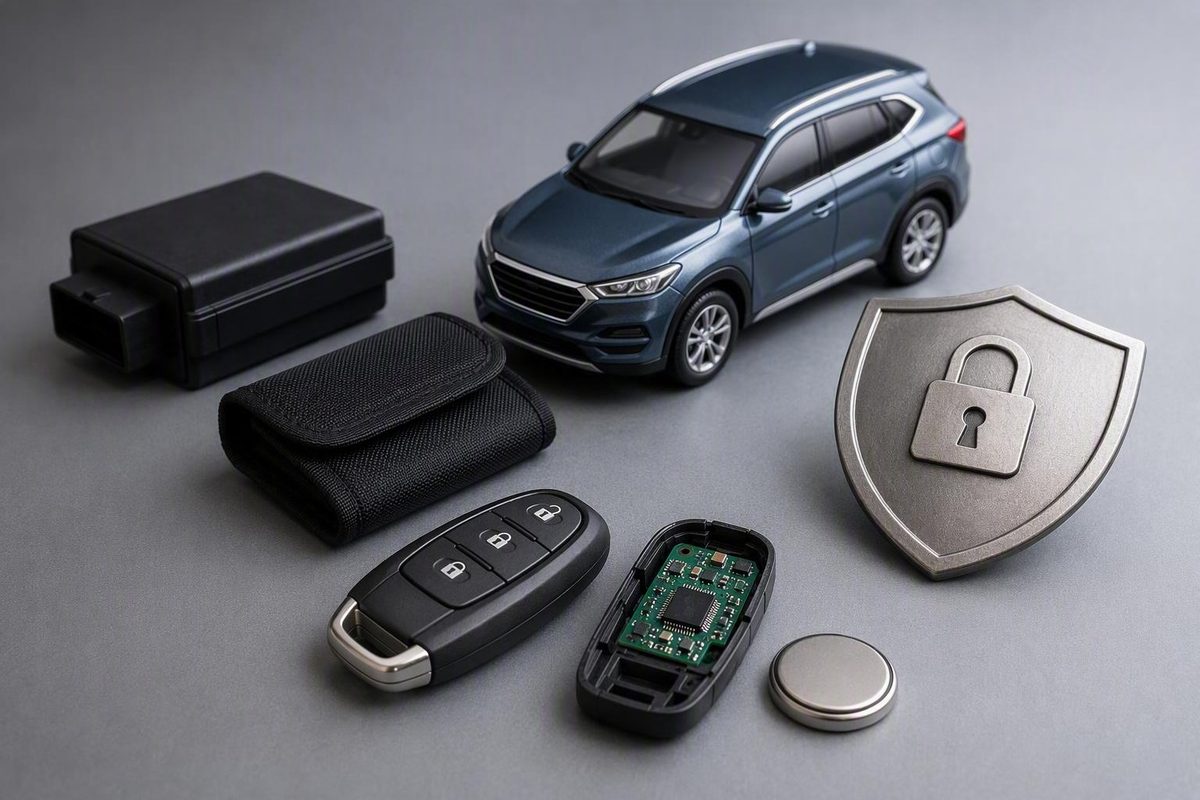
Pelletreau v. Ford is a proposed U.S. class action; Quebec's 13-automaker case is authorized. No defect found yet. What each alleges and how to cut relay risk.
Ford is a defendant in two separate smart-key theft cases, and neither has found Intelligent Access defective or Ford liable. Pelletreau v. Ford Motor Company, No. 2:26-cv-13422, was reportedly filed on September 9, 2026, in the U.S. District Court for the Eastern District of Michigan. It is a proposed class action alleging that Ford’s Smart Key system can be beaten three ways: relay amplification, software-assisted electronic entry, and VIN-based key cloning. A separate Quebec class action against Ford Canada and 12 other automakers was authorized in July 2025 and has not been decided on the merits. There is no certified U.S. class, no settlement, no recall, and no claims process in either case. What you can do this week does not depend on how either turns out: keep the fob away from exterior doors, put it in a pouch you have tested against your own vehicle, and add a steering lock.
Pick where the vehicle is registered and whether it has been stolen; the panel shows which case could touch you and what to do now.
Compared against the Quebec window reported by Driving and CBC.
Pelletreau v. Ford Motor Company (No. 2:26-cv-13422, E.D. Mich.) was reportedly filed September 9, 2026. The proposed class reportedly covers certain Ford buyers and lessees since January 1, 2015, but no class is certified, no Ford response is reported, and no claims process exists. Ford has not been found liable.
Do now
- Store the fob away from exterior doors and windows.
- Use a signal-blocking pouch and test it: sealed fob at the door should not unlock; sealed fob inside should not start.
- Confirm the fitted key system by VIN with the manual, Ford support, or a dealer.
- Install available software and connected-service updates.
- Add a steering-wheel lock; a pouch only stops relay, not cloning or port entry.
Keep, in original form, with dates
- Police report and occurrence number.
- Purchase, finance, registration, or lease documents.
- Insurance correspondence, deductible receipts, premium-increase evidence.
- Rental or alternative-transport costs; recovery, repair, or write-off records.
- Photos, video, and connected-vehicle notifications.
Sources: ClaimDepot and EDCTips (Michigan filing); CBC and Driving (Quebec authorization). Reported details, not court records; no payout or claims process exists in either case.
Two Cases, No Finding Against Ford
Everything below comes from secondary reports. The federal complaint, the docket, and the Quebec authorization judgment were not in the materials reviewed, so treat this as a summary of what has been reported, not a docket update.
| Case | Filed or authorized | Status | Relief sought |
|---|---|---|---|
| Michigan: Pelletreau v. Ford, No. 2:26-cv-13422 | Reportedly filed Sept. 9, 2026, E.D. Mich. | Proposed class; no certification or Ford response reported | Treble damages, claims fund, owner disclosures |
| Quebec: Ford Canada plus 12 automakers | Authorized July 2025 | Authorized to proceed; merits undecided | $1,500 per qualifying victim, punitive damages, recall, security modifications |
The Michigan matter is a proposed class action. That is a complaint, not a certified class, judgment, settlement, recall, or compensation program. ClaimDepot reports the filing and complaint details, including a proposed class of certain Ford buyers and lessees since January 1, 2015.
The Quebec case is further along because a judge authorized it to continue against 13 automakers. Authorization is a procedural gate. It says the case can proceed; it does not say a defect exists. Causation, negligence, consumer-law violations, and liability are all still open. CBC reported the authorization, the defendants, the class description, and the remedies sought.
Neither set of reports identifies a Ford response to the Michigan complaint, a substantive ruling, a certified U.S. class, an open claims process, or a Ford liability judgment or payout in Quebec.
What the Michigan Complaint Alleges
ClaimDepot’s summary describes three ways Ford vehicles could allegedly be taken without the owner handing over a working key:
- Relay amplification. Communication between a key near its owner and the vehicle is extended, so the vehicle responds as though the key were beside it.
- Software-assisted electronic entry. Computers and commercially available electronic tools facilitate unauthorized entry.
- VIN-based key cloning. Information tied to a vehicle identification number is used to create a working key.
These are allegations lifted from a pleading, not test results or judicial findings. ClaimDepot also reports an allegation that VIN-based cloning can be completed in about a minute. That speed has not been established for any identified Ford model.
From the locksmith counter, cutting and coding a key from a VIN is an ordinary service, and legitimate shops verify ownership before doing it. The complaint’s claim is that the same pathway can be abused. Whether it can, on which Ford systems, and how quickly, is exactly what a court has not yet examined.
The proposed class covering buyers and lessees since January 1, 2015, does not mean everyone who bought or leased a Ford after that date is in the class or owed money. A court has to address the claims, the class definition, certification requirements, Ford’s defenses, and likely vehicle-by-vehicle differences first.
The summaries reviewed lead with the F-150 but do not support a dependable model-and-model-year list. Broad references to “Ford vehicles” do not establish that every trim, fob design, radio system, or production year uses the same technology. Do not infer eligibility from the badge or the purchase date.
Plaintiffs reportedly ask for monetary and injunctive relief, including treble damages, a claims fund, and disclosures to owners. EDCTips also reports the filing and allegations and does not report that a court has granted any of it. Requested relief is what the plaintiffs want, not compensation available now.
How the Quebec Case Differs
The Quebec proceeding is not a Canadian copy of the Michigan case. Ford Canada is one of 13 defendants alongside Audi, FCA/Stellantis, Honda, Hyundai, Kia, Mazda, Mitsubishi, Nissan, Subaru, Toyota, Volkswagen, and Volvo.
Reports describe the class as qualifying Quebec owners or lessees whose vehicles used a remote access-and-start or smart-key system, did not use excluded ultra-wideband technology, came from one of the named manufacturers, and were stolen during the period covered by the authorization.
The date wording differs between reports. Driving describes a period from May 3, 2021, through May 2, 2024; CBC describes qualifying thefts occurring on or after May 2, 2021. The authorization judgment and any verified class notice control an individual eligibility decision, not either summary.
Nothing in the reports identifies a specific Ford model, model year, Ford plaintiff, or proven Ford-specific defect. They also do not establish that every vehicle in the authorized definition was taken by relay attack. CBC describes allegations involving copied or reproduced key-fob signals and exploitation of onboard diagnostic systems. Authorization is not a ruling that all 13 manufacturers used equally vulnerable systems, and excluding UWB vehicles does not prove every conventional radio-frequency smart key is defective.
Driving reports that plaintiffs seek $1,500 per qualifying theft victim, citing deductibles, higher premiums, disruption, and inconvenience, plus punitive damages tied to sales of relevant smart-key vehicles. The widely repeated $1 billion figure is a publisher’s hypothetical calculation from assumptions about sales and smart-key adoption. It is not a judgment, settlement, court valuation, or expected recovery. Driving explains the reported class parameters and damages theories. The requested recall and security modifications are proposals; the reporting does not say they have been ordered.
Relay, Cloning, and Diagnostic-Port Entry Are Different Attacks
“Keyless theft” is an umbrella term. A Ford that vanishes while both fobs are on the kitchen counter was not necessarily taken by relay.
| Method | What it targets | Needs your fob live? | Reported where |
|---|---|---|---|
| Relay theft | Key-to-vehicle communication | Yes; the signal is extended | Michigan allegations, Quebec coverage |
| Cloning or reprogramming | A new usable key credential | Not necessarily | Michigan allegations, wider keyless-theft coverage |
| Software or diagnostic-port entry | Vehicle electronics or programming access | Not necessarily | Michigan allegations, Quebec coverage |
| CAN-bus injection or key emulation | Internal network messages or an imitated credential | Usually not | Wider electronic-theft reporting; not established in any Ford theft |
The distinction matters for mitigation. A pouch defeats relay because relay needs your real fob transmitting. It does nothing against cloning or diagnostic-port entry, which do not need your fob at all. A commercial automotive-cybersecurity article separates relay, cloning, and CAN injection in similar terms, but it does not establish which method caused any particular Ford theft.
Ford says Intelligent Access communicates with the vehicle by radio frequency. In normal operation, access functions work when the key is within approximately three feet, and the key must be inside the vehicle for push-button starting, according to Ford’s Intelligent Access instructions. That three-foot figure describes intended range, not security testing. It neither proves nor disproves the relay theory.
What the F-150 Theft Numbers Do Not Prove
EDCTips reports that theft data cited in the Michigan complaint put the F-150 at the top of a national most-stolen-vehicle list in 2023 and counted 12,952 thefts the following year. The report does not identify the dataset or break the thefts down by method.
A raw total cannot establish a Smart Key defect. It ignores how many F-150s are on the road, where they operate, their age and configuration, and their exposure to theft generally. It also says nothing about how many incidents involved Intelligent Access, relay gear, cloning, a stolen physical key, fraud, or a tow truck.
Several articles repeating the same pleading do not add up to independent technical confirmation. If they all draw from one complaint, the count of articles does not strengthen the evidence.
What remains open: whether and how Ford responds; which models, years, trims, fobs, and system versions plaintiffs actually say are covered; whether a U.S. class is certified; whether independent Ford-specific testing supports or contradicts the alleged methods; and whether Ford issues a relevant recall, service bulletin, software update, replacement-fob measure, or owner notice.
What a Ford Owner Should Do This Week
You do not need to decide whether the allegations are true before cutting your exposure. The approach is layered: make the key signal harder to reach, keep software current, and add a physical obstacle. No single measure guarantees prevention.
Move the fob away from exterior doors and windows. An entryway hook next to the driveway is the relay thief’s ideal setup. Relay needs a fob within reach of the amplifier; distance is the cheapest defense you have.
Use a signal-blocking pouch or container, and test it. Seal the fob inside, stand at the driver’s door, and confirm passive entry does not unlock. Then sit inside with the sealed pouch and confirm the push-button start refuses. If either works, the pouch is not doing its job. Retest after the pouch has seen some wear.
Confirm what is actually fitted to your VIN. Some keys offer motion sensing, sleep behavior, manual signal deactivation, or UWB, but none of these can be assumed across Ford’s lineup. Check the owner’s manual for the exact model year and configuration, or ask Ford support or a dealer to identify the installed system. The Quebec class definition turns on this detail, and the Michigan reports do not sort by it at all.
Install available software and connected-service updates for the VIN. An update can close a known issue without making the vehicle theft-proof.
Add a visible steering-wheel lock. A pouch stops relay only. A steering lock is a separate obstacle for cloning and diagnostic-port entry, which never needed your fob. Consumer guidance on keyless theft recommends combining signal management, updates, and physical deterrents rather than relying on one, as set out in Admiral’s keyless-theft precautions.
What to Keep If Your Ford Was Already Stolen
If your vehicle is gone and you might eventually fall within either proceeding, preserve the police report and occurrence number; purchase, finance, registration, or lease documents; insurance claims correspondence; deductible receipts; rental or alternative-transportation expenses; recovery, repair, total-loss, or write-off records; photographs, video, and any connected-vehicle notifications; and anything showing a theft-related premium increase.
Keep the originals and note the dates. These records document ownership, timing, and losses. They do not prove eligibility or establish how the vehicle was taken.
Do not assume a claim can be filed today. Neither case has an open claims process. Follow dated court records and verified notices from appointed class counsel, not social-media posts, advertisements, or generic case summaries. This is general information, not individualized legal advice.
The Michigan filing and the Quebec authorization are separate proceedings with different defendants, classes, dates, and procedural positions. Neither proves a Ford defect or creates a payout. Verify the technology on your exact vehicle, layer your security, keep theft records, and watch for official court or class-counsel updates.