
How to Replace a CR-V Key Fob Without Buying the Wrong One
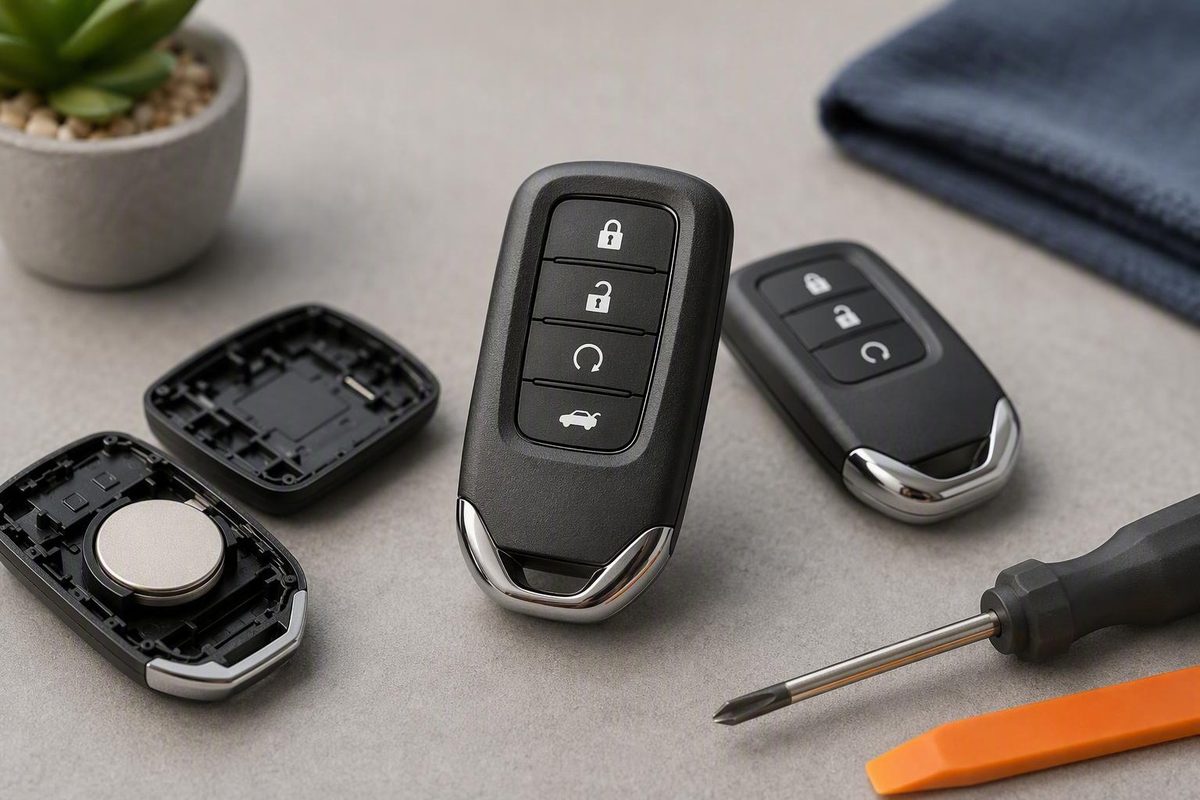
A Honda CR-V key fob replacement is not simply a matter of finding a remote with the same shape and buttons. The correct replacement depends on diagnosing what failed, identifying the vehicle’s key system, matching the original identifiers, and calculating the combined cost of hardware, cutting, remote synchronization, and immobilizer registration.
Use this order:
- Determine whether the battery, shell, buttons, blade, electronics, or vehicle is at fault.
- Identify whether the CR-V has a keyed ignition or push-button start.
- Record the VIN and every available identifier from the original fob.
- Confirm who will cut and program the replacement.
- Buy only after the seller and service provider agree that the exact fob is compatible.
This is a pre-purchase decision framework, not a year-by-year fitment or programming guide. Battery specifications, emergency-start methods, parts, and programming requirements can differ by model year, trim, and key system. Confirm vehicle-specific procedures in the applicable CR-V owner’s manual and with the provider performing the work.
First decide what actually needs to be replaced
Use this decision tree before ordering a complete fob:
- Weak range or intermittent operation: Check the battery, its orientation, and the contacts. If possible, test a spare fob to distinguish a fob problem from a vehicle-side fault.
- Cracked case or worn buttons: A correct replacement shell or button pad may be sufficient if the electronics and transponder still work.
- Physical key works but remote buttons do not: The blade and engine-start transponder may still be functional. Diagnose the battery, buttons, circuit board, and remote synchronization first.
- Lost spare, but one working key remains: Ask providers whether the working key changes the procedure, equipment requirements, or price before buying another.
- All keys lost: Avoid speculative purchases. Gather ownership documents and request an all-keys-lost quote from a Honda dealer or capable automotive locksmith.
What to check before replacing the complete fob
Start with inexpensive, reversible checks:
- Battery specification: Read the number stamped on the installed coin cell or consult documentation for the exact fob.
- Battery orientation: Install the replacement in the same direction as the old cell.
- Battery contacts: Look for flattened, bent, dirty, or corroded contacts.
- Button alignment: Check whether the rubber pad has shifted or a worn button is failing to press the switch below it.
- Interference: Test the fob in another location and away from other electronic devices.
- Physical damage: A hard drop may damage the case, switches, solder joints, or circuit board.
- Water exposure: Moisture may corrode or damage the electronics.
- Possible desynchronization: Consider this when the battery is known to be good but the remote buttons do not operate.
- Vehicle-side faults: If two fobs fail in the same way, the vehicle’s receiver, antenna, locks, or another component may be involved.
Commercial CR-V troubleshooting guidance identifies battery orientation, poor contact, interference, physical damage, desynchronization, and worn buttons as possibilities; it also notes that water exposure or a hard drop may damage the circuit board. These are diagnostic leads, not proof that a particular component has failed (CR-V fob troubleshooting guidance).
A new battery cannot repair corrosion, cracked solder, damaged switches, or a failed transmitter. Conversely, a broken shell does not automatically mean the electronic fob must be replaced. Moving working components into a new case may be practical for some designs, but ask a qualified provider to verify the case and procedure before disturbing a transponder or circuit board.
For more context on symptoms such as declining range or intermittent response, see this overview of key-fob battery lifespan and warning signs.
Changing the battery safely
Replacing a coin cell normally does not erase the fob’s programming. However, do not assume every CR-V fob uses the same battery: the supplied sources mention CR2025, CR2032, and CR2035 in different Honda and CR-V contexts. Read the installed cell or use documentation for the exact fob.
A cautious battery-change process is:
- Remove the emergency key, where applicable.
- Locate the case’s designated opening slot.
- Use the emergency-key edge or an appropriate small tool to open the case gently.
- Hold the case around the internal components so buttons and loose parts do not fall out.
- Photograph or note the old battery’s specification and orientation.
- Install the exact replacement cell in the same orientation.
- Align the case halves and press them closed without forcing them.
- Test lock, unlock, panic, liftgate, and any other available buttons near the vehicle.
Honda of Kirkland’s general Honda procedure similarly advises removing the metal key, opening the case at its slot, controlling loose components, closing the case, and testing the buttons afterward (Honda key-fob battery instructions). Because that guidance is not mapped to every CR-V fob design, use the opening point on your own case rather than forcing it to match an illustration.
Identify the CR-V key system before shopping
CR-V catalogs contain several broad product categories, but these categories can overlap. A bladed key, for example, may also contain a transponder and remote-control electronics.
- Regular mechanical key: A cut metal key without remote controls or an engine-start transponder.
- Transponder key: A mechanical key containing a chip that must be recognized by the immobilizer.
- Separate remote: A button remote used alongside a separate ignition key.
- Remote-head key: A unit combining a mechanical blade, transponder, and remote buttons.
- Proximity smart key: A fob used with passive entry and push-button start, generally with a removable emergency blade.
The first important distinction is keyed ignition versus push-button start.
A keyed-ignition replacement may require a blade to be cut, a transponder to be registered for engine starting, and the remote buttons to be synchronized. A push-button-start smart fob must be compatible with the proximity and immobilizer systems, while its hidden emergency blade may need separate cutting. A keyed-ignition button sequence should never be assumed to register a push-button smart key.
Why model year is not enough
A product labeled for the correct year can still be wrong. Compatibility may also depend on:
- Trim
- Keyed or push-button ignition
- Number and symbols of buttons
- Remote-start support
- Power-liftgate control
- Panic button
- Mechanical blade or keyway
- Driver 1 or Driver 2 designation
- OEM part number
- FCC ID
- Radio frequency
One reviewed CR-V catalog contains several product types, button counts, frequencies, FCC IDs, and part numbers. It also warns that similar-looking remotes may differ electronically or mechanically. The same captured collection included unrelated Pilot products, demonstrating that a retailer’s model filter is not proof of fitment (Honda CR-V key and remote catalog).
Before contacting a seller or programmer, record:
- Full VIN
- Model year
- Trim
- Keyed ignition or push-button start
- Number of buttons
- Symbol and function of each button
- OEM part number
- FCC ID
- Frequency, if printed
- Driver 1 or Driver 2 marking
- Blade shape or keyway
- Photos of the front, back, interior label, and blade
If the original is unavailable, ask a Honda parts department or qualified automotive locksmith to identify the correct part from the VIN. The catalog cited above also offers VIN-based assistance, but reconcile any retailer recommendation with the provider who will cut and program the fob.
Use the full compatibility checklist, not appearance alone
Complete this checklist before placing an order.
CR-V replacement-fob compatibility checklist
- [ ] VIN recorded
- [ ] Model year confirmed
- [ ] Trim confirmed
- [ ] Keyed ignition or push-button start confirmed
- [ ] OEM part number matched
- [ ] FCC ID matched
- [ ] Frequency matched
- [ ] Button count matched
- [ ] Button symbols and layout matched
- [ ] Remote start included if required
- [ ] Liftgate control included if required
- [ ] Proximity entry supported if required
- [ ] Correct mechanical blade or keyway included
- [ ] Driver 1 or Driver 2 designation checked
- [ ] Transponder or chip included
- [ ] Circuit board included
- [ ] Battery included or correct battery identified
- [ ] Uncut emergency key included if needed
- [ ] Seller confirms compatibility in writing
- [ ] Programmer confirms it can enroll this exact product
- [ ] Cutting requirements and price confirmed
- [ ] Failed-programming charge confirmed
- [ ] Return policy checked for cut or programming-attempted products
A narrow example of how specific fitment can be
One third-party marketplace listing claims compatibility with certain 2015–2016 CR-V EX vehicles. It identifies FCC ID ACJ932HK1210A and lists 72147-T0A-A11, 72147-T0A-A21, and 72147-T0A-A31 as matching part numbers. It also specifies four buttons and a matching blade. The seller describes the package as including a battery, chip, remote board, and uncut emergency key, with cutting and programming still required (2015–2016 CR-V EX aftermarket listing).
Those are seller-provided fitment claims, not universal specifications or a product recommendation. The example shows why “four-button Honda fob” is inadequate: a visually identical unit may use another frequency, contain different electronics, have another blade, or omit a function the vehicle expects.
Confirm what is in the package
“Replacement fob” may describe:
- A complete remote with board, chip, battery, and blade
- Electronics without a battery
- A remote without an emergency key
- An empty shell
- An uncut transponder key
- A refurbished fob with a new uncut blade
- A remote-only unit without an engine-start transponder
Ask for a written list of included components. Confirm the chip, circuit board, battery, blade, and required buttons rather than assuming the product is complete.
Review the return policy before cutting or programming.
Compare new OEM, refurbished OEM, used OEM, and aftermarket fobs
These labels are not interchangeable:
- New OEM: New hardware made for the original-equipment channel. It still must match the vehicle and may require cutting and programming.
- Refurbished OEM: Previously used OEM hardware that has been cleaned, repaired, tested, re-cased, or otherwise restored. It is not new.
- Used or pre-owned OEM: Previously used original equipment sold with varying levels of testing, wear, and warranty coverage.
- Aftermarket: Hardware produced outside the original-equipment supply channel. Quality, included components, supported functions, and programmer acceptance vary.
| Option | Parts-price position | Compatibility confidence | Condition | Questions to ask |
|---|---|---|---|---|
| New OEM | Usually highest | Often strongest when VIN-verified | New | Is it the exact part number? Are cutting and programming included? |
| Refurbished OEM | Often below new OEM | Potentially good when identifiers match | Previously used and restored | What was replaced, how was it tested, and what warranty applies? |
| Used OEM | Often lower | Dependent on application and enrollment feasibility | Variable wear | Can this exact unit be enrolled, and is failed labor refundable? |
| Aftermarket | Often lowest | Variable | Usually new | Are all functions supported, and will the chosen provider program it? |
A reviewed seller listing for a 2017–2021 five-button Driver 1 fob advertised a refurbished OEM unit for $59.77, excluding the battery, cutting, and professional programming. A related aftermarket unit was listed at $32.77. These were seller snapshots rather than current installed-price guarantees (refurbished CR-V five-button fob listing).
Used OEM can work—but “Honda” is not enough
In a December 2023 owner discussion, a used Civic fob reportedly failed to program to a 2016 CR-V, while a compatible used CR-V fob reportedly succeeded. That outcome does not establish that every matching used fob can be enrolled. It illustrates why the source application and identifiers matter.
Before buying customer-supplied hardware, ask:
- Will the provider program new aftermarket hardware?
- Will it program used or refurbished OEM hardware?
- Does it program only fobs that it supplies?
- Who pays if enrollment fails?
- Is labor due when the fob proves incompatible?
- Does cutting or attempted enrollment void the seller’s return policy?
- What hardware and programming warranties apply?
- Will every original function be tested before payment?
The cheapest part is not the cheapest solution if it becomes a nonreturnable fob accompanied by a failed-programming bill.
Calculate the complete replacement cost
Build each quote from all potentially necessary charges:
| Cost component | What to confirm |
|---|---|
| Fob or key hardware | Condition, identifiers, electronics, included blade, and warranty |
| Coin-cell battery | Included or separate; exact battery required |
| Mechanical or emergency-key cutting | Included, outsourced, or unavailable |
| Remote synchronization | Whether button pairing is a separate service |
| Immobilizer registration | Whether engine-start authorization is included |
| Diagnostics | Charge for identifying a fob or vehicle-side fault |
| Mobile service | Travel radius, after-hours rate, and cancellation terms |
| Shipping | Delivery time and return-shipping responsibility |
| Taxes | Whether the quote is pre-tax or out-the-door |
| Failed-programming fee | Amount owed if the supplied fob cannot be enrolled |
In reviewed retailer snapshots, some CR-V transponder-key products started at approximately $15, while several aftermarket, used, refurbished, or recent smart-fob examples appeared around $30–$80 before cutting, programming, shipping, and taxes. These are volatile catalog examples, not installed-price promises (CR-V key catalog and price examples).
For broader context, Kelley Blue Book gives general total ranges of $125–$250 for transponder keys, $150–$300 for switchblade fobs, and $200–$400 for smart-key fobs. These are general estimates by key type, not CR-V-specific quotations (Kelley Blue Book key-fob cost guide).
A Honda dealership article published on June 17, 2026 estimates $150–$400 for modern Honda OEM fob hardware, plus $100–$200 for professional programming and emergency-key cutting. Treat those figures as a broad dealership estimate, not a binding quote for a particular CR-V (Piedmont Honda programming and cost guidance).
Local owner reports show how quotes may be structured but cannot predict your price. In the December 2023 forum discussion, one owner reported paying $60 for a compatible used OEM fob and $80 for mobile cutting and programming. Another chose a $170 hardware-store package after receiving local dealer or locksmith quotes of approximately $225–$250 or more. The vehicles, providers, dates, and locations were specific to those owners (CR-V owner cost discussion).
Request comparable, itemized quotes
Give every dealer, locksmith, or store the same information:
- VIN
- Model year and trim
- Ignition type
- Number of working keys
- Required functions
- Original part number and FCC ID, if available
Then request an out-the-door quote stating whether it includes:
- Fob
- Battery
- Emergency blade
- Blade cutting
- Remote synchronization
- Immobilizer registration
- Diagnostics
- Mobile service
- Taxes
- Warranty
- Failed-programming charges
A low parts price can be misleading once labor and travel are added. Conversely, a bundled price may be poor value if it excludes an emergency blade, remote start, liftgate support, or a required return visit.
Choose between a Honda dealer, automotive locksmith, hardware store, and DIY route
No provider is automatically best for every CR-V. The practical choice depends on the key system, the number of working keys, local equipment, product availability, and your tolerance for compatibility risk.
| Route | Compatibility assurance | Convenience | Can work at vehicle? | Outside-fob policy | Parts choices | Price transparency |
|---|---|---|---|---|---|---|
| Honda dealer | Strong option for VIN-verified OEM parts | Usually requires an appointment and vehicle access | Usually at dealership | May be restrictive | Primarily OEM | Request an itemized quote |
| Automotive locksmith | Depends on equipment and CR-V coverage | Mobile service may be available | Often | Varies | OEM, refurbished, used, or aftermarket may be possible | Often quoteable after VIN details |
| Hardware store | Depends on supported inventory and equipment | Convenient where offered | Usually in-store | May refuse outside keys | Generally limited to stocked products | Bundles may be easy to compare |
| DIY | Buyer assumes compatibility risk | Convenient only when the exact procedure is supported | Yes | Not applicable | Broad online selection | Hardware may look inexpensive, but failures add cost |
Honda dealer
A Honda dealer is a logical route when you want VIN-verified OEM hardware, emergency-key cutting, and immobilizer registration handled through one provider.
Requirements vary. Kelley Blue Book reports that the dealers it surveyed required an in-person visit and proof of ownership or registration before programming a fob. Commercial CR-V guidance also advises owners to expect possible requests for registration documents and photo identification. Confirm the required paperwork before the appointment.
Ask whether:
- The quoted part is new OEM
- Every required function is included
- Cutting and programming are separate charges
- The vehicle must be present
- All existing fobs must be brought
- A missing key can be removed from the authorized list
A dealer is not established as mandatory for every CR-V, but it can reduce uncertainty when supplying a VIN-verified part for a modern or all-keys-lost job.
Automotive locksmith
A qualified automotive locksmith may offer lower-cost hardware choices, mobile service, key cutting, and programming at the vehicle. Capability is not universal.
Ask specifically about:
- Model year and trim
- Keyed or push-button ignition
- Part number and FCC ID
- New, used, refurbished, or aftermarket fob acceptance
- All-keys-lost capability
- Emergency-blade cutting
- Failed-enrollment charges
Do not rely on a general statement that the business supports “Honda keys.” Send the proposed listing and identifier photos for approval before buying.
Hardware store
Some hardware stores offer bundled replacement, cutting, and programming. That may produce a straightforward installed price, but vehicle coverage and inventory vary.
A store may refuse externally purchased keys. One owner in the December 2023 CR-V discussion reported that a local hardware store would not program outside hardware. Confirm the policy before ordering a fob elsewhere.
DIY
Reasonable DIY tasks include:
- Identifying and purchasing a compatible part
- Replacing a coin-cell battery
- Replacing a shell or button pad carefully
- Following a procedure explicitly verified for the exact CR-V and key system
DIY should not mean applying a generic lock-button sequence to a push-button smart key or assuming that working buttons prove the immobilizer has been registered. Modern transponder work may require specialized equipment.
Provider call script
I have a Honda CR-V with VIN ending in [last eight digits], model year [year], trim [trim], and [keyed/push-button] ignition. I currently have [number] working keys. Do you support this exact vehicle and key system?
Do you supply the fob? Will you program a customer-supplied new aftermarket, refurbished OEM, or used OEM fob? Can I send the part number, FCC ID, and listing before purchasing?
Does the quote include the fob, battery, emergency blade, blade cutting, remote-button synchronization, immobilizer registration, diagnostics, mobile service, and tax?
Do you need a working key? Must I bring every existing key? If enrollment fails, what do I owe? Is enrollment guaranteed when you supply the part?
If a key is missing, can you remove it from the vehicle’s authorized-key list? Please explain what is possible for this VIN rather than assuming deactivation occurs automatically.
No available evidence establishes that every CR-V requires a dealer or that every locksmith can program every CR-V. Provider capability must be checked case by case.
Understand programming, pairing, and key cutting
“Programming a key” can refer to three different jobs:
- Mechanical or emergency-key cutting: Shaping the blade so it operates the applicable lock or ignition.
- Remote synchronization: Pairing lock, unlock, panic, liftgate, or related buttons.
- Immobilizer registration: Enrolling the transponder so the vehicle authorizes engine starting.
The tasks may be completed during one appointment, but they are not interchangeable. A remote can lock and unlock the doors while remaining unable to start the engine. Successful button pairing therefore does not prove successful immobilizer registration.
Modern smart-fob registration may require specialized equipment.
Why generic DIY sequences are risky
Some general Honda instructions describe a procedure using a mechanical ignition key, repeated On/Off cycles, and presses of the Lock button. The stated result is cycling the door locks, indicating remote synchronization rather than proof of immobilizer registration (generic keyed-ignition Honda pairing procedure).
Only use a DIY procedure when reliable documentation explicitly covers:
- Your model year
- Your trim or key system
- Keyed versus push-button ignition
- The exact fob type
- The specific task being performed
Ask whether a working key is required and whether all current keys must be present. Those answers may depend on the vehicle, the equipment, and whether the provider is adding a spare or handling an all-keys-lost case.
Post-programming test checklist
Do not leave until you test:
- [ ] Engine starts
- [ ] Engine restarts after being turned off
- [ ] Passive or proximity entry works
- [ ] Lock works
- [ ] Unlock works
- [ ] Panic works
- [ ] Remote start works, if equipped
- [ ] Liftgate control works, if equipped
- [ ] Driver 1 or Driver 2 behavior is correct
- [ ] Memory behavior is correct, if linked
- [ ] Emergency blade operates the intended lock
- [ ] Every previously working key still functions
- [ ] Replacement works at a normal practical range
Do not assume that adding a replacement automatically removes missing keys. Ask whether deactivation is available for the exact vehicle and request confirmation of what the provider changed.
Handle a dead fob or an all-keys-lost situation
A dead coin cell and the loss of every authorized key require different responses.
If the fob battery is dead
Many smart fobs contain a hidden mechanical key that may provide entry through a compatible lock cylinder. General Honda guidance also describes placing a weak or dead fob at a designated location near the Start/Stop button so the vehicle can detect it. Because the location and steps can vary, use the emergency-entry and startup instructions in the owner’s manual for the exact CR-V rather than treating a generic Honda procedure as universal (Honda dead-fob entry and startup guidance).
A dead coin cell does not necessarily mean the fob’s engine-start authorization has disappeared.
If every key is lost
Before contacting a provider, gather:
- Full VIN
- Vehicle registration or other proof of ownership
- Government-issued photo identification
- Model year and trim
- Vehicle location
- Whether the doors are locked
- Available photos or records of the missing fob
- Required functions, such as remote start or liftgate control
Kelley Blue Book reports that surveyed dealers required an in-person visit and proof of ownership or registration before programming; exact identification and access requirements should be confirmed with the selected provider (Kelley Blue Book replacement guidance).
An all-keys-lost job may proceed differently from adding a spare because no working key is available, the vehicle may be inaccessible, and the provider may need to travel to it. Ask whether towing is necessary or whether a mobile automotive locksmith can complete the work at the vehicle.
Also ask whether a missing fob can be removed from the vehicle’s authorized-key list. Do not assume that enrolling a replacement automatically disables it.
HondaLink should not be treated as a substitute for a compatible physical key. Piedmont Honda states that connected services supplement access or convenience, while engine starting still requires an authorized transponder in the cabin (HondaLink and physical-key guidance).
Once the vehicle is operational, consider creating and fully testing a spare so a future loss does not immediately become another all-keys-lost service call.
Honda CR-V key-fob replacement FAQ
Will changing a Honda CR-V key-fob battery erase its programming?
Normally, no. A coin-cell replacement does not ordinarily erase the fob’s programming. Install the exact battery specified for the fob, preserve its orientation, and test every function afterward.
If the fob still fails, inspect the contacts and button alignment, consider physical or water damage, and compare it with a spare if available. Do not conclude that programming was lost solely because a fresh battery did not restore operation.
Can I program a Honda CR-V replacement key fob myself?
Limited remote-button synchronization may be possible on certain keyed-ignition configurations, but there is no universal CR-V procedure. A keyed-ignition lock-button sequence should not be treated as push-button smart-key or immobilizer programming.
Verify the exact model year, ignition type, fob, and task before attempting any sequence. Otherwise, use a Honda dealer or properly equipped automotive locksmith.
Can a locksmith program a customer-supplied, used, or aftermarket CR-V fob?
Some can, but policies and equipment vary. A locksmith may accept new aftermarket hardware while refusing used fobs, or it may program only products it supplies.
Send the VIN, ignition type, part number, FCC ID, photographs, and product listing before purchasing. Ask who pays if enrollment fails and whether attempted programming affects the seller’s return policy.
What documents will I need if every Honda CR-V key is lost?
Expect to provide the VIN, vehicle registration or another form of proof of ownership, and government-issued photo identification. The provider will also need the vehicle’s location and access details.
Requirements vary, so confirm the documents, appointment conditions, and vehicle-access requirements before arranging service.
Can I unlock or start my CR-V when the key-fob battery is dead?
Many CR-V smart fobs contain a removable mechanical key that may allow entry through the vehicle’s lock cylinder. Some Honda systems can also detect a weak or dead fob when it is held at a designated point near the Start/Stop button.
Use the owner’s manual for the exact model year because the location and sequence are vehicle-specific. If the fob is physically damaged or incompatible, replacing the battery or using the backup-detection position may not help.
Before buying, complete one final check:
- Diagnose the failure.
- Record the VIN and exact fob identifiers.
- Confirm every required button and feature.
- Obtain itemized dealer and locksmith quotes.
- Verify whether the provider accepts outside, used, refurbished, or aftermarket fobs.
- Confirm cutting, remote synchronization, and immobilizer registration separately.
- Ask about failed-attempt charges and warranties.
- Review return restrictions before cutting or programming.
- Buy only after the seller and programmer agree in writing that the exact product is compatible.