
Your Mercedes Recall Letter Is About a Door Switch, Not Your Fob
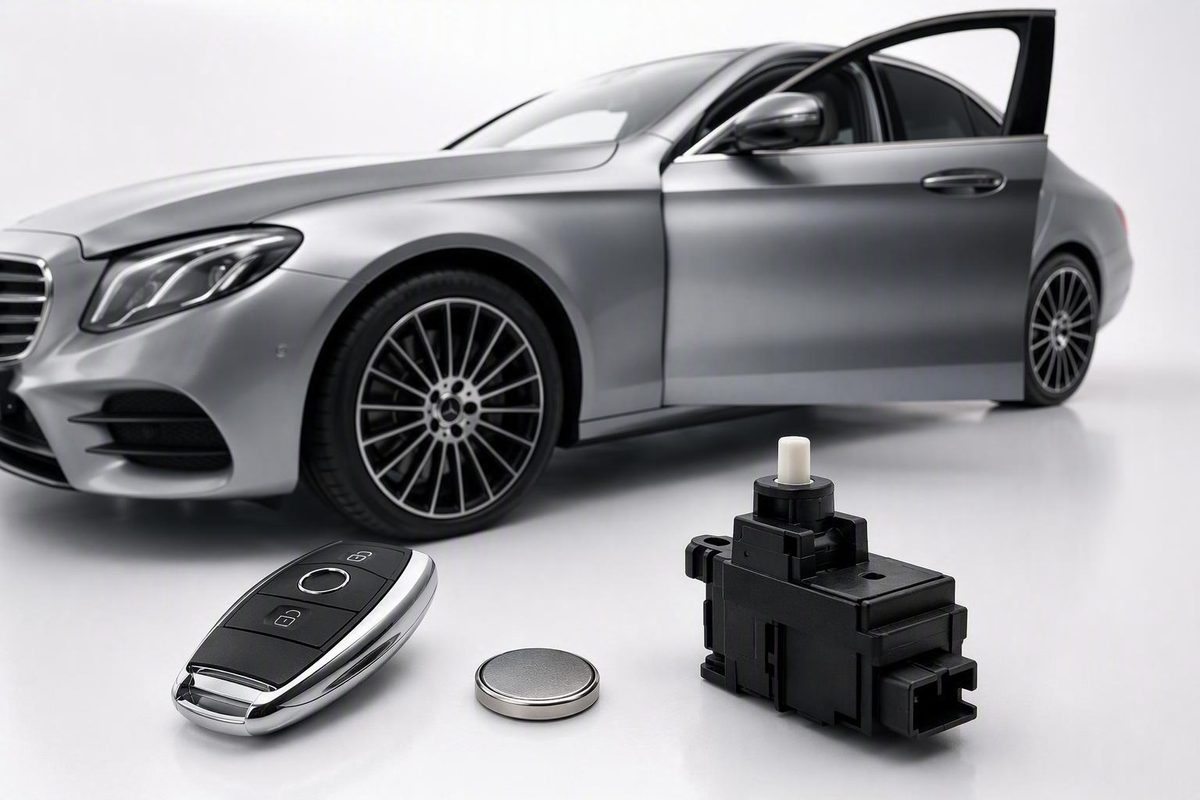
NHTSA campaign 26V481 covers 310,667 Mercedes-Benz cars. See which 2019–2026 models are listed, what fails, and why a new fob or battery won't fix it.
Campaign 26V481 is not a key-fob recall. The defect NHTSA lists for 310,667 U.S. Mercedes-Benz vehicles from the 2019–2026 model years is a microswitch inside the driver’s-door lock: moisture gets into the housing, the contacts corrode, and the car can miss the signal that the driver’s door has opened. Without that signal the electronic parking brake or Auto Park may not engage the way the owner expects, and a car that has not been secured any other way can roll. A fresh fob battery, a reprogrammed remote or a replacement fob does nothing for this. Until a dealer has inspected the car, select Park, set the parking brake by hand every time, and run the VIN through the Mercedes-Benz USA or NHTSA recall lookup. The interim precautions and the no-cost repair are set out in the campaign summary for 26V481000 and in the NHTSA recall acknowledgment for 26V481. The two identifiers refer to the same campaign; 26V481000 is just the longer display format.
Pick your model and model year; the verdict appears beside the selectors.
Is my Mercedes-Benz on the 26V481 list?
Choose a model and year.
The verdict is a screening result from the reported model-year ranges. Only a VIN lookup at Mercedes-Benz USA or NHTSA confirms whether your car is included.
Reported model-year ranges (U.S. campaign 26V481)
| Model | Reported years | Note |
|---|---|---|
| A-Class | 2019–2022 | Certain 2020–2021 AMG A35 included |
| CLA | 2020–2021 | Certain AMG CLA35 and CLA45 included |
| GLA | 2021–2025 | Selected GLA and AMG GLA only |
| GLB | 2020–2026 | Selected GLB and AMG GLB only |
| C-Class | 2022–2023 | Plus certain 2024 AMG C43 |
| GLC | 2023–2024 | Certain SUV, coupe and AMG versions |
| CLE | 2024 | Selected coupes, cabriolets and AMG |
Source: NHTSA campaign 26V481 (310,667 U.S. vehicles, issued July 30, 2026); ranges condensed from Cars.com reporting of the recall notice. U.S. vehicles only; Canada's related action is Transport Canada 2026364.
Why Owners Blame the Fob and Why That Is the Wrong Part
The recall letter talks about the car not recognising an open driver’s door, and the fob is the thing in your hand when you walk away from the car. So the first call I would have taken at the counter is “my Mercedes has a rollaway recall, do I need a new key?” No. The remote and the keyless-entry system talk to the car over radio. The door-open microswitch is a mechanical contact inside the lock assembly, wired to the body electronics. They are separate circuits, and the recall names only the second one.
That separation cuts both ways. A fob with strong range and crisp buttons does not clear a car from the recall, because the fob was never the suspect. A fob with reduced range, intermittent buttons or failed proximity entry does not show the rollaway defect is present either; that is an ordinary remote problem with its own fixes. Sort out the fob if it needs it, but do not book it as the recall repair, and do not skip the VIN check because the remote seems fine.
How a Corroded Door Switch Turns Into a Rollaway
The microswitch has one job: report whether the driver’s door is open. The lock still latches, locks and unlocks mechanically without it, which is why a failing switch can go unnoticed. Car and Driver lays out the failure sequence and that distinction.
The chain reported in the recall paperwork runs like this:
- Moisture enters the microswitch housing inside the driver’s-door lock or latch assembly.
- Corrosion develops over time.
- The switch stops reliably detecting that the driver’s door has opened.
- The electronic parking brake, Auto Park or related automatic parking behaviour may not engage as expected.
- If the driver has not otherwise secured the car, it can roll.
Reports differ on the exact consequence. Some describe the automatic electronic-parking-brake engagement failing, others refer to Auto Park or to both systems. It would overstate the record to say every switch failure leaves the transmission in gear. The narrower, safer reading is the one that matters: do not rely on anything the car is supposed to do automatically when the driver’s door opens.
Possible clues that the switch is missing the door signal include the radio, interior lighting or other retained comfort functions staying on after you get out and close the door. Those behaviours are worth a diagnosis whether or not the VIN comes back with an open campaign. The reverse also holds: a car that behaves normally is not thereby cleared. Coverage is decided by the vehicle-specific campaign record, not by symptoms.
Which Models and Years Are on the 26V481 List
The U.S. campaign, issued July 30, 2026, covers 310,667 vehicles across the A-Class, CLA, GLA, GLB, C-Class, GLC and CLE, including certain AMG versions. Model and model year are screening information only; they cannot confirm that a specific car is included. The ranges below are condensed from the detailed model list published by Cars.com.
| Model family | Reported model years | Note |
|---|---|---|
| A-Class | 2019–2022 | Includes certain 2020–2021 AMG A35 |
| CLA | 2020–2021 | Includes certain AMG CLA35 and CLA45 |
| GLA | 2021–2025 | Selected GLA and AMG GLA variants |
| GLB | 2020–2026 | Selected GLB and AMG GLB variants |
| C-Class | 2022–2023, plus certain 2024 AMG C43 | Check the exact VIN |
| GLC | 2023–2024 | Certain SUV, coupe and AMG versions |
| CLE | 2024 | Selected coupes, cabriolets and AMG versions |
Two cars with the same badge, year and trim can return different results because inclusion depends on production details. The headline 2019–2026 span also does not apply to every family: the A-Class range starts at 2019, while the listed CLE vehicles are all 2024. Use the table to decide how urgently you need the VIN check, not as proof either way.
Check the VIN, Not the Symptoms
Enter the 17-character VIN into the Mercedes-Benz USA recall lookup, which returns vehicle-specific information on current and past U.S. campaigns, or into NHTSA’s recall database. The Mercedes-Benz USA tool covers U.S. vehicles only. VINs for this campaign became searchable on July 31, 2026, so there is no reason to wait for the letter.
Then act on the lookup result, not on how the fob, radio, lights or door lock behave:
| What the lookup shows | What to do |
|---|---|
| Campaign 26V481 / 26V481000 open | Book recall service with an authorized Mercedes-Benz dealer |
| No campaign, but the car sometimes misses the open driver’s door | Request a diagnosis; do not assume the fob |
| Fob range is short or buttons need repeat presses | Troubleshoot the fob separately, but still complete the recall check |
If the campaign is open, tell the dealer you are calling about the driver-door-lock recall and give the VIN; they will confirm the service procedure for that car. If no campaign appears but comfort functions stay on after you exit, describe that behaviour precisely when you book the diagnosis. If the online result or the dealer’s answer is unclear, Mercedes-Benz customer service is at 800-367-6372 and the NHTSA vehicle-safety hotline at 888-327-4236.
What the Dealer Repair Covers and What to Do Until Then
The remedy is dealer inspection and, where required, replacement of the affected driver’s-door lock or latch component at no charge. It is a vehicle-side repair to the assembly that houses the microswitch. Nothing about it involves a fob battery, remote reprogramming or a new key.
September 18, 2026 is the scheduled owner-notification date. That is a schedule, not proof that every letter was mailed or received that day. Cars.com lists the date, the remedy and the manufacturer contact details.
Until the repair is done, every time you park: bring the car to a complete stop, select Park deliberately, set the parking brake manually, and confirm the car is secure before walking away. If the campaign is open, book the dealer visit promptly. These steps remove the dependence on the door-open signal; they do not fix the corroding switch or cover every parking hazard, so keep following the parking instructions in the owner’s manual.
The recall information reviewed here says nothing about current parts availability, a standard repair time, towing, reimbursement or loaner eligibility. Ask the servicing dealer what applies to your car and appointment rather than assuming any of it is included.
Owners Outside the United States
The Mercedes-Benz USA VIN tool returns nothing useful for non-U.S. vehicles. Use your national Mercedes-Benz recall lookup or your vehicle-safety regulator’s database, and do not assume the U.S. campaign number, model list, notification schedule or service details carry over unchanged. Recall administration and VIN populations are country-specific even when the component is the same.
For Canada, the related action is Transport Canada recall 2026364, reported to cover nearly 37,000 vehicles. Canadian owners should check with Mercedes-Benz Canada or Transport Canada using their VIN rather than the U.S. table above.
The one thing that holds in every market: this is a door-lock sensor fault on the car, not a defect in the remote. Keep your money in your pocket at the fob counter, secure the car by hand, check the VIN through the right official source, and take the no-cost dealer repair if the campaign is open.