
Find Every Battery in Your Ford Transit
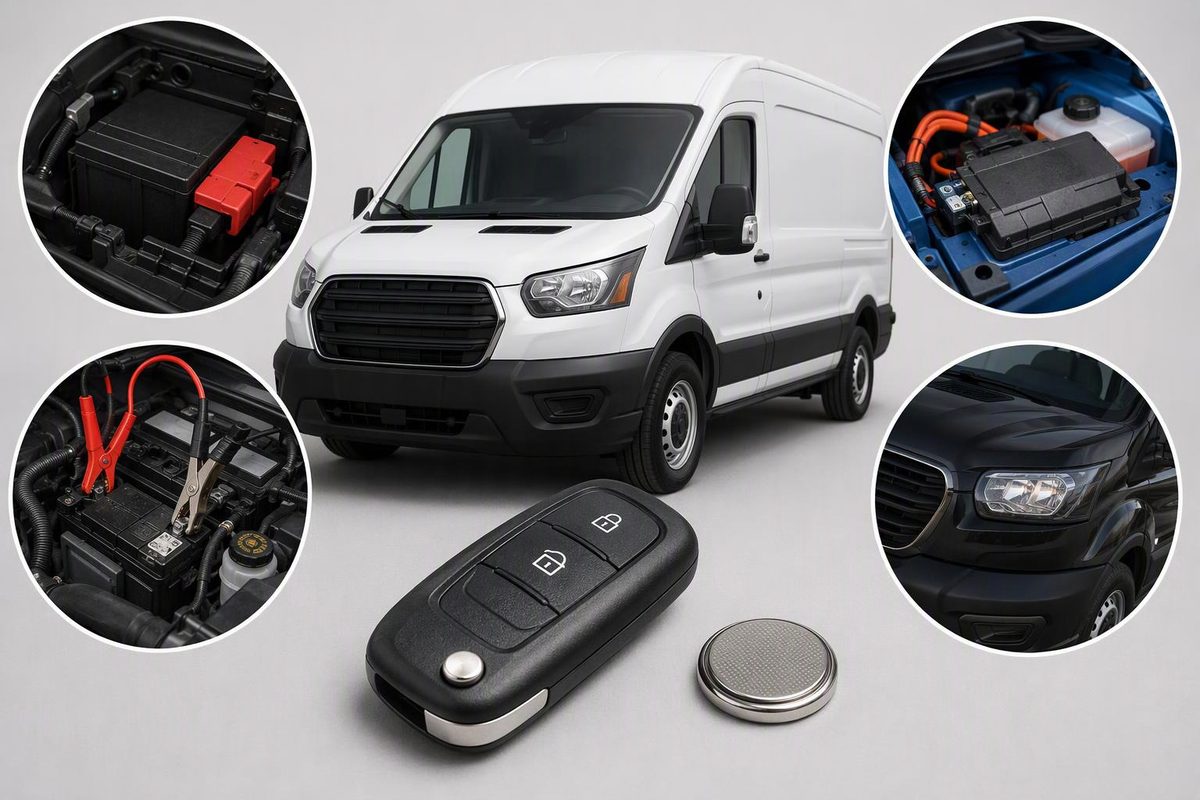
Locate the Ford Transit 12V battery, under-hood jump points, Transit Connect exception, E-Transit system and the correct 2025 key-fob cell.
For the North American full-size Ford Transit documented in Ford’s 2015 and 2025 manuals, the main 12-volt battery is inside the cabin beneath the driver seat, not under the hood. Some gasoline configurations have two 12V batteries in that compartment. The smaller Transit Connect is the main exception: its documented 2018 battery is under the hood.
Choose the Transit model; the locator shows where its 12V battery and jump connection are.
Transit Battery Locator
12V battery location
Beneath the driver seat
For jump-starting, use the designated positive terminal and ground point under the hood. Some gasoline configurations have two under-seat batteries.
| Vehicle | 12V location | Jump connection |
|---|---|---|
| Full-size gasoline Transit | Under driver seat | Under-hood terminals |
| 2025 E-Transit | Under driver seat | 12V procedure only |
| 2018 Transit Connect | Under hood | Battery positive and approved ground |
Source: Ford’s North American 2015 and 2025 Transit manuals and 2018 Transit Connect manual. Confirm the model year and market before service.
Ford documents the under-seat location in both its 2015 Transit Owner’s Manual and 2025 Transit Owner’s Manual. Battery layouts can vary by model year and market, so use the manual for the specific van before removing trim or buying a replacement.
| Vehicle | 12V battery location | Jump-start connection |
|---|---|---|
| Full-size gasoline Transit | Beneath the driver seat | Positive terminal and ground point under the hood |
| 2025 E-Transit | Beneath the driver seat | Model-year 12V jump-start points |
| 2018 Transit Connect | Under the hood | Battery positive terminal and approved ground |
Accessing the Full-Size Transit Battery
For the 2025 gasoline Transit, Ford’s access procedure begins with the following steps:
- Switch the van off and apply the parking brake.
- Fully raise the driver seat if it has height adjustment, then move it fully forward.
- Pull the tabs upward to remove the rear cover, if fitted.
- Unhook the next cover and tuck it beneath the seat.
That is enough if you only need to confirm the battery location. Full removal also requires taking off the seat-track end caps, removing two seat-adjustment stop bolts, and removing the battery clamp and cover. Ford warns that the seat-runner bolts must be securely refitted.
The battery is heavy. A dual-battery van has additional disconnection and removal steps, so follow the illustrated procedure for that configuration rather than treating it like a single-battery installation.
If a power seat cannot move because the battery is discharged, do not force it. The 2025 manual says to jump-start the van first so the seat can be repositioned.
Use the Under-Hood Terminals for Jump-Starting
You do not need to open the under-seat battery compartment merely to jump-start a full-size Transit. On the 2025 gasoline Transit, Ford provides two connections under the hood:
- Positive terminal: Next to the engine-compartment fuse box, beneath a red cap.
- Negative ground point: On the driver side near the hood hinge, beneath a rubber cover.
Ford specifies this connection order for that vehicle:
- Connect the positive jumper lead to the Transit’s positive access terminal.
- Connect the other end to the assisting battery’s positive terminal.
- Connect the negative lead to the assisting battery’s negative terminal.
- Make the final connection at the Transit’s designated ground point.
Ford specifically warns not to attach the final negative lead elsewhere on the van. Use the illustrated instructions in the manual for the exact model year rather than relying only on cable colors or a generic jump-start sequence.
The designated ground point also matters when connecting an external charger. The 2025 manual directs owners to connect the charger’s negative cable to the vehicle ground point, not directly to the battery-negative post. This allows the battery-management system to measure current correctly.
The E-Transit Has Separate 12V and High-Voltage Batteries
The 2025 E-Transit also has a 12V battery beneath the driver seat, but it is separate from the high-voltage traction battery. Ford explains that the 12V battery controls the switches and contacts that engage the high-voltage system.
A standard 12V booster may be used only for the 12V system and only according to Ford’s procedure. It must not be used to “jump” the high-voltage battery. If the high-voltage battery will not accept a normal charge, Ford says to have the vehicle towed to an authorized dealer.
The 2025 manual also directs owners to an authorized dealer for E-Transit 12V-battery service. Do not attempt to access or repair high-voltage components.
The 2018 Transit Connect Battery Is Under the Hood
A Transit Connect is a different model, not simply a short-wheelbase version of the full-size Transit. The component diagram in Ford’s 2018 Transit Connect Owner’s Manual identifies its battery in the engine compartment.
For jump-starting that model, Ford says to connect the positive lead to the discharged battery’s positive terminal. Make the final negative connection to an exposed metal part of the engine or a designated ground point. Do not connect that final lead to the discharged battery’s negative terminal.
Check the rear badge and registration to determine whether the vehicle is a Transit or Transit Connect. Then verify the battery layout in the model-year manual; the documented 2018 Transit Connect arrangement does not establish the location for every year or market.
Resetting the 2025 Transit Battery Sensor
For the 2025 gasoline Transit, Ford requires a replacement battery of exactly the same specification. Its manual gives the following battery-sensor reset procedure:
- Switch the ignition on without starting the engine.
- Within 10 seconds, flash the high beams five times, ending with them off.
- Press and release the brake pedal three times.
- Confirm that the battery warning lamp flashes three times.
After replacement—or sometimes after external charging—the battery-management system may need eight hours to relearn the battery’s state of charge. During that period, Ford says the van must remain fully locked with the ignition off.
Do not automatically apply this reset to an older Transit, a Transit Connect or a van from another market. Check its model-year manual first.
The 2025 Push-Button Key Fob Uses a CR2450
The key-fob battery is unrelated to the van’s 12V starting battery. For the push-button-start remote documented in the 2025 North American Transit manual, Ford specifies one CR2450 three-volt coin cell, installed with the positive side facing upward.
Older keyed remotes and fobs supplied in other markets can differ. Before buying a cell, identify the remote design and read the complete battery code printed on the installed cell. For opening instructions and replacement precautions, see how to replace a Ford key-fob battery by fob type.