
Prius Battery Replacement: Check the Fob, 12V Battery or Hybrid Pack First
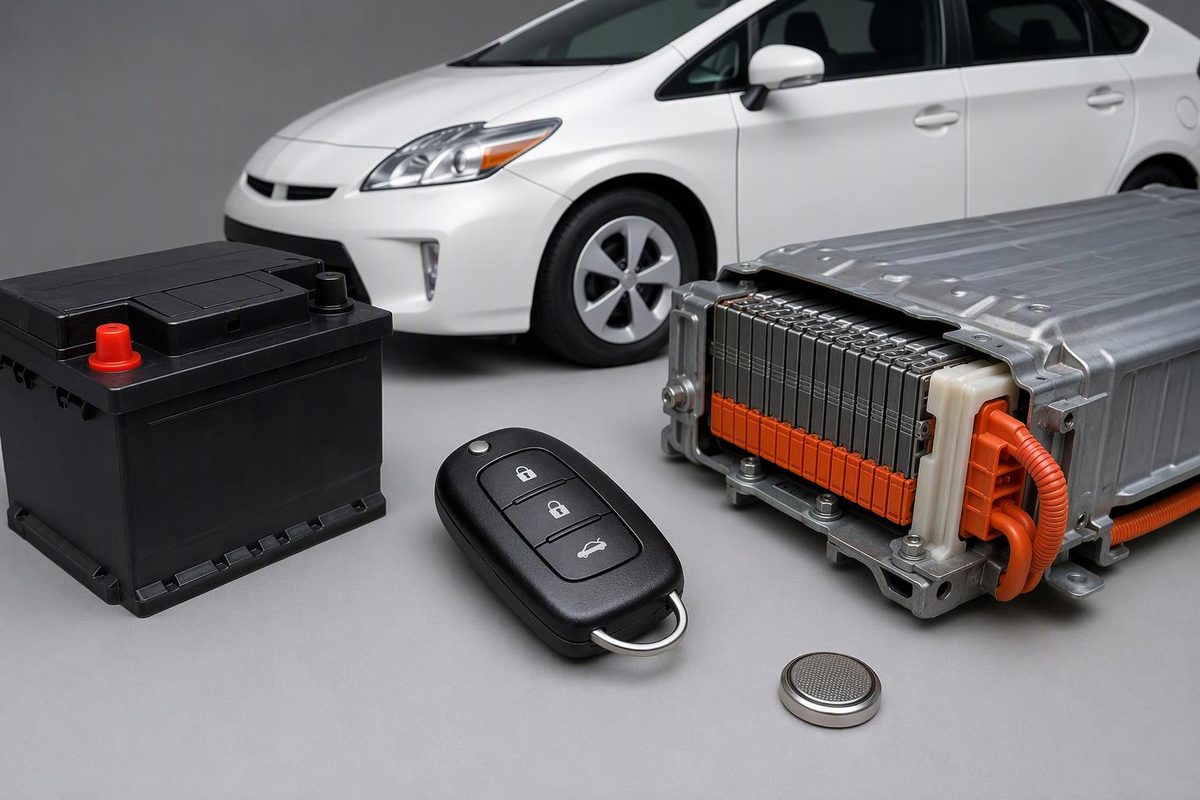
Separate Prius key-fob, 12V and hybrid-battery faults before buying a replacement. Check documented coin cells, emergency starting and U.S. warranty coverage.
A Prius that will not unlock or start does not automatically need a replacement hybrid battery. There are three separate batteries to distinguish: the key-fob coin cell, the vehicle’s 12-volt auxiliary battery and the high-voltage traction battery.
Start with your model year, exact model—Prius, Prius c, Prius v or Prius Prime—and the symptoms. The examples below use Toyota’s U.S. manuals for the 2014 and 2023 Prius; do not transfer their battery specifications or starting procedures to another version without checking its manual.
Choose the right diagnostic path
| What you observe | Check first | Stop point |
|---|---|---|
| Reduced remote range or intermittent unlocking | Key-fob battery | Confirm the coin-cell code before buying |
| Dim or absent lights, a weak horn and failure to enter READY | 12V battery and its connections | Arrange testing before replacing parts |
| A hybrid-system warning or reduced propulsion power | Vehicle/hybrid-system diagnosis | Follow the displayed instructions; do not open the traction battery |
Toyota’s manuals identify reduced range and unreliable smart-key/remote operation as depleted-fob-battery symptoms. They identify dim lights or a weak horn as possible signs of a discharged 12V battery or loose/corroded connections. These are diagnostic clues, not proof that a particular battery has failed. See the 2014 Prius manual, pages 460–461 and 545–546 and 2023 Prius manual, pages 446 and 503.
If the key fob is the problem
Try your spare fob, if available. If it works normally while the first does not, inspect the first fob’s battery before pursuing a vehicle-side repair.
Documented Prius coin cells
| Prius model year | Battery specified by Toyota | Installation polarity |
|---|---|---|
| 2014 | CR1632 | Positive (+) side up |
| 2023 | CR2450 | Positive (+) side up |
These specifications come from the 2014 manual, pages 460–461 and 2023 manual, pages 446–448. They are not a universal Prius fitment chart. For a replacement or aftermarket fob, compare its installed cell and housing with the applicable instructions.
For the 2023 Prius electronic key shown in Toyota’s manual:
- Release the lock and remove the mechanical key.
- Remove the key cover using an appropriately sized flathead screwdriver, with its tip wrapped in a rag.
- Remove the depleted cell using a small flathead screwdriver. If the electronic module sticks to the cover and hides the battery, remove the module to expose it.
- Install a CR2450 with the + terminal facing up.
- Reassemble in reverse order, then test remote locking, proximity entry and starting separately.
Toyota cautions against excessive force, wet hands, moving other internal components or bending the battery terminals. Keep new and used coin cells away from children; suspected swallowing requires immediate emergency medical attention. If the cover will not close securely, stop using the fob, store it out of children’s reach and contact your Toyota dealer. Source: Toyota’s 2023 replacement instructions.
For other fob designs, use our Prius key-fob battery replacement guide. Do not jump straight to programming if a fresh cell changes nothing: recheck the code, polarity and seating first. Toyota’s cited battery-change procedures do not include a reprogramming step. For continuing smart-key or key-related problems, the 2023 manual directs owners to take the vehicle and all its electronic keys to a Toyota dealer. 2023 manual, page 505.
Need to get in or start with a dead fob battery?
Mechanical entry and emergency key detection are separate from normal remote operation. For a 2014 Prius, Toyota directs you to use the mechanical key for the door, depress the brake, touch the Toyota-emblem side of the fob to the POWER switch, then press POWER within 10 seconds of the buzzer while keeping the brake depressed. 2014 manual, pages 548–549.
The 2023 instructions instead specify touching the area behind the fob’s buttons to the power switch. Follow that model’s complete sequence rather than assuming emblem-side contact applies to every Prius. This backup procedure addresses key detection; it does not recharge a discharged vehicle battery. 2023 manual, pages 505–506.
If the 12V battery is the problem
Have the battery and connections tested before ordering a replacement. A discharged battery and a worn-out battery are not the same diagnosis.
Use the exact model-year manual for battery access and jump-starting points. Both cited Prius manuals provide an under-hood exclusive jump-starting terminal, even though their 12V batteries are in the right-hand luggage compartment. 2014 manual, pages 437 and 550–552; 2023 manual, pages 422 and 507–508.
Do not buy solely by “Prius battery.” Have fitment confirmed for your vehicle. The 2023 manual specifically requires the replacement battery’s exhaust hose and exhaust-hole plug to be attached securely, warning that incorrect installation can allow hydrogen into the interior. It also notes that some systems may require initialization after 12V disconnection. That is not a generic key-fob reset. 2023 manual, pages 509–511.
If you mean the high-voltage hybrid battery
A hybrid-system warning is not, by itself, a traction-battery replacement diagnosis. Follow the warning’s instructions and obtain a diagnosis from a Toyota dealer or hybrid-qualified repair shop. Do not remove high-voltage covers, connectors or the service plug. Toyota warns owners not to touch, disassemble, remove or replace high-voltage components. 2014 manual, pages 38–43.
Before authorizing replacement, ask for the diagnostic findings, the exact replacement pack being quoted, installed cost, written warranty and arrangements for the removed battery.
For U.S. vehicles, check coverage first: Toyota states that hybrid batteries beginning with model year 2020 have 10-year/150,000-mile coverage from original first use, whichever comes first, subject to warranty terms. Earlier vehicles may have longer coverage under emissions provisions than the standard 8-year/100,000-mile coverage. Ask the dealer to check your VIN, mileage, in-service date and applicable warranty guide. Toyota hybrid-warranty guidance.