
Key Fob vs. Keyless Entry Remote: What You Have and What to Replace
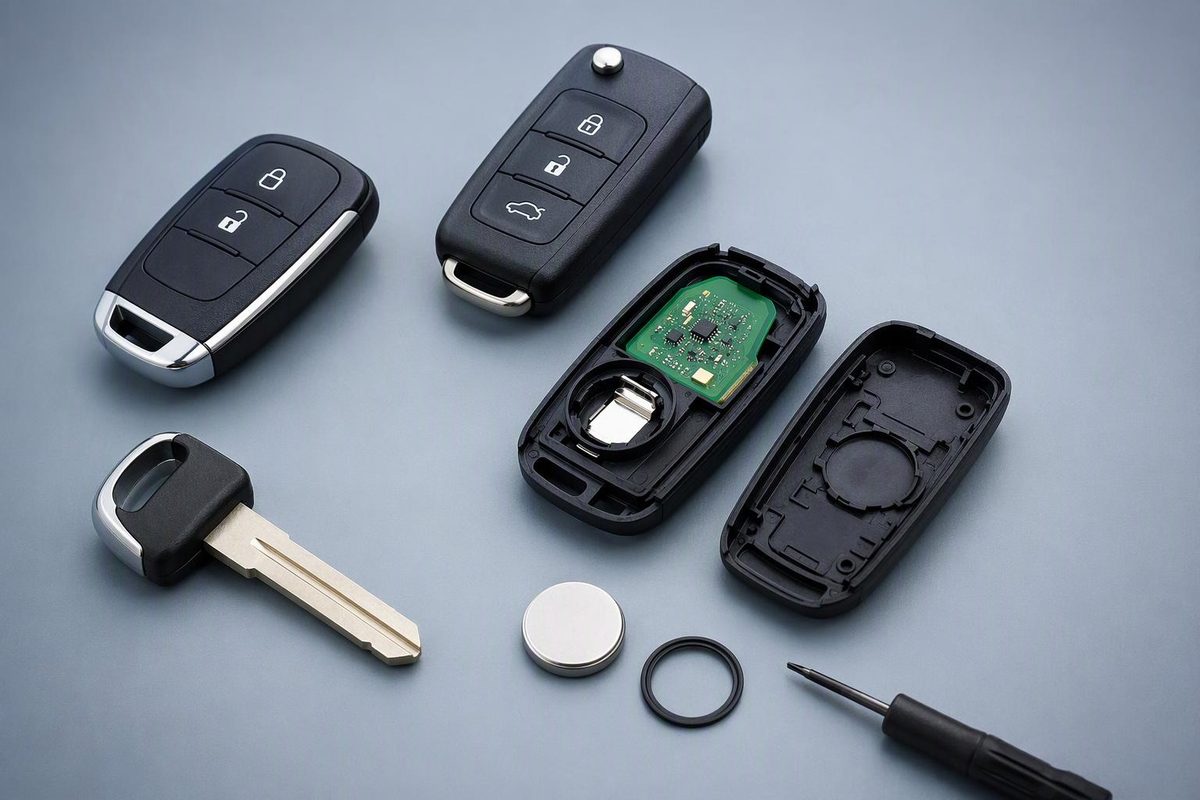
Identify your key fob or keyless entry remote, isolate battery, locking and starting faults, and match a replacement without guessing.
“Key fob” and “keyless entry remote” are often used interchangeably, but the device in your hand may perform several separate jobs. It might operate the door locks, authorize the engine to start, provide passive entry and contain an emergency metal key.
That distinction matters when troubleshooting or ordering a replacement. A remote that locks the doors is not necessarily programmed to start the car, and a dead fob battery does not always prevent emergency entry or engine starting.
First identify which type you have
Use the physical device and the vehicle’s starting method—not just a seller’s product title.
Remote-only transmitter
This is a separate button remote used to lock and unlock an older vehicle. The ignition key is a different item. Replacing the remote may restore button-operated locking, but it does not replace the ignition key or any transponder inside that key.
Key with an integrated remote
The buttons and metal ignition key share one housing. The unit may contain:
- a remote transmitter for the locks;
- a transponder for the immobilizer;
- a cut metal blade for the ignition and door lock.
Those are separate requirements. A newly cut blade might turn the ignition but fail to start the engine if the transponder has not been enrolled.
Smart or proximity key fob
A smart fob supports push-button start and may unlock the vehicle when the fob is near a door handle. Its buttons provide active remote locking, while proximity entry and starting are separate functions. Many smart fobs also contain a removable mechanical key, but the emergency-entry and backup-start procedures vary by model.
Test the functions separately
Before buying anything, test the fob beside the vehicle and then test the spare, if available.
| What you observe | Most useful next check |
|---|---|
| One fob has poor range or needs repeated presses; the spare works normally | Replace the weak fob’s battery with the exact type and polarity shown in the manual or on the installed cell. |
| Buttons fail, but passive entry or backup starting still works | Suspect the fob battery, a damaged button or the remote-transmitter section before blaming the immobilizer. |
| Buttons lock and unlock the doors, but the engine will not start | Do not repeat a remote-pairing procedure. Starting authorization is a separate issue. Try the model-specific backup-start method and check for immobilizer messages. |
| Both fobs stop operating and the cabin lights, horn or power locks are also weak or dead | Check the vehicle’s 12-volt battery before replacing both fobs. |
| The spare works in every mode but the primary fob does not | The fault follows the primary fob; inspect its battery, contacts, case and circuit board. |
| Neither fob works in one location but works elsewhere | Radio interference is possible. Move the fob away from phones, laptops, metal objects and other electronics before attempting programming or replacement. |
Honda’s 2022 CR-V instructions illustrate why these checks must stay separate: the built-in key can unlock the door when the keyless-remote battery is weak, while the keys also contain immobilizer electronics. Honda also notes that damaged key circuitry can prevent starting and stop the remote transmitter from working (Honda).
If battery replacement is the likely fix, follow a fob-specific guide or use this remote keyless entry battery replacement process. Do not assume every similar-looking case uses a CR2032.
A dead fob battery may have a backup path
Many smart-key vehicles provide two fallbacks:
- a mechanical key stored inside the fob for the driver’s door;
- a designated place to hold or insert the depleted fob so the vehicle can recognize it at close range.
Toyota, for example, says the mechanical key inside its Smart Key can open the driver’s door and that holding the Smart Key next to the START button will most likely allow the engine to start. Toyota also says that a no-start combined with inoperative power locks may point to a weak vehicle battery rather than the Smart Key battery (Toyota).
Do not generalize Toyota’s procedure to another make—or even every Toyota generation. Check the “key battery depletion,” “backup starting” or “emergency entry” section of the exact owner’s manual.
Match a replacement before paying for programming
A matching shell and button count are not enough. Record all of the following:
- vehicle year, make, model and body style;
- trim and original factory key system;
- keyed ignition or push-button start;
- every required button, including hatch, panic and remote start;
- OEM part number from the original fob, where present;
- FCC ID or other regulatory identifier;
- frequency or market specification when documented;
- metal-blade style;
- whether a working programmed key remains.
Treat the FCC ID as one matching clue, not proof of compatibility by itself. A replacement must support the vehicle’s remote and immobilizer system, not merely resemble the original or use a related radio design.
Before ordering, ask the seller to confirm compatibility against the VIN and original part number. Also ask whether the unit is new, refurbished or previously paired, whether it can be enrolled in your vehicle, and whether the emergency blade is included. The broader keyless entry remote replacement checklist covers these buying checks in more detail.
“Programming” can mean different jobs
A complete replacement may require up to three operations:
- Remote pairing so the lock, unlock and other buttons work.
- Immobilizer or smart-key enrollment so the vehicle authorizes starting.
- Mechanical blade cutting for the door or ignition cylinder.
A seller’s claim that a remote is “self-programmable” may cover only the first operation. Ask explicitly whether the stated procedure enables both remote functions and engine starting on your exact year and configuration.
DIY eligibility is vehicle-specific. Ford, for instance, says an owner can program a spare coded key when they already have two programmed Intelligent Access Keys or Integrated Keyhead Transmitters and follow the applicable owner’s-manual procedure. Without two such keys, Ford directs owners to a dealer (Ford). That is an example, not a universal two-key rule.
Dealer or qualified automotive-locksmith programming and diagnostic equipment may be required when:
- all working keys are lost;
- the immobilizer or smart-key system must be accessed securely;
- the model has no documented owner procedure;
- a used fob needs a supported reset before enrollment;
- lost keys need to be removed from vehicle memory;
- diagnosis points to an antenna, receiver or vehicle-module fault rather than a bad fob.
Stop before programming if a fresh, correctly installed battery changes nothing and both fobs fail in the same way. Check the vehicle’s 12-volt supply and obtain system-specific diagnosis; purchasing another remote may add cost without fixing the fault.