
Protect Your Car From Unauthorized Fob Programming
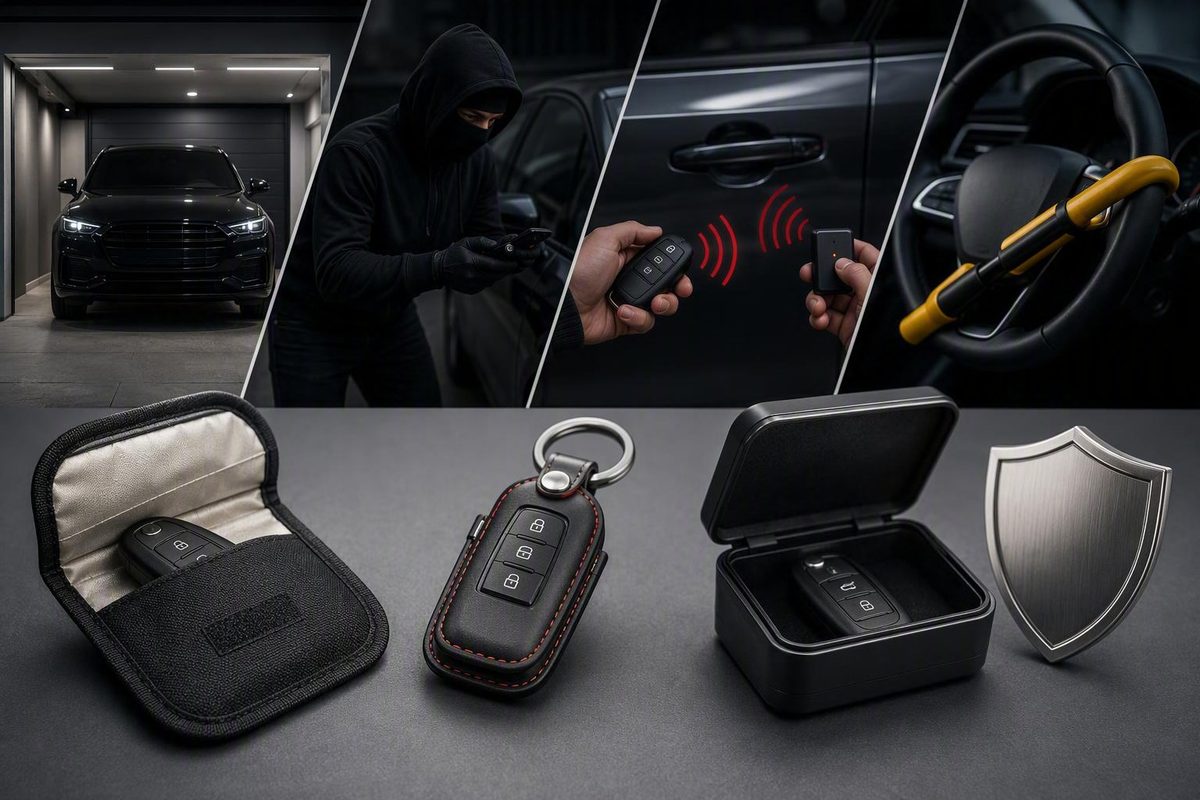
Distinguish programming from relay theft, then layer secure parking, a steering-wheel lock, tested fob storage and vehicle-specific safeguards.
To reduce the risk of key fob programmer car theft, protect the fob’s wireless signal and the vehicle itself. Park in a garage or secure, well-lit location when possible, use a visible steering-wheel lock, and ask your manufacturer, dealer, or a qualified automotive locksmith about applicable security updates, approved immobilizers, authorized-key reviews, and compatible diagnostic-port protection. Use tested signal-blocking storage for relay-theft risk, but do not expect it to stop an intruder who has already entered the vehicle and reached its electronics.
The short answer: protect both the fob and the vehicle
Start with five priorities:
- Use a garage or secure, well-lit parking location when available.
- Add a visible physical lock, such as a steering-wheel lock.
- Ask about vehicle-side protection, including security updates, approved immobilizers, and compatible diagnostic-port guards.
- Store the fob away from exterior doors, windows, and walls.
- Use a tested Faraday pouch for relay risk, not as a complete answer to programmer-assisted theft.
No measure guarantees prevention. Layering secure parking, physical locks, fob protection, alarms, immobilizers, and appropriate vehicle-specific safeguards may add time, difficulty, or visibility. Official crime-prevention guidance similarly recommends combining measures rather than relying on one product (Police.uk vehicle-theft prevention guidance).
The distinction is important: securing a household fob addresses attacks involving its wireless signal. Securing the doors, cabin, controls, and vehicle electronics addresses forced entry and attempts to add an unauthorized key.
This article intentionally does not explain how to enter a vehicle, connect programming equipment, obtain security credentials, bypass safeguards, or register a key. Owners should leave security inspections and key registration to the manufacturer, a dealer, or a qualified automotive locksmith.
What a key-fob programmer is—and how it can be misused
A key-fob programmer is a legitimate automotive tool used by locksmiths and other professionals to register replacement keys. It may be needed when an owner loses a fob, requests a spare, or replaces a damaged unit. Like other diagnostic equipment, however, it can be repurposed.
At a non-operational level, reported programmer-assisted theft follows three stages:
- An intruder gains physical access to the vehicle.
- The intruder reaches the vehicle’s electronic systems.
- The intruder attempts to register a blank fob as a credential the vehicle will accept.
This is different from extending or capturing the signal of a fob inside someone’s home. The owner’s original fob may not be involved in an unauthorized-programming attempt.
A July 2026 report attributed to Milwaukee police detective Jon Kramschuster said thieves plug a tablet-like programming device into the OBD port to reprogram a fresh key fob Milwaukee thieves use car key fob programmers to steal vehicles.
Harris County officials separately demonstrated blank-fob programming after physical entry and described the equipment as legitimate locksmith technology that can be misused. Their demonstration presented about five minutes as a possible completion time, not a universal figure for every vehicle or attempt (ABC13 Houston’s report on the sheriff’s demonstration).
In another report, an Illinois law-enforcement official estimated that creating a working fob after entry could take one to two minutes. That estimate was attributed to local experience and was not supported by comparative testing across vehicles (FOX 32 Chicago’s report).
These reports support a limited conclusion: some theft attempts may involve adding a key after gaining access to vehicle-side systems. They do not establish one fixed completion time or prove that every vehicle can be attacked in the same way.
Programmer theft, relay theft, cloning, and jamming are not the same
News reports sometimes use programming, cloning, signal capture, and relay theft interchangeably. The exact method may therefore remain uncertain unless the vehicle is professionally inspected.
- Unauthorized key programming: An intruder attempts to add a new credential through the vehicle’s electronic systems, generally after gaining physical access.
- Relay theft: Equipment extends communication between the vehicle and an existing authorized fob. The fob may remain inside the owner’s home while the vehicle is made to believe it is nearby.
- Signal capture or cloning: Broad labels for copying, storing, reproducing, or reusing credential-related signals. News coverage does not always use these terms precisely.
- Jamming: Interference prevents a lock command from reaching the vehicle, leaving the doors unlocked even though the driver pressed the lock button.
Because jamming is a separate risk, watch or listen for the expected lock confirmation and manually check that the vehicle locked when it is safe to do so. Pressing the button does not by itself confirm that the command reached the car.
Attack-to-defense matrix: choose protection for the actual threat
| Measure, limitation, and next step | Relay theft | Unauthorized programming | Conventional entry |
|---|---|---|---|
| Tested Faraday pouch. Seal the fob inside and check whether the vehicle still responds. It protects only while blocking the signal correctly. | Helps reduce fob-signal exposure | Does not stop post-entry programming | Does not prevent physical entry |
| Interior fob storage or disabled wireless function. Keep the fob away from exterior openings; consult the manual before changing settings. | Helps reduce exposure | Does not stop post-entry programming | No direct protection |
| Compatible diagnostic-port guard. Ask about servicing, installation, compatibility, effectiveness, and warranty considerations. | No direct protection | May add difficulty to relevant attempts | Does not prevent initial entry |
| Steering-wheel lock. Fit it visibly and consistently; it is a deterrent, not an impenetrable barrier. | Does not block the relay | May impede driving away after electronic compromise | Does not stop entry but adds a physical barrier afterward |
| Garage or secure parking. Lock the garage and favor visible, well-lit parking where possible. | May reduce opportunity | May reduce opportunity | May reduce opportunity |
| Alarm or approved immobilizer. Confirm that the option suits the exact vehicle and is professionally installed. | Role depends on system | May impede unauthorized operation | Alarm may draw attention to entry |
| Tracker. Treat it as a recovery aid, not prevention or a guarantee of recovery. | No direct prevention | No direct prevention | No direct prevention |
| Manufacturer security update. Check by make, model, year, software, and configuration. | Only if the update addresses that risk | Only if an applicable update exists | Usually no physical-entry protection |
A Faraday pouch should be tested rather than trusted solely because of its label. Seal the fob inside according to the product instructions and check whether passive entry or starting still responds. AAA describes this basic test and advises consulting the owner’s manual before changing keyless settings (AAA guidance on keyless-car theft).
Choose protection for the relevant threat and confirm vehicle compatibility.
A prioritized prevention checklist
Free or immediate actions
- Remove valuables and never leave keys in the vehicle.
- Watch or listen for lock confirmation, then verify that the doors locked.
- Keep fobs away from exterior walls, doors, and windows.
- Disable passive entry or the fob’s wireless function if the manufacturer supports it.
- Use a locked garage when available; otherwise favor a visible, well-lit location.
- Do not leave the vehicle running and unattended.
- Review the owner’s manual sections covering security, keys, and keyless entry.
Moderate-cost deterrents
- Use tested signal-blocking storage to reduce relay exposure.
- Fit a visible steering-wheel lock consistently.
- Consider an alarm designed for the vehicle.
- Consider a tracker as a possible recovery aid, while recognizing that it neither prevents theft nor guarantees recovery.
Professional, vehicle-specific measures
Ask the manufacturer, dealer, or a qualified automotive locksmith:
- Whether security software or firmware updates apply.
- Whether compatible diagnostic-port protection is appropriate.
- Whether a manufacturer-approved immobilizer or other upgrade is available.
- Whether the vehicle supports reviewing registered keys.
- Whether missing or unknown keys can be removed from authorization.
- Whether passive entry can be disabled without affecting functions you need.
Instructions for another model year or a similar-looking fob may not apply to your vehicle.
What to do after suspected tampering or a missing key
If you find broken glass, damaged locks, displaced trim, unfamiliar warnings, or other signs of tampering:
- Document what you found. Photograph visible exterior and interior damage without unnecessarily moving items.
- Preserve available video. Save relevant doorbell, garage, parking-lot, dashcam, or neighboring recordings before routine deletion.
- Contact police and your insurer. Follow their instructions concerning reports, inspection, towing, and claim documentation.
- Ask before using a damaged vehicle. If you are concerned about safe operation or preserving evidence, contact police, the dealer, or a qualified automotive professional and follow their instructions.
- Arrange a professional inspection. Ask for damaged locks, windows, alarms, wiring, and relevant electronic systems to be checked.
- Ask about authorized keys. Determine whether the vehicle supports reviewing registered credentials and removing a missing or unknown key. Not every model exposes a simple key list or permits selective erasure.
- Check for applicable security updates.
If a fob is missing, replacing the physical key is not necessarily the entire remedy. Ask whether the missing credential can be invalidated and whether the remaining keys need to be registered again.
If the vehicle is missing, give police the VIN, registration, plate number, distinguishing features, available video, and tracker information. Follow police instructions rather than attempting recovery yourself.
Used-car security handover checklist
A used-car purchase should include a security handover, not just payment and paperwork.
- Verify that the VIN on the vehicle matches the title and available records.
- Obtain a vehicle-history report.
- Account for every fob and emergency key promised by the seller.
- Test the intended functions of each supplied key.
- Ask whether any key has been lost, replaced, or retained.
- Have unresolved key questions checked by a dealer or qualified automotive locksmith.
None of these signs alone proves that a vehicle is stolen.
If a key is missing or unaccounted for, ask whether the old credential can be invalidated and replacement keys securely registered. General crime-prevention guidance recommends addressing old keys after a used-car purchase, but the correct procedure is vehicle-specific. Do not use an unknown consumer programmer or attempt to obtain security credentials yourself.
What recent reports establish—and what they do not
Milwaukee police detective Jon Kramschuster said key-fob-programmer theft initially involved higher-end cars and is now seen across all automakers Milwaukee thieves use car key fob programmers to steal vehicles. It does not establish that every automaker, model, or keyless vehicle is vulnerable.
A September 2026 Jefferson Park report said police recovered a key-fob programmer after an attempted vehicle theft and arrested three teenagers (Hoodline’s Jefferson Park incident report). The report does not establish that the programmer was used, and recovery of an item or an arrest does not establish guilt.
The available evidence does not provide:
- National prevalence for programmer-assisted theft.
- A reliable risk comparison with relay theft, jamming, or conventional theft.
- A verified make-model-year vulnerability list.
- Independent product rankings.
- A universal time required to add an unauthorized key.
Broad auto-theft totals cannot reveal what share involved programmer-assisted theft or relay attacks.
The practical response is to start with free measures, add a visible physical deterrent, and then ask the manufacturer, dealer, or a qualified automotive locksmith which updates, key-audit options, immobilizers, and diagnostic-port protections suit the exact vehicle.
Can a Faraday pouch stop key-fob programmer car theft?
Not by itself. A functioning pouch may reduce relay exposure by blocking communication with the legitimate fob. It does not prevent an intruder who has entered the vehicle from attempting to add another key through vehicle-side systems. Test the pouch as directed and combine it with physical and vehicle-specific protection.
Can someone add a key while my original fob is inside my home?
Potentially, depending on the vehicle and method. Reported unauthorized-programming attacks involve attempts to add a blank fob after physical entry, so the original fob may remain in the home. A relay attack is different because it communicates with an existing authorized fob.
Are key-fob programmers illegal to own?
That cannot be answered universally without the law for the relevant jurisdiction. Reporting documents legitimate professional uses as well as criminal misuse, but it does not establish local rules governing ownership or possession. Consult an appropriate local legal authority if you need a jurisdiction-specific answer.
Are all keyless cars vulnerable to programmer-assisted theft?
No universal conclusion is supported. Risk may vary by make, model, year, software, configuration, and enabled features. Local reports describing attacks against a broader range of vehicles do not prove that every keyless car is vulnerable. Check the owner’s manual and ask the manufacturer or dealer about notices and updates for your exact vehicle.