
How to Choose the Right Equinox Fob-Programming Path Without Disabling Your Existing Keys
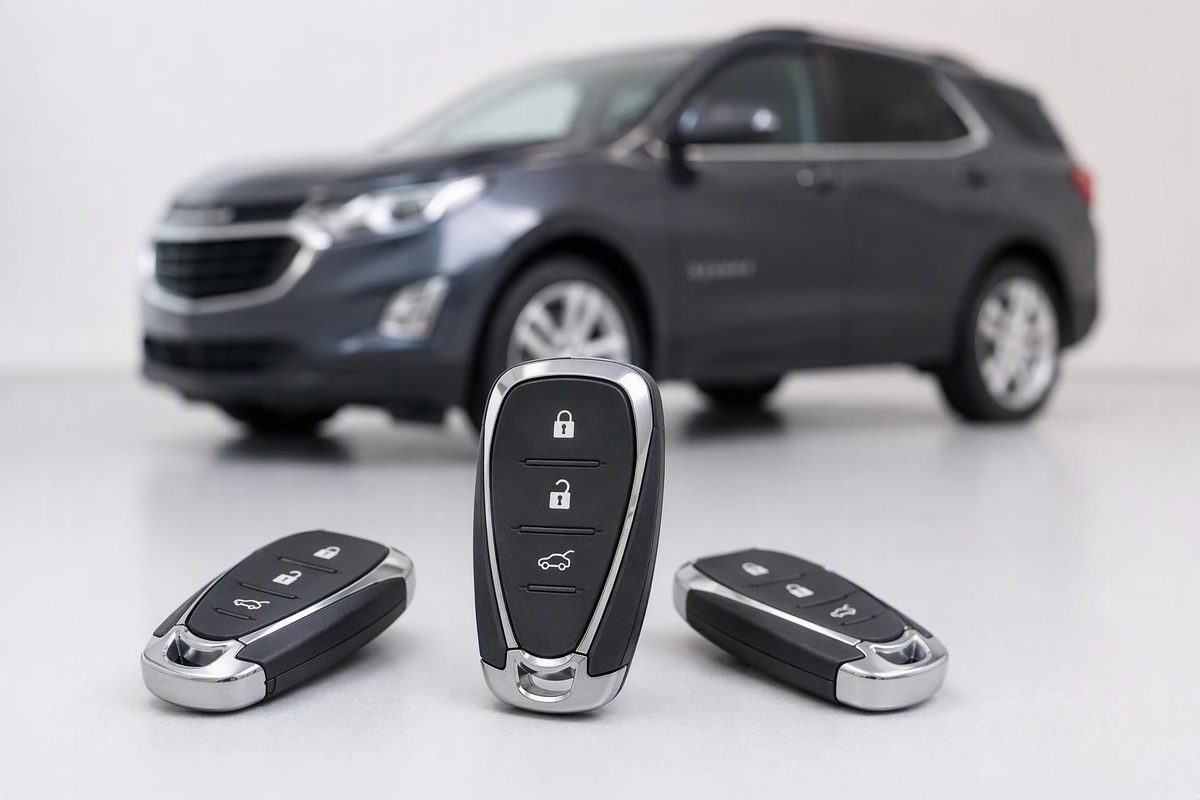
See when two recognized transmitters may allow the short add-a-fob path or fewer require a timed relearn, with safeguards for existing fobs.
Programming a Chevy Equinox key fob is not governed by one universal button sequence. The available method depends on the model year, push-button versus keyed ignition, vehicle market, replacement-fob compatibility, and number of transmitters the vehicle already recognizes.
The evidence available here covers only certain push-button-start configurations. A third-party demonstration addresses the 2018–2020 Chevrolet Equinox, while a separate retailer guide describes a 2022 Equinox smart-key system. These sources are not Chevrolet owner’s manuals or GM service information, so this article explains how to identify the potential path—not a manufacturer-verified procedure to follow in place of your manual.
That distinction matters most when fewer than two recognized transmitters remain. The reported timed relearn may remove the current authorization of previously known fobs unless they are relearned during the same session. Before turning the door-lock cylinder or entering programming mode, confirm the exact procedure in the Chevrolet owner’s manual for the vehicle’s year, ignition type, and market.
Start Here: Identify Your Equinox Before Attempting Programming
Use this decision tree before removing an emergency key or operating the driver-door lock:
-
What is the model year? - The detailed third-party material covers certain push-button-start configurations from 2018–2020 and 2022. - For another model year, use that year’s Chevrolet owner’s manual or consult a provider equipped for the vehicle.
-
Does the Equinox have push-button start? - Yes: Continue checking eligibility. - No—it has a separate ignition key and remote: Stop. The available 2018–2020 demonstration expressly says its smart-key sequence does not apply to that arrangement.
-
Where was the vehicle sold? - Check a manual written for that market. - For Canadian vehicles, verify whether the manual permits owner programming when fewer than two recognized transmitters are available. Third-party guides report a Canadian limitation, but the evidence pack does not contain official Canadian Chevrolet documentation confirming it.
-
How many transmitters does the vehicle currently recognize? - Two: The vehicle may offer the shorter add-a-transmitter path. - One or zero: It may require the longer timed relearn, if the exact configuration and market support it. - Unsure: Test each existing fob individually for both remote operation and engine starting.
-
Does the Driver Information Center show the prompt specified by the manual? - Yes: Continue only according to the manual. - No: Stop. Do not substitute instructions from another Chevrolet model, model year, or market.
The two reported paths can be summarized as follows:
| Situation | Potential path on a supported push-button Equinox | Principal concern |
|---|---|---|
| Two recognized transmitters | Short add-a-fob process | An incompatible replacement will not learn |
| One recognized transmitter | Timed relearn, if the manual permits it | The existing transmitter may need to be relearned |
| No recognized transmitters | Timed relearn, if supported | A correctly cut emergency blade is needed to begin |
| Keyed ignition | Not covered by these smart-key sources | Push-button instructions do not apply |
| Missing or unexpected DIC prompts | Stop and verify | Improvisation may leave programming incomplete |
| Canadian vehicle with fewer than two transmitters | Verify with Chevrolet documentation | Third-party guides report a market restriction |
A third-party guide for the 2019 Equinox smart-key system describes both a recognized-transmitter path and a longer path when two recognized transmitters are unavailable. That does not establish support for every 2019 trim or regional configuration.
Procedure status: The programming information below is a comparison of third-party accounts. It is not a substitute for the year- and market-specific Chevrolet owner’s manual. If the ignition type, controls, transmitter location, messages, or timing in your manual differ, follow the manual or stop and obtain professional help.
Pre-Programming Checklist: Fobs, Emergency Blade, Batteries, and Compatibility
Prepare the entire job before entering any programming mode. This is especially important if the manual confirms a relearn that requires every transmitter intended for future use to be present.
Gather everything first
Have the following ready:
- The vehicle parked safely and switched off
- Every currently recognized transmitter
- Every replacement transmitter you want to add
- The emergency key blade
- The year- and market-specific Chevrolet owner’s manual
- Fresh, correctly installed fob batteries if battery condition is uncertain
- The replacement fob’s identifying information
- Enough uninterrupted time for the manual-specified procedure
Read the complete manual procedure before beginning. The third-party 2018–2020 demonstration describes three timed waits and recommends allowing 30–40 minutes for the overall process, but that timing should not be applied to another configuration without manual confirmation.
Verify the replacement transmitter
A matching case, logo, or button layout does not prove electronic compatibility.
Ask the seller, automotive locksmith, or Chevrolet dealer to check:
- Part number
- FCC ID
- Operating frequency
- Regional or market version
- Push-button-start application
- Button configuration
- Whether the transmitter is new or used
- Whether a previously paired transmitter requires preparation before reuse
The evidence pack does not include a validated Equinox part-number or FCC-ID compatibility table. Compatibility should therefore be checked against the vehicle rather than inferred from appearance.
Important: A replacement fob is not guaranteed to program merely because it looks identical to the original.
Programming eligibility depends on the combination of vehicle year, ignition system, market, recognized-key count, and transmitter electronics. Verify those details before beginning any relearn that could affect existing fobs.
Separate the mechanical and electronic tasks
These jobs are distinct:
- Mechanical cutting shapes the emergency blade so it can operate the door lock.
- Programming authorizes a compatible transmitter to communicate with the vehicle.
- Battery replacement restores electrical power to a fob.
- Resynchronization, where applicable, attempts to restore communication for an already authorized remote.
Electronic programming does not cut the emergency blade. In an all-keys-lost case, the third-party 2020 guidance says the blade must already be mechanically cut because the reported relearn begins at the driver-door lock cylinder. The 2020 Equinox retailer instructions also direct readers to consult the vehicle-specific owner’s manual.
Confirm the transmitter pocket
Do not assume the transmitter pocket is an ordinary cupholder. Written third-party instructions refer to a front cupholder, while the 2018–2020 video demonstrates a center-console location with a particular fob orientation.
The evidence does not resolve whether that difference reflects model year, trim, terminology, or presentation. Use the location and orientation shown in the applicable Chevrolet manual. If the manual is unclear, ask Chevrolet or an equipped automotive locksmith before entering programming mode.
Prevent avoidable interruptions
Before starting a manual-confirmed timed relearn:
- Turn off unnecessary accessories.
- Do not begin when the vehicle may need to be moved.
- Keep every intended transmitter within reach.
- Confirm how to access the concealed driver-door lock cylinder.
- Keep the relevant manual page available offline or in print.
- Arrange professional assistance if all keys are lost or eligibility remains uncertain.
Method 1: Add a New Fob When You Have Two Recognized Transmitters
Consider this path only when all of the following are true:
- The Equinox has push-button start.
- The applicable Chevrolet manual confirms onboard programming.
- Two transmitters are already recognized by the vehicle.
- The replacement transmitter has been verified as compatible.
- The vehicle’s lock-cylinder access, transmitter location, and DIC prompts match the manual.
The independent third-party guides for the covered 2019 and 2022 systems describe the same general workflow: the vehicle is switched off, both recognized transmitters are present, programming is initiated through the driver-door lock cylinder, and the new transmitter is learned at the designated pocket.
Procedure status: The outline below is for path recognition only. Do not use it as an executable substitute for the Chevrolet owner’s manual.
What the manual should confirm
Before proceeding, locate and confirm all of these elements in the manual:
- Starting condition: The vehicle must be off, with both recognized transmitters and all proposed replacements present.
- Placement of recognized transmitters: Third-party accounts place both recognized fobs in a cupholder, but the manual must control the location.
- Door-lock initiation: The reported sequence uses the emergency blade in the driver-door cylinder and may require removal of a handle cap.
- DIC confirmation: The expected interface language includes READY FOR REMOTE and a transmitter number.
- New-fob location: The replacement is placed in the designated transmitter pocket in the prescribed orientation.
- Learning and confirmation: The reported process uses ENGINE START/STOP, followed by removal of the learned transmitter and a press of Lock or Unlock.
- Additional fobs: Further compatible transmitters are added during the same session without repeating the door-lock initiation.
- Exit action: The manual should specify how programming mode ends.
For the covered system, the third-party 2022 guide reports initiating the session with five counterclockwise unlock turns within 10 seconds, learning each transmitter with ENGINE START/STOP, and holding that button for about 12 seconds after all intended transmitters have been added. Those exact numbers require confirmation in the manual before use.
If the expected DIC prompt does not appear, stop. Recheck the model year, ignition system, vehicle market, lock-cylinder access, and the manual rather than changing the timing or trying instructions from another model.
The covered third-party guides report capacity for as many as eight matched transmitters. Treat that as a claim about the systems described in those guides, not a universal capacity for every Equinox.
An unprogrammed replacement does not count as a second recognized transmitter. If only one current fob can unlock and start the vehicle, the quick path described by these sources is not the applicable route.
Method 2: The Long Relearn With One or No Working Fobs
The available third-party accounts direct vehicles with fewer than two recognized transmitters to a timed security-relearn path rather than the short add-a-fob process. That includes an owner with one fully functional fob: one is still fewer than the two recognized transmitters required by the reported short workflow.
Existing-fob authorization warning: The third-party 2019 guide reports that after the third timed learning cycle, previously recognized transmitters stop working unless they are relearned during the same session. Have every fob you intend to retain available, and do not begin unless the applicable Chevrolet manual confirms the complete process.
This is not necessarily a permanent loss: the sources say prior transmitters can be restored by relearning them during the session. Nevertheless, beginning without the complete set—or being unable to finish—could leave a previously working fob unusable.
If no recognized fob remains, obtain a correctly cut emergency blade before attempting any manual-confirmed onboard relearn. The electronic learning process cannot cut the blade, and the reported workflow begins at the mechanical driver-door cylinder.
Procedure status: Because the evidence pack contains no official Chevrolet procedure for the covered years and markets, the following is a non-operational overview of what third-party sources report. Use it only to identify the relevant section of the official manual or to discuss the job with a professional.
What the reported relearn contains
The 2018–2020 Equinox demonstration describes this overall pattern:
- The vehicle is off, and every compatible transmitter intended for future use is present.
- Programming is initiated at the driver-door lock cylinder using a mechanically cut emergency blade.
- The DIC displays REMOTE LEARN PENDING, PLEASE WAIT.
- The process includes three approximately 10-minute learning periods.
- After each wait, the operator responds to a DIC instruction involving ENGINE START/STOP.
- After the third cycle, the display changes to READY FOR REMOTE #1 or corresponding wording.
- Each compatible transmitter is placed in the manual-specified pocket and learned individually.
- Each learned transmitter is removed and confirmed using Lock or Unlock.
- Every older transmitter that should remain usable is relearned before the session ends.
- Programming mode is exited according to the manual.
The same source advises allowing 30–40 minutes, while written third-party guides describe the process as approximately 30 minutes. Do not shorten a wait, anticipate a prompt, or press a control merely because an estimated time has elapsed; the vehicle’s manual and displayed instructions must govern.
The third-party 2020 guide reports the same critical initiation values—five counterclockwise unlock turns within 10 seconds—and an exit hold of approximately 12 seconds. Because these are security-sensitive instructions and have not been validated here against official Chevrolet documentation, confirm every value before acting.
Third-party 2019, 2020, and 2022 guides state that owner programming without two recognized transmitters is unavailable in Canada. The evidence pack does not contain an official Canadian Chevrolet manual confirming that restriction, so Canadian owners should check their exact manual or ask Chevrolet about the year, trim, and market configuration.
Stop and seek professional assistance if:
- The vehicle has keyed ignition.
- The year or configuration falls outside the documented systems.
- The expected pending or ready message does not appear.
- A timed period ends without the manual-specified instruction.
- The procedure is interrupted.
- The replacement transmitter is rejected.
- The correct transmitter pocket cannot be identified.
- The vehicle’s sequence differs materially from the manual.
The available evidence does not establish a safe restart point after an interrupted relearn. Do not skip a cycle, resume from memory, or assume the vehicle retained a particular programming state.
Finish the Session and Test Every Fob
A transmitter should not be considered successfully added until programming mode has been exited correctly and every old and new fob has been tested independently.
Procedure status: Third-party guides describe an approximately 12-second ENGINE START/STOP hold as the exit action for the covered systems. Confirm that instruction in the applicable Chevrolet manual before using it.
After a manual-confirmed session:
- Exit programming mode exactly as the manual directs.
- Return the emergency blade to the fob.
- Reinstall the driver-door lock-cylinder cap, if removed.
- Move all transmitters away from the designated pocket.
- Test each transmitter separately, with the others outside detection range.
Check every equipped function:
- Lock: Do all intended doors lock?
- Unlock: Does the expected unlock behavior occur?
- Passive entry: Does handle-based entry work, if equipped?
- Engine start: Does the vehicle recognize and start with only that fob present?
- Panic: Does the panic function respond, if equipped?
- Liftgate: Does the liftgate command work, if equipped?
- Remote start: Does remote start work, if equipped?
- Emergency blade: Is the blade securely restored to the fob?
Testing older fobs is particularly important after a timed relearn because the reported third cycle removes their existing authorization unless they are learned again.
Test remote-button operation and vehicle starting separately.
If a fob fails one or more tests, do not immediately repeat the long relearn. First:
- Check whether the transmitter was included in the completed session.
- Verify its battery type, orientation, and fit.
- Reconfirm the part number, FCC ID, frequency, and regional application.
- Recheck the manual’s pocket location and orientation.
- Ask whether a used transmitter requires preparation before it can be accepted.
Identify the likely cause before beginning another process that could affect the currently working set.
Why the Procedure May Not Start or Complete
Treat the following situations as stop conditions rather than invitations to experiment.
Stop: Five lock-cylinder turns produce no programming message
Recheck:
- The exact model year
- Push-button versus keyed ignition
- The correct mechanical lock cylinder
- Whether a handle cap must be removed
- The timing and direction specified in the manual
- The owner’s manual for the vehicle’s original market
Do not repeatedly change the speed, direction, or number of turns. If the manual does not describe the same entry sequence, the third-party workflow may not apply.
Stop: The vehicle enters programming mode but rejects the replacement
Compatibility is one possible cause, but the evidence does not support diagnosing it as the only cause.
Have a qualified seller, locksmith, or Chevrolet dealer verify:
- Part number
- FCC ID
- Frequency
- Regional application
- Ignition-system application
- New or previously used status
The available sources provide no authoritative Equinox-specific compatibility table. Do not infer compatibility from the shell, logo, or button layout.
Stop: You cannot identify the transmitter pocket
The third-party descriptions conflict: some identify a front cupholder, while the video demonstration uses a center-console transmitter pocket.
Do not test every storage compartment. Find the location and orientation in the applicable manual or ask a provider familiar with that specific Equinox configuration.
Stop: No fob buttons work reliably
First distinguish a power problem from an authorization problem.
Replacing the battery powers an existing fob; it does not authorize a replacement transmitter the vehicle has never recognized.
If a fresh, correctly installed battery does not restore an existing fob, consult the manual or a qualified provider. The evidence here cannot determine from symptoms alone whether the cause is the fob, battery installation, synchronization, compatibility, or the vehicle.
Stop: The long relearn is interrupted or the prompts differ
Contact an automotive locksmith with suitable programming equipment or a Chevrolet dealer. The evidence does not establish a safe restart procedure after an interruption.
Do not assume that an unsuccessful attempt has caused a security lockout. That conclusion requires diagnosis; failure to complete a procedure does not prove a lockout by itself.
Programming, Resynchronizing, and Replacing a Battery Are Different Jobs
These terms describe separate tasks.
Programming authorizes a compatible transmitter or transponder to communicate with the vehicle’s security system. For a smart key, that authorization can be required for starting as well as remote functions.
Battery replacement exchanges the coin cell in an existing fob. It restores electrical power but does not add an unknown transmitter to the vehicle.
Resynchronization is a vehicle-specific process that may restore communication for a transmitter already authorized to the vehicle. It is not automatically equivalent to adding a new fob.
Mechanical key cutting shapes the emergency blade so it can operate the lock cylinder. It does not power or electronically authorize the transmitter.
A general key-fob battery guide says most fobs do not require reprogramming after a battery change, while noting that some GM keys may require a vehicle-specific resynchronization process described in the owner’s manual. It does not identify applicable Equinox years, so it should not be treated as an Equinox resynchronization procedure.
Use this basic distinction:
| Symptom | Sensible starting point |
|---|---|
| An existing recognized fob gradually loses range | Check the battery and its installation |
| Buttons become intermittent after battery replacement | Check battery type, orientation, and fit |
| A newly purchased fob has never been recognized | Verify compatibility and programming eligibility |
| Doors respond, but the vehicle will not start with that fob alone | Check start authorization and compatibility |
| A previously working fob stops after a timed relearn | Determine whether it was relearned during that session |
| The emergency blade does not operate the door lock | Investigate blade cutting or mechanical compatibility |
Do not use battery replacement as a substitute for programming, and do not begin a timed security relearn solely because an existing fob’s range has weakened.
When to Use an Automotive Locksmith or Chevrolet Dealer
Professional programming is the safer or necessary option when:
- The Equinox has keyed ignition rather than push-button start.
- The model year or configuration lacks a confirmed onboard procedure.
- All keys are lost and no correctly cut emergency blade is available.
- A Canadian-market manual does not offer the fewer-than-two-transmitter path.
- Replacement-fob compatibility is uncertain.
- The expected DIC prompts do not appear.
- The transmitter pocket cannot be confirmed.
- A timed relearn was interrupted.
- A used transmitter may require preparation.
- You do not want to risk losing use of the only recognized transmitter.
- The vehicle requires diagnostic equipment, security access, or software unavailable to the owner.
Dealerships and many automotive locksmiths can program transponder keys and fobs, but capabilities vary. An Edmunds replacement-fob guide recommends confirming self-programming eligibility before buying a replacement and notes that programming methods depend on the vehicle.
When requesting a quote, provide:
- Model year and trim, if known
- Push-button or keyed ignition
- Country or original vehicle market
- Vehicle identification details requested by the provider
- Number of fobs that currently unlock and start the vehicle
- Replacement-fob part number
- FCC ID and frequency, if available
- Whether the replacement is new or used
- Whether the emergency blade is already cut
- Whether a previous attempt was interrupted
Ask whether the quote includes:
- The replacement transmitter
- Emergency-blade cutting
- Electronic programming
- Preparation of a used transmitter
- Mobile service-call charges
- Testing of remote buttons, passive entry, and engine start
- Taxes or shop charges
- A remedy if a provider-supplied transmitter is incompatible
Do not treat generic national price ranges as Equinox-specific estimates. Cost depends on the vehicle, transmitter type, provider, location, working-key count, blade-cutting needs, and whether the provider supplies the fob. Also ask the selected provider what ownership or identification documents it requires for the work.
A commercial locksmith guide notes that equipment and software coverage vary among providers, so confirm that the locksmith can service your exact Equinox before scheduling.
Frequently Asked Questions
Can I program a Chevy Equinox key fob myself?
Possibly, but the available evidence supports only a cautious answer. Third-party material describes onboard programming for certain push-button-start Equinox configurations from 2018–2020 and 2022. It does not establish that every Equinox from those years supports DIY programming.
Check the model year, ignition type, vehicle market, recognized-fob count, replacement compatibility, and applicable Chevrolet manual. If the vehicle has a separate ignition key and remote, lacks the expected DIC prompt, or falls outside the documented configurations, use an equipped automotive locksmith or Chevrolet dealer.
Can I use the quick programming method with only one working Equinox fob?
Not under the reported quick workflow. The cited 2019 procedure requires two transmitters the vehicle already recognizes. One working transmitter plus one unprogrammed replacement does not satisfy that condition.
With one recognized fob, the reported alternative is the longer timed relearn—if the manual for that exact vehicle and market permits it. Because previously recognized transmitters may need to be relearned during that session, confirm the procedure before starting.
Will the 30-minute relearn erase my existing key fobs?
Third-party sources report that after the third timed cycle, previously known transmitters lose their current authorization unless they are relearned during the same session. That is why every old and new fob intended for future use should be present.
The sources do not establish that the loss is irreversible; they say the transmitters can be relearned. Even so, do not begin unless the manual confirms the procedure and you are prepared to complete the entire transmitter set.
Where is the Chevrolet Equinox transmitter pocket?
The location may vary by year or configuration. Written third-party guides identify a front cupholder, while a 2018–2020 demonstration uses a center-console transmitter pocket.
Use the year- and market-specific owner’s manual to determine the correct location and orientation. If it remains unclear, ask Chevrolet or an equipped automotive locksmith before entering programming mode.
Does changing an Equinox key-fob battery require reprogramming?
Battery replacement and programming are different jobs. Replacing a coin cell powers an existing fob; it does not authorize a new transmitter.
General guidance says most fobs do not require reprogramming after a battery change, although some GM keys may need vehicle-specific resynchronization. Because the available evidence does not identify affected Equinox years, consult the applicable Chevrolet manual rather than using a generic resynchronization sequence.
The Four-Part Rule Before You Begin
Use four checks before attempting to program a Chevy Equinox key fob:
- Verify the model year and ignition type.
- Count the transmitters the vehicle currently recognizes.
- Confirm the replacement transmitter and designated pocket.
- Read the applicable Chevrolet owner’s manual before starting.
Two recognized transmitters may permit the shorter reported workflow. Fewer than two may place a supported vehicle on a timed relearn path that can remove existing fob authorization unless every intended transmitter is learned during the same session.
If the vehicle, market, controls, pocket location, or DIC prompts do not match the documented push-button configurations, stop. Use an equipped automotive locksmith or Chevrolet dealer rather than improvising a vehicle-security procedure.