
An “RFID key fob” may combine four separate functions
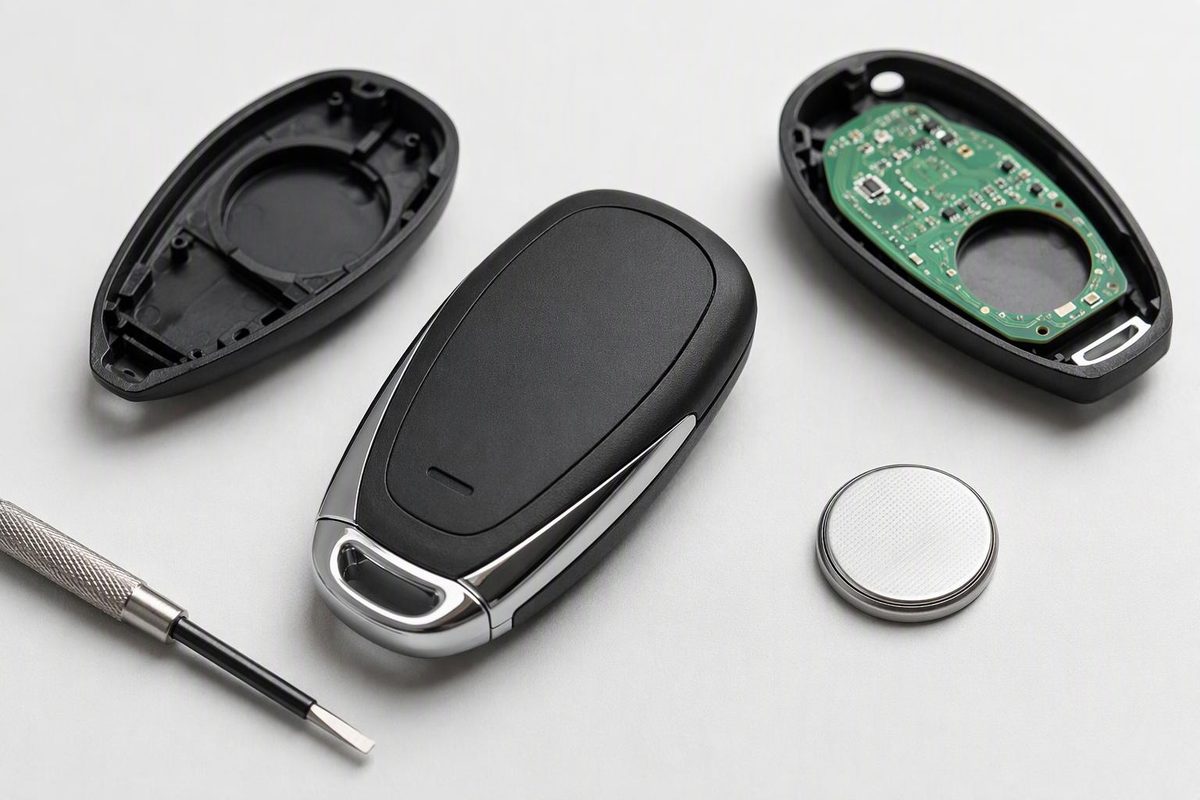
Learn what RFID means in a car key fob, which functions need a battery, how to diagnose failures, and what to match before replacement or programming.
An automotive “RFID key fob” is rarely one simple device. Depending on the vehicle, the same plastic housing may contain:
- A remote transmitter for lock, unlock, panic and trunk buttons.
- An immobilizer credential that authorizes the engine to start.
- A passive-entry system that detects the fob near the vehicle for touch-to-unlock and push-button start.
- A mechanical emergency key for opening a door when electronic entry fails.
These functions can fail independently. Identify the vehicle by year, make, model and trim—and identify the exact fob—before buying a battery, replacement remote or programming service.
What “RFID” means in a car key
RFID, or radio-frequency identification, is often used loosely for any wireless key. In automotive use, it commonly refers to the coded transponder or credential the vehicle recognizes. That is not necessarily the same radio system used when you press the unlock button.
Modern fobs can combine remote keyless entry (RKE), passive keyless entry (PKE) and immobilizer functions in one unit. Automotive chip supplier NXP describes integrated products combining these functions and lists LF/RF, NFC, Bluetooth and ultra-wideband technologies used in car-access systems. There is no universal “RFID frequency” or copying procedure for every vehicle fob (NXP Secure Car Access).
The immobilizer is the start-authorization layer. Ford describes its SecuriLock system as preventing an engine start unless the vehicle detects a correctly coded, programmed key (Ford SecuriLock overview). A cut blade may therefore open the door and turn an ignition cylinder but still fail to start an immobilizer-equipped vehicle.
Diagnose the failed function first
| What happens | More likely area to check |
|---|---|
| Buttons do not work, but the vehicle starts normally | Coin-cell battery, battery contacts, remote transmitter or remote pairing |
| Mechanical key opens the door, but the engine will not start | Immobilizer recognition, wrong or unprogrammed transponder, or a vehicle-side fault |
| Buttons work, but touch-to-unlock or walk-up entry fails | Passive-entry detection, interference, fob position or vehicle antenna |
| “No key detected” appears, but the car starts with the fob at its backup location | Weak fob battery or disrupted normal wireless detection |
| Both fobs fail at the same place or time | Vehicle battery, receiver, antenna or local radio interference—not necessarily two bad fobs |
| One fob fails and the spare works everywhere | Fault is likely confined to the first fob or its battery |
This table narrows the problem; it does not replace the model-specific procedure in the owner’s manual.
Stop 1: Compare the spare fob
Test the spare under the same conditions. A working spare is strong evidence that the vehicle can still receive and authenticate a valid key. If neither fob works, check the vehicle’s 12-volt battery and dashboard messages before replacing both remotes.
Stop 2: Separate button operation from starting
A dead coin cell can stop button-operated locking without proving that the immobilizer credential has failed. Conversely, working lock buttons do not prove that an unprogrammed replacement fob can start the engine.
On some push-button vehicles, a weak fob battery can be bypassed temporarily by holding or placing the fob at a designated backup reader. Toyota, for example, tells owners with a weak Smart Key battery to hold the key next to the START button; that is a Toyota-specific instruction, not a universal method (Toyota Smart Key start guidance). Check the owner’s manual for the exact backup location and sequence before assuming the car requires a tow.
The removable mechanical key may let you enter the cabin, but it does not by itself establish start authorization. A 2024 Prius manual separately covers wireless entry, mechanical-key entry and the procedure for starting when the smart-key system does not operate normally (Toyota 2024 Prius Smart Key manual).
Stop 3: Rule out interference
Move other keys, access badges, toll tags, chargers and aftermarket electronics away from the fob and vehicle, then retest in another location. A 2021 General Motors diagnostic bulletin lists other immobilizer keys, access transponders, some chargers and certain aftermarket LED lights among possible sources of radio-frequency interference. It says affected vehicles may show poor remote range, passive-entry failure, a security warning or “No Fob Detected” (GM bulletin hosted by NHTSA).
Do not replace modules merely because the fob works intermittently in one parking lot. If moving the vehicle or removing nearby electronics restores operation, investigate interference first.
Replacing an RFID key fob requires more than matching its shape
Before ordering a replacement, record:
- Year, make, model and trim
- Ignition type: key cylinder or push-button
- Button count and button functions
- OEM part number from the original fob
- FCC ID, when present
- Any regional frequency or market designation
- Whether at least one or two programmed keys still work
- Whether a metal blade must be cut
The FCC explains that an FCC ID has a grantee code and a product code and is generally shown on a certified radio-frequency device (FCC ID Search guidance). It can help identify the transmitter, but it should not be the only compatibility check. Similar-looking fobs can differ in electronics, immobilizer generation, frequency, button layout or emergency-blade design.
Programming eligibility is also vehicle-specific. Ford permits owner programming for certain keys only when two previously programmed keys are available; otherwise, it directs owners to a dealer (Ford spare-key guidance). Other models may require a scan tool, security-code access or dealer-level equipment even when one working key remains.
Use the model-year owner’s manual before attempting any sequence. A generic online “RFID copier” is not a substitute for confirming transmitter compatibility, cutting the blade and enrolling the immobilizer credential. For the decision process, see how to program a key fob.
When a battery change is the right repair
Replace the coin cell when button range shrinks, operation becomes intermittent or the vehicle reports a low key battery—and only after confirming the cell code and polarity from the installed battery or exact manual. Photograph the old battery before removal, avoid bending its contacts and test every button after reassembly.
A routine coin-cell replacement addresses the fob’s powered functions; it does not create a new immobilizer identity. If a fresh, verified battery changes nothing, stop replacing batteries and return to the function-based checks above. The fault may be a damaged switch, battery contact, fob circuit, vehicle receiver, antenna, interference issue or lost programming.